What are the requirements to bring a dog to the USA in 2026?
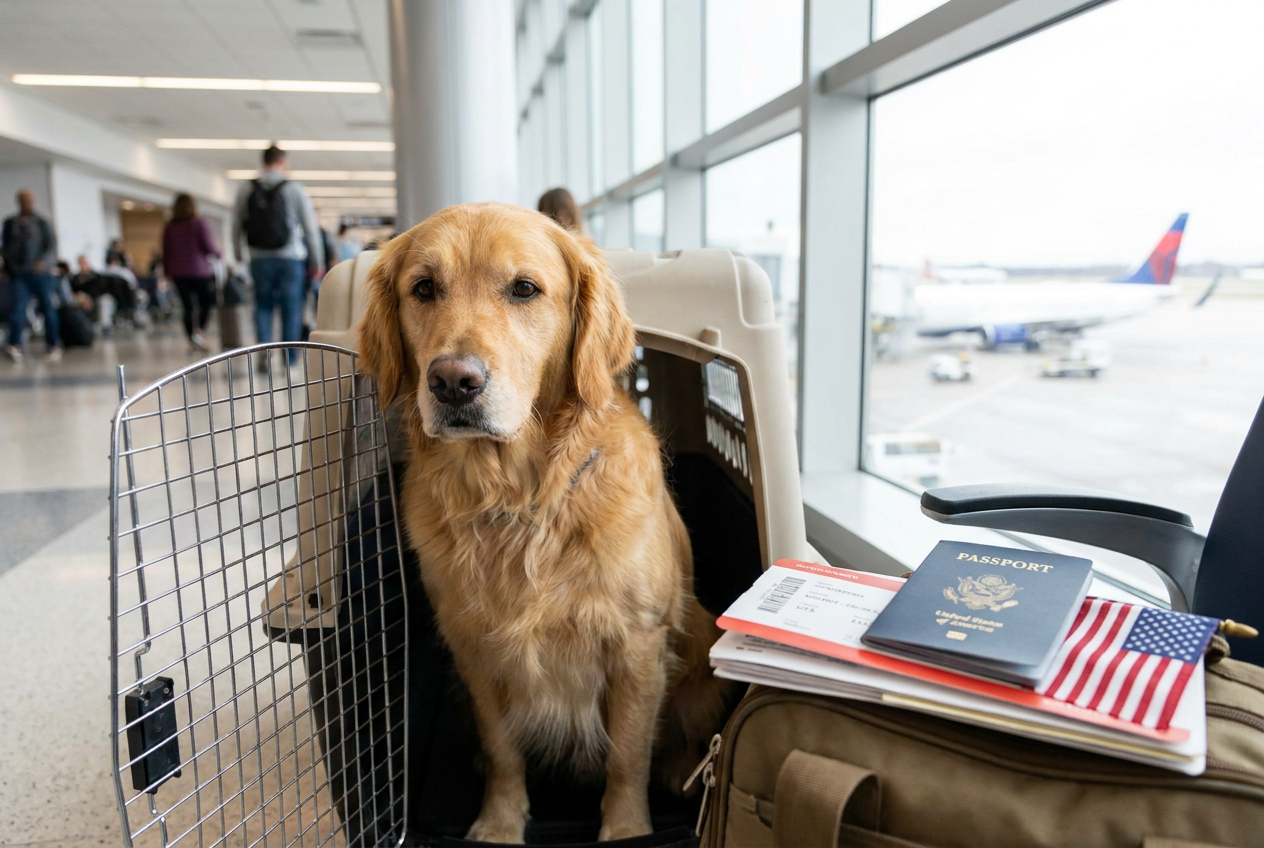
For decades, flying a dog into the United States was a relatively relaxed logistical process. As long as you had a standard rabies certificate from a local vet and a generic health declaration sheet, customs officers would routinely wave your pet through the airport terminal. However, major regulatory shifts permanently altered America's borders.
Under the strict framework enforced by the Centers for Disease Control and Prevention (CDC) alongside USDA APHIS, the United States operates a multi-layered border control system for companion animals. The historical loopholes that allowed young puppies or undocumented rescue animals to land at U.S. ports of entry have been completely closed. Find out exactly which document your pet needs at PetHolidayClub.com to keep your travel timeline secure. Let's break down the rules for bringing your dog to the USA this year.
The 2026 U.S. Dog Import Eligibility Matrix
Your baseline entry path is determined entirely by where your dog has lived during the 6 months prior to their travel date:
Dog Has Spent the Past 6 Months ONLY in Low-Risk or Rabies-Free Countries (e.g., Canada, UK, EU, Australia)
Minimum Age Requirement: Strictly 6 months (180 days) old on flight day.
Mandatory Identification: 15-digit ISO-compliant microchip.
Core Border Paperwork: Online CDC Dog Import Form receipt (Free; submission can be done up to the day of travel).
Authorized Ports of Entry: Any international airport or land border crossing.
U.S.-Vaccinated Dog Returning from a High-Risk Rabies Country (e.g., Select countries across Latin America, Asia, Africa)
Minimum Age Requirement: Strictly 6 months old.
Mandatory Identification: 15-digit ISO-compliant microchip (Implanted before the qualifying vaccine).
Core Border Paperwork: CDC Dog Import Form receipt + an official Certification of U.S.-Issued Rabies Vaccination form endorsed by the USDA before departure.
Authorized Ports of Entry: Any airport offering standard customs preclearance.
Foreign-Vaccinated Dog Arriving from a High-Risk Rabies Country (e.g., Non-U.S. dog traveling from a high-risk zone)
Minimum Age Requirement: Strictly 6 months old.
Mandatory Identification: 15-digit ISO-compliant microchip.
Core Border Paperwork: CDC Dog Import Form receipt + Certification of Foreign Rabies Vaccination & Microchip form endorsed by an official government vet + valid Rabies Titer Test ($\ge 0.5\text{ IU/mL}$).
Authorized Ports of Entry: Must land exclusively at one of the 6 U.S. airports featuring a CDC-registered Animal Care Facility.
Part 1: The Non-Negotiable Universal Baseline Requirements
Regardless of your country of origin, every single dog crossing a United States border must pass four baseline entry filters. There are zero exceptions for personal pets, emotional support animals, or small purebred breeds.
The Hard Six-Month Age Cap:
To crack down on illegal puppy importing and protect young animals from flight stress, the CDC bans the entry of any dog under 6 months of age. If your puppy is even one day shy of their 180-day milestone on the morning of their flight, they will be denied boarding at the departure gate or seized at U.S. customs.
Universal Microchip Identification:
Your dog must have a working 15-digit microchip that complies with ISO 11784/11785 standards. If your dog has an older, non-ISO chip, you must carry your own universal microchip scanner or face immediate entry delays. Crucially, the microchip must be implanted or verified prior to their rabies shots; any vaccine administered before a documented microchip scan is legally invalid.
Visual Health Inspection:
Upon arrival at a U.S. port of entry, border officials perform a visual screening. Your dog must appear healthy and free of contagious clinical signs, such as open sores, extreme lethargy, severe coughing, or obvious parasitic infestations.
The Digital CDC Dog Import Form:
Every dog needs their own individual CDC Dog Import Form receipt. The system features an updated, streamlined interface. While you can fill this form out online on the day of travel, the CDC strongly recommends completing it a few days early. You must present the resulting receipt (either printed or displayed clearly on your smartphone) to your airline before checking in and to the U.S. Customs and Border Protection officers upon arrival.
Part 2: High-Risk Rabies Country Pathways
If your dog has spent any time in a country flagged on the CDC's high-risk list within the 6 months prior to entering the United States, your paperwork requirements increase significantly.
[High-Risk Country Origin] ➔ [Check Vaccination Source]
                                      |
         +----------------------------+----------------------------+
         |                                                         |
  [U.S.-VACCINATED TRACK]                                 [FOREIGN-VACCINATED TRACK]
  - CDC Dog Import Form Receipt                           - CDC Dog Import Form Receipt
  - USDA-Endorsed U.S. Rabies Form                       - Government-Endorsed Foreign Rabies Form
  - Land at any standard port                             - Valid Blood Titer Test (Approved Lab)
                                                          - Must land at 1 of 6 specific CDC airports
The U.S.-Vaccinated Return Track
If your dog was originally vaccinated against rabies within the United States, you must present an official Certification of U.S.-Issued Rabies Vaccination form. This document must be completed by a USDA-accredited veterinarian and formally endorsed via the digital USDA database before your pet departs the country. The CDC notes that these forms cannot be retroactively issued after a dog has already left the United States.
The Foreign-Vaccinated Track (The Most Intensive Entry Path)
If your dog was vaccinated outside of the United States and is arriving from a high-risk country, you must execute a strict, multi-step biosecurity sequence:
Official Document: Secure a Certification of Foreign Rabies Vaccination and Microchip form completed by your local vet and endorsed by an official government veterinarian of the exporting country.
The Rabies Titer Requirement: Your dog must have an approved rabies serology blood titer test from an authorized laboratory. The blood sample must be drawn at least 30 days after their initial valid rabies shot and at least 28 days before trying to enter the United States.
The Quarantine Trap: If you arrive from a high-risk country with a foreign-vaccinated dog without an approved rabies titer test, you are legally required to book a formal reservation at a CDC-registered Animal Care Facility for a 28-day quarantine and a mandatory rabies revaccination upon arrival—costing thousands of dollars out-of-pocket.
Specific Landing Constraints: These dogs cannot land at just any airport. They must fly exclusively into one of the six U.S. gateways equipped with a CDC quarantine facility: Atlanta (ATL), Washington D.C. (IAD), New York (JFK), Los Angeles (LAX), Miami (MIA), or San Francisco (SFO).
Part 3: Secondary Regulatory Layers (USDA APHIS and State Laws)
While the CDC focuses heavily on preventing the reintroduction of dog rabies, you must also monitor agricultural and state-level requirements before clearing customs.
USDA Screwworm & Foot-and-Mouth Disease (FMD) Protocols:
If you are importing a dog from a country known to be affected by the New World screwworm or Foot-and-Mouth Disease, USDA APHIS requires additional veterinary verification. Your private vet must perform an intensive physical exam within 10 days of your flight departure, explicitly certifying that the dog is completely free of screwworm maggots and has been treated with topical antiparasitic compounds if any suspicious wounds were found.
State-Specific Health Enforcement:
Federal clearance at an airport customs desk does not mean you have met all local rules. Individual U.S. states hold sovereign biosecurity powers. For example, states like Hawaii or territories like Guam operate strict island rabies exclusion zones; crossing into these territories requires specific local import permits, FAVN titer testing, and separate localized quarantine structures that differ wildly from continental U.S. law.
Master Pre-Travel Operational Timeline
Coordinate your U.S. border entry milestones using this chronological countdown:
180 Days Before Moving Day: Verify your dog has an ISO 15-digit microchip. Review the CDC's high-risk country index to determine your dog's classification.
120 Days Before Moving Day: If arriving via the foreign-vaccinated high-risk track, complete your vet blood draw for the rabies titer test and confirm the sample is routed to a CDC-approved laboratory.
90 Days Before Moving Day: Order your airline-approved, IATA-compliant travel carrier. Begin daily crate conditioning and positive behavioral reinforcement at home.
30 Days Before Moving Day: Secure your airline pet reservations. If a U.S.-vaccinated dog is traveling to a high-risk country, ensure your accredited vet completes the USDA-endorsed certificate before you leave.
10 Days Before Moving Day: For countries requiring screwworm or FMD clearance, have your vet complete the specialized physical inspection and print the required typed declarations.
3 Days Before Moving Day: Log onto the official CDC web portal, complete the digital CDC Dog Import Form, print two physical backup copies, and save the electronic receipt to your phone.
Flight Arrival Day: Present your microchip records, stamped government certifications, and your active CDC receipt to airline gate staff and U.S. Customs officials.
Find out exactly which document your pet needs at PetHolidayClub.com to align your milestones perfectly.
Frequently Asked Questions
What are the main requirements to bring a dog to the USA?
To enter the United States, all dogs must be at least 6 months old, appear completely healthy, have an ISO-compliant 15-digit microchip, and carry a completed digital CDC Dog Import Form receipt. Additional vaccine and titer documents are required if the dog has visited a high-risk rabies country.
Can I bring a 3-month-old puppy to the USA if they are fully vaccinated?
No. Under modern CDC biosecurity laws, there are zero age exemptions for personal companion animals or purebred puppies. All dogs must be at least 6 months (180 days) old at the time of entry, regardless of their vaccination status or country of origin.
What happens if I forget to fill out the CDC Dog Import Form before my flight?
While the CDC form can be filled out on your smartphone at the gate in under five minutes, forgetting to complete it can lead to your airline denying you boarding. It is best to complete the form a few days before your trip and keep a printed backup copy with your passport.
How long is a CDC Dog Import Form receipt valid for multiple entries?
For dogs traveling from low-risk or rabies-free countries, the CDC Dog Import Form receipt is valid for multiple entries into the United States for up to 6 months from its date of issuance, provided the dog does not enter a high-risk rabies country during that time.
What are the 6 authorized airports for foreign-vaccinated dogs from high-risk countries?
Foreign-vaccinated dogs arriving from high-risk countries must fly exclusively into one of six designated U.S. ports of entry equipped with a CDC-registered Animal Care Facility: New York (JFK), Los Angeles (LAX), Miami (MIA), San Francisco (SFO), Atlanta (ATL), or Washington D.C. (IAD).