USDA APHIS Pet Travel Requirements 2026: Complete Documentation Guide
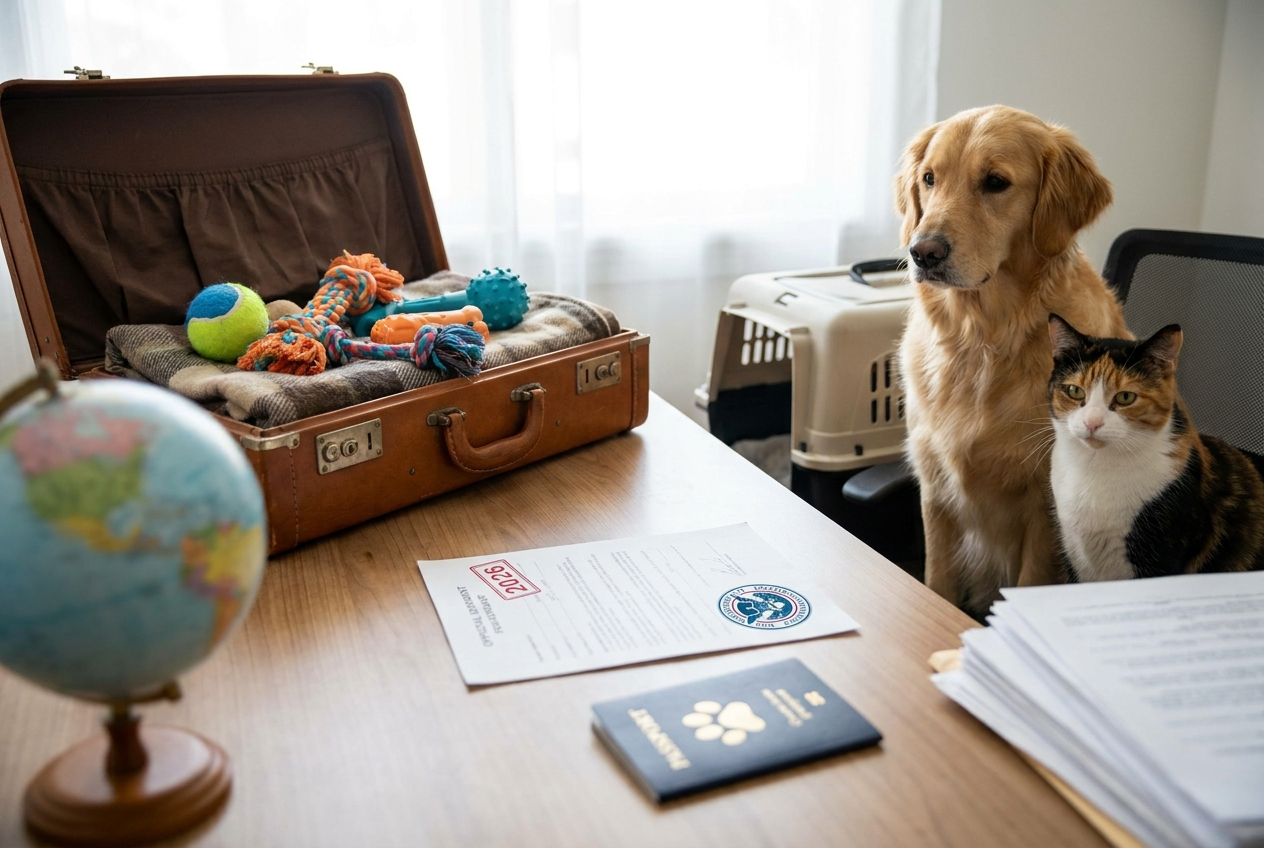
One thing I need you to understand before we dive into the scheduling logistics: picking your flight route is step two. Step one is knowing exactly how to satisfy USDA APHIS so they don't reject your digital paperwork forty-eight hours before departure. An airline can gladly sell you a pet ticket, but if federal officers deny your international health certificate endorsement, your pet stays grounded on U.S. soil. Before you book a single non-refundable flight, use our free checklist at PetHolidayClub.com to verify exactly what documentation your specific route requires.
Now, let's break down the rules.
The 2026 Landscape: What Actually Changed?
Three critical regulatory and technical updates shifted in late 2025 and 2026 that completely transformed the federal pet export market. If you are working from outdated, pre-2026 blog posts, your travel plans are highly likely to hit a wall.
First, the historic 2026 European Union and United Kingdom health certificate overhaul is officially active. Sweeping legislation finalized earlier this year completely redesigns the template formats for non-commercial animal health certificates. If your vet issues your paperwork using the old, legacy forms after the hard autumn compliance cutoff, EU and UK border agents will deny entry, forcing immediate quarantine or repatriation.
Second, the CDC’s aggressive digital import gatekeeping has changed how you exit the country. The Centers for Disease Control and Prevention completely overhauled its return-to-U.S. dog importation rules. Under the new 2026 framework, if you take a U.S.-based dog abroad without securing a specialized, federally endorsed export form before leaving American soil, you will face an absolute entry ban when trying to bring your dog back home.
With that context established, let's dive into the literal mechanics of the USDA APHIS process.
Technical Deep Dive: The 10-Day Clock & Microchip-Vaccine Sequencing
The chronological order of your pet’s medical treatments is the single most heavily scrutinized element of the USDA endorsement process. If the sequence is incorrect by even a single hour, federal veterinary medical officers will instantly reject your health certificate inside the digital portal.
[ISO Microchip Implanted & Read] ➔ [Rabies Vaccine Administered] ➔ [Clinical Exam & IHC Signed] ➔ [VEHCS Federal Endorsement]
The Golden Rule of Microchipping
Before any vaccine is administered, your pet must be implanted with a 15-digit microchip that complies strictly with ISO Standards 11784 and 11785. If your pet has an older, non-ISO 9-digit or 10-digit chip commonly used in the United States years ago, it will be flatly rejected by international customs agents unless you carry your own universal radio-frequency reader.
The biggest error pet parents make is getting a standard rabies vaccine first, and then microchipping the pet months later when an international travel opportunity arises. In the eyes of USDA APHIS and foreign biosecurity agencies, a rabies vaccine given before an ISO microchip is implanted does not legally exist. Because an animal cannot be uniquely identified before the chip is active in the tissue, that vaccine cannot be officially tied to that specific pet. If your pet was microchipped after their last rabies shot, your accredited vet must perform a re-vaccination on the day of or any day after the microchip is implanted.
Navigating the 1-Year vs. 3-Year Rabies Vaccine Trap
While the United States widely recognizes 3-year rabies vaccines, many international destinations do not, or they impose incredibly strict parameters on what constitutes a lapse. For instance, European Union rules specify that your pet must receive a booster rabies vaccination within 12 months from its primary vaccination. If your pet does not receive another rabies vaccination within 1 year of a primary shot, the coverage has legally lapsed under their framework, and you must start over with an entirely new 21-day waiting period.
When your vet fills out the international health certificate, they must attach the primary rabies vaccination certificate displaying the product name, manufacturer, serial number, and expiration date. To eliminate paperwork issues, a highly effective insider strategy is to ask your vet to administer a fresh 1-year rabies vaccination (after verifying the microchip) at least 21 days before your travel window opens.
Mastering the 10-Day Clock
The "10-day window" is an industry-standard phrase that is frequently misunderstood. This window means the health certificate must be fully completed by your vet and officially endorsed by APHIS within 10 days of your pet's physical arrival at your international destination (for standard EU/UK routes).
For example, if you fly out of New York on June 10th and land in Paris on June 11th, your veterinary appointment should ideally be scheduled on June 2nd or 3rd. This provides a narrow but safe cushion. Booking your appointment 11 days prior means your paperwork is dead on arrival at the airport, and the airline's counter staff will deny boarding.
The VEHCS Digital Pipeline & Hidden Costs Matrix
The Veterinary Export Health Certification System (VEHCS) is a secure, web-based portal developed by APHIS to transition pet travel from slow, error-prone paper processing to a streamlined digital workflow. While it has drastically reduced processing times, it requires precision from both you and your veterinarian.
How VEHCS Operates Behind the Scenes
Once your accredited veterinarian completes the physical examination of your pet, they log into their federally authenticated VEHCS dashboard. They select your destination country and begin inputting data. The system categorizes countries into distinct sub-types:
VEHCS Option 1 (Completely Digital): For countries with formal bilateral electronic agreements with the US (like the EU, UK, and South Korea), the USDA officer digitally signs the document. The status changes to "Completed," and your vet prints it out. This is a true digital health certificate.
VEHCS Option 2 (Hard Copy Return Needed): For countries requiring a physical "wet signature" and embossed federal seal, the USDA officer reviews the digital upload, prints it out in their regional office, physically stamps it, and drops it into a physical courier mailbox.
The Return-Shipping Logistical Nightmare
If your destination falls under Option 2, your paperwork cannot clear customs unless you physically hold that stamped paper copy when boarding. To get this document back from the regional USDA office, you must provide your veterinarian with a pre-paid, fully completed shipping label (typically FedEx or UPS) during your initial vet appointment.
Never use USPS (United States Postal Service) for this step, as standard mail tracking cannot guarantee the hyper-fast turnaround required to preserve your 10-day travel window. A single delayed envelope can cause you to miss your international relocation window, forcing you to pay thousands in airline rebooking fees.
2026 USDA APHIS Endorsement Fee Structure
The baseline cost for USDA to endorse an international health certificate depends entirely on the destination country’s categorization and whether specialized laboratory tests (like blood titers) require manual validation.
Certificate Category | First Pet Fee | Additional Pet Fee (Per Animal) |
Category 1: No blood tests or titers required (e.g., standard EU/UK entry) | $38.00 | $12.00 |
Category 2: Requires test validation (e.g., Rabies Titer Check) | $121.00 | $24.00 |
Category 3: Complex biosecurity protocols (e.g., Australia/New Zealand) | $173.00 | $36.00 |
Note: These are flat government administrative fees and do not include your private veterinarian’s examination charges, vaccination costs, or required overnight courier shipping labels.
Advanced Global Route Strategies: EU, UK, and High-Risk Biosecurity Zones
A standard mistake made by U.S. travelers is assuming that a completed USDA certificate automatically guarantees entry anywhere worldwide. APHIS requirements vary significantly by destination country. Furthermore, 2026 marks a massive legislative pivot year for major global trade blocks.
The 2026 European Union & UK Rule Overhaul
If you are aiming for Europe, you need to watch the calendar closely. New EU legislation (EU 2026/131 for non-commercial pet movements and EU 2026/848 for commercial movements) has officially altered the layout of international health certificates.
While there is an active transition period, the layout is strictly defined:
The current standard non-commercial health certificates can only be endorsed on or before September 30, 2026.
The brand-new health certificate formats officially become mandatory on October 1, 2026.
Commercial pet travel certificates shift permanently on October 17, 2026.
Additionally, for dogs targeting the UK, Ireland, Finland, Malta, or Norway, your accredited vet must administer a specific preventative treatment against the Echinococcus multilocularis tapeworm. For standard non-commercial travel, this must be done strictly between 24 and 120 hours (1 to 5 days) prior to scheduled arrival in the destination country, and the active ingredient must be explicitly recorded (typically Praziquantel).
The Mexico Zero-Tolerance Policy on Handwriting
If you are exporting a pet south of the border to Mexico, USDA APHIS emphasizes a total zero-tolerance policy regarding clerical details. The international health certificate must be entirely typewritten or completed using a word processor. Any certificate containing handwritten information or hand-made corrections, erasures, or line-outs will be immediately rejected at Mexican customs.
Furthermore, you cannot use standard abbreviations. For example, writing "Jan" instead of "January", "TX" instead of "Texas", or "yrs" instead of "Years" will trigger an immediate border refusal. All documents must be printed single-sided; Mexican authorities will not accept double-sided printouts.
Island Nations & High-Difficulty Destinations
Countries like Australia, New Zealand, and Japan, alongside the U.S. state of Hawaii, maintain rigorous anti-rabies protocols due to their rabies-free environmental status. Entering these regions requires bypassing standard documentation timelines entirely. You must map out a 6-to-7-month runway that includes a Fluorescent Antibody Virus Neutralization (FAVN) rabies titer test verified by an approved reference laboratory. APHIS will refuse to endorse your final export documents unless the precise number of days has elapsed since the blood draw, and failure to coordinate these timelines can lead to immediate quarantine at the owner’s expense.
The Return Journey: Surviving the CDC USA Border Rules
An international pet vacation isn't just about getting out of the U.S.—it’s about getting back in. The Centers for Disease Control and Prevention (CDC) enforces extremely rigid entry laws that directly impact your APHIS export strategy. Every single dog entering or returning to the United States must have a completed CDC Dog Import Form receipt. This form is filled out online by the owner, but the requirements depend entirely on where your dog has been in the preceding 6 months:
Low-Risk Countries: If your pet has only been in rabies-free or low-risk countries for the past 6 months, the online CDC form receipt and standard baseline health criteria are all that is required for entry.
High-Risk Countries (The Trap): If your dog has spent any time in a country designated as high-risk for dog rabies within the past 6 months, you face an elevated compliance wall. For a U.S.-vaccinated dog to return, they must hold a Certification of U.S.-issued Rabies Vaccination form.
Crucial Warning: This specific certification form must be completed by your USDA-accredited vet and fully endorsed by the USDA before your pet ever leaves the United States. The CDC explicitly states that this form cannot be retroactively issued after the dog has departed the country. If you leave without it and enter a high-risk zone, your dog will be barred from re-entering the U.S. or forced into commercial quarantine.
Step-by-Step Checklist for a Flawless USDA Endorsement
To ensure you don’t miss a single step, utilize this operational timeline when preparing your paperwork:
Step 1: Check the APHIS Live Destination Matrix. Biosecurity rules update constantly. Confirm if your destination requires specialized entry permits, blood titers, or multi-month quarantine protocols.
Step 2: Confirm Vet Accreditation. Ask your clinic directly, "Which doctor on staff holds active USDA-Accredited status?". A standard state license cannot access VEHCS for international exports.
Step 3: Run a Microchip Verification Scan. Have your vet scan the pet’s chip to ensure it reads cleanly on a universal scanner and matches your paperwork to the exact digit.
Step 4: Fund Your Courier Return Account. If your destination requires a physical wet signature, create a FedEx or UPS shipping account, generate an overnight return label, and hand it to your vet.
The Verdict: How to Prevent a Late Rejection
Navigating federal export portals requires absolute, uncompromising precision. A minor clerical error, a missing checkbox, an invalid country abbreviation, or an incorrectly dated booster shot will cause federal agents to reject your digital submission, risking canceled flights and immense travel stress.
APHIS requirements vary by destination country — get your route-specific checklist at PetHolidayClub.com to ensure every document, microchip timeline, and endorsement step is flawlessly aligned before you head to the clinic.
Frequently Asked Questions
What does USDA APHIS require for international pet travel?
USDA APHIS requires a destination-specific international health certificate issued by a USDA-accredited veterinarian. This certificate must generally be completed within 10 days of travel and, for most countries, electronically submitted to USDA APHIS for official endorsement via the Veterinary Export Health Certification System (VEHCS) before departure.
Can any veterinarian sign a USDA pet health certificate?
No. Only a veterinarian who has completed federal training and holds formal active status as a USDA-Accredited Veterinarian can issue an international pet health certificate. Standard state licenses are not sufficient for international customs clearance.
How long does it take for USDA APHIS to endorse a certificate?
Through the electronic VEHCS platform, standard processing time typically ranges between 2 to 5 business days. However, seasonal travel peaks can create backlogs, making it vital to submit your paperwork immediately once your 10-day travel window opens.
What happens if my dog's rabies vaccine expires while we are traveling abroad?
If your rabies vaccine expires while out of the country, your pet loses their legal status for easy re-entry into the U.S. Getting a booster shot from a foreign vet can trigger complex CDC validation requirements or mandatory hold periods. Always boost your pet before leaving the U.S. if the expiration date falls within your travel window.
Does Mexico accept handwritten health certificates?
No. Mexico enforces a zero-tolerance policy for handwriting. The entire health certificate must be typewritten or completed digitally. Any handwritten corrections, line-outs, or non-standard abbreviations (like "TX" instead of "Texas") will cause immediate rejection at the border.
Frequently Asked Questions
Written by
Anano Gudushauri
SEO & Content Strategy Specialist at Pet Holiday Club