Turkish Airlines Pet Policy Review 2026: Cargo Specialist for Middle East & Asia Routes
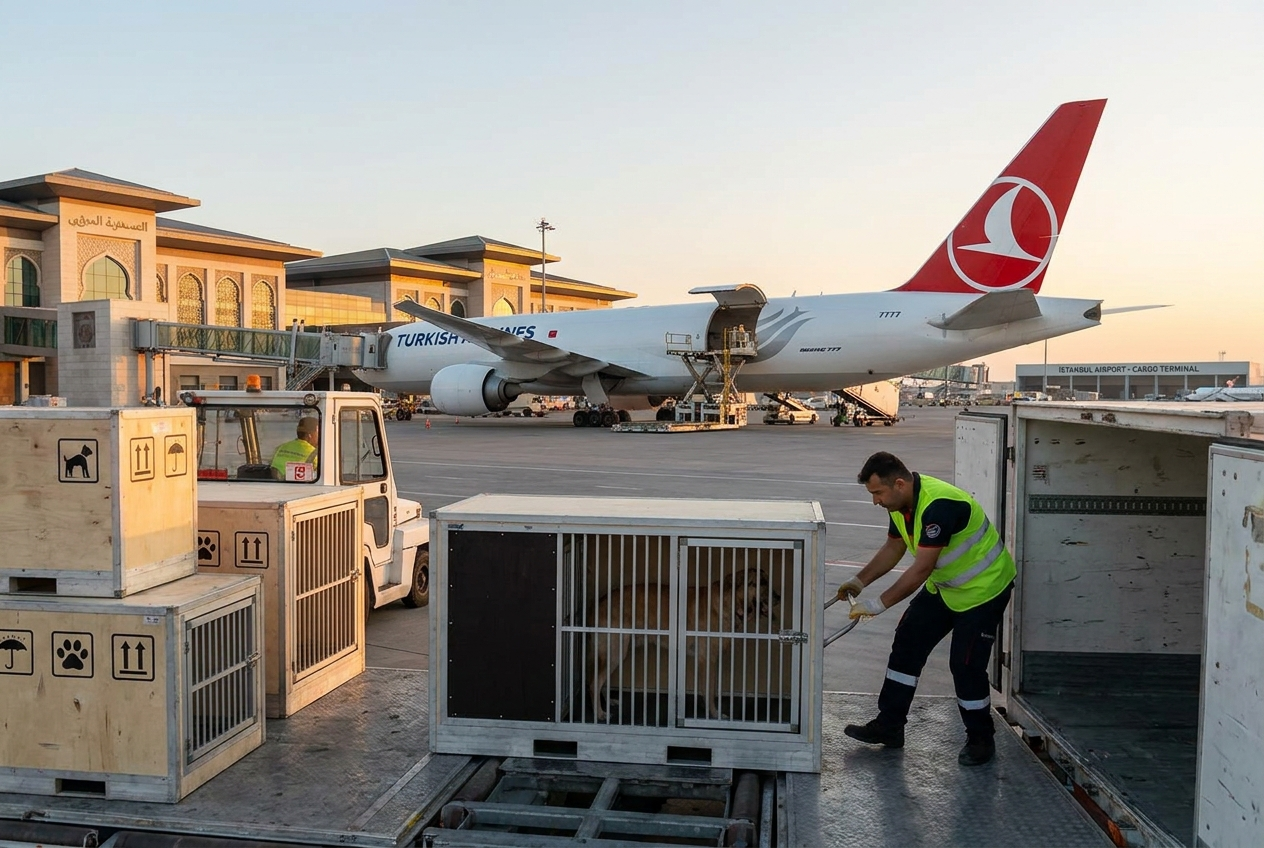
Operating out of its massive, ultra-modern hub at Istanbul Airport (IST), Turkish Airlines flies to more countries than any other carrier in the world. For global pet parents, this expansive network makes them a frequent choice for long-haul travel across Europe, Asia, Africa, and the Americas. However, routing a companion animal through a sprawling global hub requires strict adherence to metric weight caps, specific country-to-country route bans, and sweeping breed safety restrictions.
This comprehensive guide dissects the operational rules of the turkish airlines pet policy 2026. We will outline the under-seat space metrics required for the cabin, evaluate the carrier's advanced cargo hold alternatives via Istanbul, map out country-specific route restrictions, and highlight the strict breed safety bans you must navigate. Istanbul transit routes require specific health certifications — prepare yours at PetHolidayClub.com to ensure smooth international border clearance.
In-Cabin Metrics: The PETC Weight & Sizing Blueprint
For passengers planning on turkish airlines traveling with pets within the passenger cabin (designated by the airline code PETC), your animal must satisfy strict physical dimension and weight constraints.
The 8 kg Weight Limit
The maximum allowable weight for an in-cabin pet is 8 kg (17.6 lbs). This weight limit is an absolute cap that combines the weight of the animal plus its travel container. Turkish Airlines ticketing agents routinely weigh pets at the check-in counter; if your container registers even slightly over 8 kg, the animal will be barred from the cabin and must be rebooked into the cargo hold.
  [ Pet Weight ] + [ Travel Carrier Weight ] = Must be ≤ 8 kg (17.6 lbs)
  *Rigidly enforced at check-in desks worldwide.
Your pet carrier serves as your single permitted piece of cabin hand luggage. While you are allowed to carry a small personal item (such as a briefcase or purse) for floor storage, your standard rolling overhead carry-on allowance is typically forfeited or must be checked, depending on your ticket class.
Carrier Sizing and Materials
Turkish Airlines accepts both hard-sided and soft-sided carriers in the cabin, though soft-sided, flexible fabric bags are highly recommended due to their ability to compress beneath the seat frames. The maximum allowable dimensions are:
Maximum Size: 40 cm long x 30 cm wide x 23 cm high (15.7 inches x 11.8 inches x 9 inches).
Inside the closed container, the animal must be able to stand up, turn around 360 degrees, and lie down comfortably. The carrier must remain completely zipped and secured beneath the seat for the entire duration of the flight.
Route Restrictions: Banned Destinations and Flight Segments
Because Turkish Airlines operates on a massive global scale, pet parents must navigate an intricate web of country-specific biosecurity laws. The airline restricts or completely bans pet travel on several high-profile routes.
1. Absolute Country Entry Bans
Turkish Airlines will not transport pets—either in the cabin or in the cargo hold—to destinations that legally mandate that all animals arrive strictly via manifest cargo or face long-term quarantine. These routes include, but are not limited to:
The United Kingdom (UK)
United Arab Emirates (UAE)
Kingdom of Saudi Arabia (KSA)
Australia and New Zealand
2. The U.S. CDC Dog Import Blanket Ban
If you are planning turkish pet travel from a country designated by the U.S. Centers for Disease Control (CDC) as a high-risk rabies zone into the United States, Turkish Airlines enforces strict booking limits. High-risk departures must clear specific CDC-approved US border airports, which may restrict your connecting flight choices through Istanbul.
Advanced Cargo Infrastructure: The Istanbul SmartIST Hub
For companion animals that exceed the 8 kg in-cabin weight limit, Turkish Airlines offers an exceptionally advanced, climate-controlled cargo hold program. This system is divided into checked baggage (AVIH) and manifest cargo handled through Turkish Cargo.
[Arrival at Istanbul Transit] ➔ [Immediate Offloading by Live Animal Teams]
➔ [Transfer to Climate-Controlled SmartIST Lounge] ➔ [Vet Inspection & Feeding]
Pets routing through Turkey on long-haul connecting flights benefit from the state-of-the-art SmartIST Cargo Facility at Istanbul Airport.
Dedicated Live Animal Rooms: Turkish Cargo operates massive, isolated live animal transit areas completely separate from standard commercial freight. These spaces feature independent, automated HVAC systems to maintain optimal temperatures for different species.
Around-the-Clock Care: The facility is staffed by dedicated animal handlers and veterinary technicians who monitor transiting pets, clean travel crates, refresh water bowls, and administer food provided by the owner during long layovers.
Breed Restrictions: Dangerous and Snub-Nosed Bans
To ensure flight safety and preserve animal welfare at high altitudes, Turkish Airlines enforces some of the strictest breed-specific exclusions in the aviation industry.
1. Prohibited "Dangerous" Dog Breeds
Turkish Airlines will completely refuse transport—both in the cabin and in the cargo hold—to specific dog breeds classified as dangerous by international civil aviation guidelines. These include:
American Pit Bull Terrier, American Staffordshire Terrier, Pit Bull Terrier
Staffordshire Bull Terrier, Bull Terrier
Tosa, Dogo Argentino, Fila Brasileiro, Rottweiler
American Bulldog, Cane Corso, Doberman, Mastiff (and their crosses)
2. Brachycephalic (Snub-Nosed) Breeds
Snub-Nosed cats and dogs suffer from compressed upper respiratory systems, making them highly vulnerable to respiratory distress and heatstroke when stressed or subjected to air pressure changes.
In-Cabin (PETC): Snub-nosed breeds (such as French Bulldogs, Pugs, Pekinese, and Persian cats) are permitted to travel in the passenger cabin, provided they safely meet the 8 kg weight ceiling and remain stress-free.
Cargo Hold (AVIH/Cargo): Snub-nosed breeds are completely banned from traveling in the cargo compartment or as checked baggage due to elevated safety risks.
Fee Structure Across the Network
Turkish Airlines calculates pet travel fees based on the total weight of the animal and carrier, categorized by your flight routing. These fees are collected at the airport ticket counter:
Flight Route Type | In-Cabin (PETC) Fee Framework | Cargo Hold (AVIH) Fee Framework |
Domestic Flights (Within Turkey) | Flat fee based on weight tiers (approx. 200–400 TRY) | Scaled by exact weight metrics |
International Short-Haul (Europe) | Approx. €70 – €100 each way | Scaled by combined weight x route metrics |
Transcontinental (e.g., US to Asia) | Approx. $150 – $250 each way | Calculated based on precise volumetric crate dimensions |
You must submit an official pet reservation request at least 48 hours prior to your flight's scheduled departure. Turkish Airlines limits the total number of live animals permitted in the cabin per flight, and they strictly prohibit certain species combinations (for example, a dog and a cat cannot be booked in the same passenger cabin zone on the same flight).
Documentation Milestones for Transit and Entry
Clearing international borders when flying through Istanbul requires complete synchronization of your veterinary records.
1. Basic International Documentation Requirements
ISO 11784/11785 Microchip: Must be a 15-digit, non-encrypted microchip implanted before the primary rabies vaccination is administered.
Rabies Vaccination Certificate: Must be current and administered at least 21 days prior to travel.
International Health Certificate: Must be issued by an accredited veterinarian and endorsed by your origin country's agricultural department (e.g., a USDA APHIS endorsement for US departures) within 10 days of arrival.
2. The Rabies Titer Blood Test (FAVN)
If you are traveling from a country classified as a high-risk rabies zone into the European Union or other strictly regulated nations via Istanbul, your pet must clear a Rabies Titer Blood Test. The blood sample must be drawn at least 30 days after the rabies vaccine, and the pet must wait a mandatory 3 calendar months from the draw date before entering the destination border.
[Microchip & Vaccine] ➔ [Wait 30 Days] ➔ [Titer Blood Draw] ➔ [Wait 3 Calendar Months] ➔ [Flight Allowed]
Istanbul transit routes require specific health certifications — prepare yours at PetHolidayClub.com to build an accurate, stress-free countdown timeline.
Peer Comparison: Turkish Airlines vs. Lufthansa vs. Qatar Airways
See how Turkish Airlines' international pet program compares against competing mega-connectors:
Airline Platform | In-Cabin Weight Cap | Dedicated Transit Care | Snub-Nosed Cargo Policy |
Turkish Airlines | 8 kg (17.6 lbs) | Yes (SmartIST Live Animal Facility) | Completely Banned from Hold |
Lufthansa | 8 kg (17.6 lbs) | Yes (Frankfurt Animal Lounge) | Restricted / Seasonal Exceptions |
Qatar Airways | Banned (Except Falcons/Service Dogs) | Yes (Doha Live Animal Centre) | Completely Banned from Hold |
While Qatar Airways completely bans standard companion dogs and cats from their passenger cabins, Turkish Airlines remains highly competitive by offering an 8 kg cabin allowance alongside a world-class cargo transit hub in Istanbul.
The Verdict: Is Turkish Airlines Right for Your Pet?
Your Travel Configuration | Final Operational Recommendation |
Small Companion Pets (<15 lbs) Flying Economy | Highly Recommended. The 8 kg cabin weight limit aligns with European standards, and the carrier size accommodates most standard soft-sided travel bags. |
Long-Haul Connecting Itineraries via IST | Excellent. The advanced SmartIST facility provides top-tier climate controls, food/water replenishment, and veterinary oversight during layovers. |
Large Dogs and Guard Breeds | High Risk / Restricted. Check the dangerous breed list carefully. If your dog belongs to a banned breed, Turkish Airlines will reject them at the counter. |
Snub-Nosed Breeds Over 8 kg | Completely Incompatible. Because brachycephalic animals are banned from the cargo hold, a snub-nosed dog or cat that exceeds the 8 kg cabin limit cannot fly on Turkish Airlines. |
Frequently Asked Questions
Does Turkish Airlines allow pets in the cabin?
Yes, Turkish Airlines allows small dogs, cats, and songbirds to travel in the passenger cabin on select routes, provided the animal and its carrier have a combined maximum weight of 8 kg (17.6 lbs) and the carrier fits completely under the seat in front of you.
What are the maximum pet carrier dimensions for Turkish Airlines?
The maximum allowable dimensions for an in-cabin pet carrier on Turkish Airlines are 40 cm long x 30 cm wide x 23 cm high (15.7 x 11.8 x 9 inches). Soft-sided, flexible travel bags are highly recommended.
Can I fly with my dog to the UK on Turkish Airlines?
No. Turkish Airlines does not accept pets—either in the cabin or as checked baggage—on flights arriving into the United Kingdom due to strict UK border laws requiring animals to enter exclusively via manifest cargo through designated UK ports.
Are snub-nosed dogs allowed to fly on Turkish Airlines?
Snub-nosed (brachycephalic) dogs and cats are permitted in the passenger cabin if they weigh under the 8 kg limit. However, they are completely banned from traveling in the cargo hold or checked baggage compartments due to elevated respiratory risks.
What happens to my pet during a layover at Istanbul Airport?
Pets traveling in the cargo hold on connecting flights are transferred to the specialized, climate-controlled SmartIST Live Animal Facility. Dedicated handlers inspect the animal, sanitize crates, and refresh food and water throughout the layover.
Frequently Asked Questions
Written by
Anano Gudushauri
SEO & Content Strategy Specialist at Pet Holiday Club