Top 3 Private Pet Aviation Services vs. Commercial Airlines in 2026: Which Is Right for You?
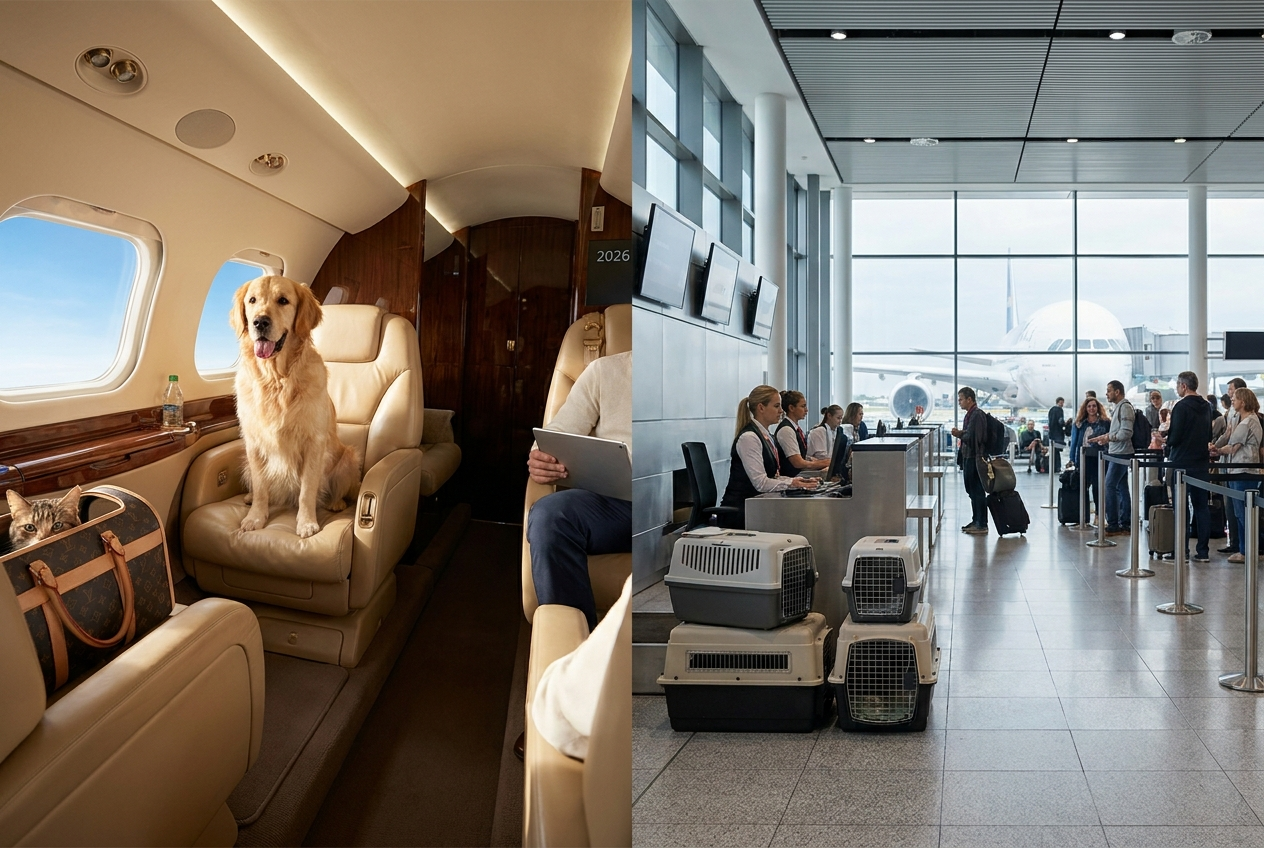
Should I use a private jet or commercial airline for my pet? Choose a shared private pet aviation service (Bark Air, K9 JETS, or SkyePets) if you are flying a large dog, a snub-nosed breed, or an anxious animal that requires in-cabin comfort. Opt for a commercial airline if your pet is under 20 pounds and fits beneath a passenger seat.
Should I use a private jet or commercial airline for my pet? Choose a shared private pet aviation service (Bark Air, K9 JETS, or SkyePets) if you are flying a large dog, a snub-nosed breed, or an anxious animal that requires in-cabin comfort. Opt for a commercial airline if your pet is under 20 pounds and fits beneath a passenger seat.
International travel with a family pet has fundamentally changed over the last several years. Gone are the days when flying a dog simply meant paying a small baggage fee at the commercial airport check-in counter. Tightening commercial constraints, absolute bans on brachycephalic (flat-faced) breeds, and a growing understanding of animal behavioral health have forced a massive shift in how we move our animals.
Today, pet parents are faced with a stark crossroad: do you navigate the rigid rules and potential anxiety of commercial transport, or invest in the new wave of shared private pet aviation? Regardless of which option you choose, the documentation requirements at your destination don't change — prepare at PetHolidayClub.com to ensure you satisfy border biosecurity laws. Let's pit the top three private pet aviation services against commercial airlines to determine which is right for your budget, route, and animal.
Private Pet Jet vs. Commercial Airline: The 2026 Core Comparison
To help guide your choice, look at how the fundamental elements of private seat-share services compare directly to standard commercial legacy air carriers:
Travel Metric | Shared Private Pet Aviation | Commercial Airlines (In-Cabin/Cargo) |
Primary Animal Space | Open cabin floor, custom beds, or leather seats | Under-seat footwell or isolated cargo hold |
Weight & Breed Caps | None (Accepts all large and brachycephalic dogs) | Max 20 lbs for cabin; extensive cargo breed bans |
Average Pricing Model | $2,500 – $26,990 per seat-share ticket | $125 – $250 (Cabin) | $3,000 – $6,000 (Cargo) |
Airport Terminal Flow | 15-minute executive FBO lounge processing | 2-to-6 hour commercial freight line processing |
Sensory Distress Level | Minimal; constant human companionship and care | High; loud machinery, isolation, or tight confinement |
Part 1: Profiling the Top 3 Private Pet Aviation Services
Shared private aviation works via a "public charter seat-share" model. Instead of paying $50,000 to $150,000 to charter an entire executive aircraft privately, these operators allow you to buy an individual seat, splitting the cost with other pet owners flying the exact same route.
       [THE BIG THREE PRIVATE PET AVIATION ECOSYSTEM]

               /              |              \
       BARK AIR            K9 JETS            SKYEPETS
          |                   |                   |
   - Ultimate luxury    - Transatlantic &   - Ultra-long-haul
     for highly anxious   Middle East        transpacific
     canines.             specialist.         pioneer.
1. Bark Air: The Ultra-Luxury Canine Experience
Bark Air focuses on delivering top-tier comfort tailored specifically to dogs. They view the human passenger as the "plus one," prioritizing the animal's needs at every stage of the journey.
Unique In-Flight Amenities: Bark Air features onboard treats, calming pheromone-infused cloths, and specialized beverages designed to help relieve painful inner-ear pressure changes during takeoff and landing.
Best For: Highly anxious pets, dogs requiring a high-touch environment, and popular routes within the US domestic network and select transatlantic hubs.
2. K9 JETS: The Established Relocation Standard
K9 JETS is a premier public charter seat broker that focuses heavily on high-demand international relocation corridors. The onboard environment mirrors a quiet, premium executive workspace.
The Route Core: They dominate the transatlantic market, providing highly consistent routes connecting New York (Teterboro) with London, Paris, and Frankfurt, alongside connections out to Dubai.
Best For: Families undertaking transatlantic relocations with large breeds who need a highly reliable, professional schedule.
3. SkyePets: The Long-Haul Transpacific Pioneer
SkyePets has made waves in the industry by establishing highly anticipated routes across the Pacific ocean, a region traditionally cut off from shared private pet travel due to complex fuel logistics.
Bypassing Strict Overbelly Travel: SkyePets specializes in ultra-long-range heavy jets, safely carrying dogs and cats inside the cabin between Los Angeles, Melbourne, and Auckland cage-free.
Best For: Expats and travelers moving pets to and from Australia or New Zealand who want to completely bypass traditional commercial cargo holds.
Part 2: The Commercial Airline Alternative — Cabin vs. Cargo
Commercial aviation remains a viable option for many families, but its utility depends entirely on the size, breed, and physical health of your pet.
              [COMMERCIAL LINE SEPARATION MATRIX]
                            /          \
               PET UNDER 20 LBS          PET OVER 20 LBS
                     /                    \
        - Fits in soft carrier.       - Must travel as Manifest Cargo.
        - Stays under your seat.       - Requires IPATA broker booking.
        - Affordable cabin add-on.    - Subject to seasonal weather bans.
1. Traveling In-Cabin (Small Pets Only)
If your cat or small dog weighs less than 20 pounds (including the weight of their soft-sided travel carrier), commercial airlines like Delta or Alaska Airlines offer a very affordable solution. Your pet stays safely enclosed inside their carrier beneath the passenger seat in front of you for a small pet fee (usually $125 to $250 per way). For small, calm pets, this is an excellent, cost-effective method.
2. Traveling as Manifest Cargo (Large Pets)
If your dog weighs over 20 pounds, they cannot travel in a commercial passenger cabin. They must be shipped inside a specialized structural container within the aircraft’s underbelly cargo hold via Manifest Cargo.
The Regulatory Realities: You cannot call an airline to book a manifest cargo space directly for international flights; you are legally required to contract a professional IPATA-certified relocation broker.
The True Costs: When you add up broker management fees, custom wooden travel crates, airport handling charges, and clearance tariffs, a commercial cargo journey routinely winds up costing between $3,000 and $6,000 per sector. This narrows the price gap between cargo and a private seat-share ticket considerably.
Part 3: Assessing the Safety and Stress Factors
When weighing private pet options against traditional commercial flights, behavioral stress and safety risks are often the ultimate deciding factors for pet parents.
   [Private Flight: 15-Min FBO Entry] ➔ [Relaxed Cabin Access Beside Owner]

   [Commercial Cargo: 4-Hr Freight Line] ➔ [Isolated Noise & Dark Hold Stress]
Tarmac Extreme Climates: Commercial cargo holds are pressurized and temperature-regulated while in the air, but threats spike during ground logistics. If an aircraft experiences a lengthy tarmac delay during a summer heatwave or a winter storm, the cargo bay can quickly experience dangerous temperature spikes. Private pet jets park directly at executive FBO terminals, keeping animals in climate-controlled spaces until boarding.
Sensory Overload: The roaring sounds of jet engines, the heavy thuds of luggage being loaded, and traveling in pitch darkness for 8 to 14 hours can trigger severe panic in a nervous dog. On a shared private flight, your pet stays right by your side, allowing you to soothe them, offer fresh water, and monitor their comfort in real time.
Part 4: The Core Choice Checklist — Which Is Right for You?
To make the best choice for your upcoming journey, use this decision framework to match your travel needs with the ideal aviation method:
Choose a Shared Private Pet Jet Service If:
Your dog weighs over 50 pounds and you refuse to ship them in a dark cargo hold.
Your pet belongs to a brachycephalic (flat-faced) breed—such as a French Bulldog, Pug, Boxer, or Persian cat—that faces permanent cargo bans on major commercial airlines.
Your pet suffers from severe separation anxiety or noise phobias that could cause them to panic or injure themselves inside a traditional travel crate.
You are relocating internationally and want a low-stress, highly supportive experience for your animal.
Choose a Commercial Airline If:
Your pet is a cat or small dog under 20 pounds that can relax comfortably inside a soft-sided carrier under a passenger seat.
Your dog is completely healthy, has an even temperament, and is accustomed to resting calmly inside a travel crate.
You are flying a domestic route where cargo transit times are brief and weather conditions are mild.
Private aviation pricing does not align with your current moving or travel budget.
Crucial Requirement: Border Papers Don't Change
A dangerous mistake made by luxury travelers is assuming that flying private exempts their pets from destination customs checks and agricultural biosecurity laws. This is completely false.
Biosecurity Officials Board Every Private Jet: When your plane touches down at international airports like London Biggin Hill or Melbourne, government agricultural officers board the aircraft. If your international health certificate lacks a verified stamp or your rabies timeline is flawed, your pet will face immediate quarantine.
Regardless of which option you choose, the documentation requirements at your destination don't change — prepare at PetHolidayClub.com to ensure your microchips, vaccines, and health certificates are perfectly aligned before booking your flight.
Frequently Asked Questions
Should I use a private jet or commercial airline for my pet?
If your pet is small (under 20 pounds) and can fit beneath a commercial passenger seat, a commercial airline is highly cost-effective. However, if your pet is large, belongs to a brachycephalic breed, or suffers from severe anxiety, a shared private jet service is the safest choice.
How much does it cost to fly a dog on a private pet jet in 2026?
Fares vary significantly based on your destination route. Short European or domestic US flights range from $2,500 to $7,500, transatlantic crossings via K9 JETS cost between $8,000 and $11,000, and ultra-long-haul transpacific journeys via SkyePets start around $26,990 per seat.
Do pets need to be inside crates on private pet airlines?
No. On specialized services like Bark Air, K9 JETS, and SkyePets, pets are permitted to rest openly on the cabin floor, on memory foam mattresses, or right on the leather passenger seats beside you. They only need to be leashed or harnessed during taxiing, takeoff, and landing.
Why do commercial airlines ban certain breeds from traveling in cargo?
Most commercial airlines ban snub-nosed (brachycephalic) breeds—such as Pugs, Bulldogs, and Shih Tzus—from cargo transit due to hereditary respiratory limitations. The stress of travel, combined with poor ventilation or ambient heat on the tarmac, can make cargo holds incredibly dangerous for these animals.
Do I still need a government health certificate if I fly on a private pet jet?
Yes. Private aviation operators must comply with the exact same international biosecurity laws, customs checkpoints, and import regulations as commercial airlines. Your pet must possess an officially endorsed international health certificate to clear customs upon arrival.