Qatar Airways Pet Policy Review 2026: Best Cargo Airline for International Relocation?
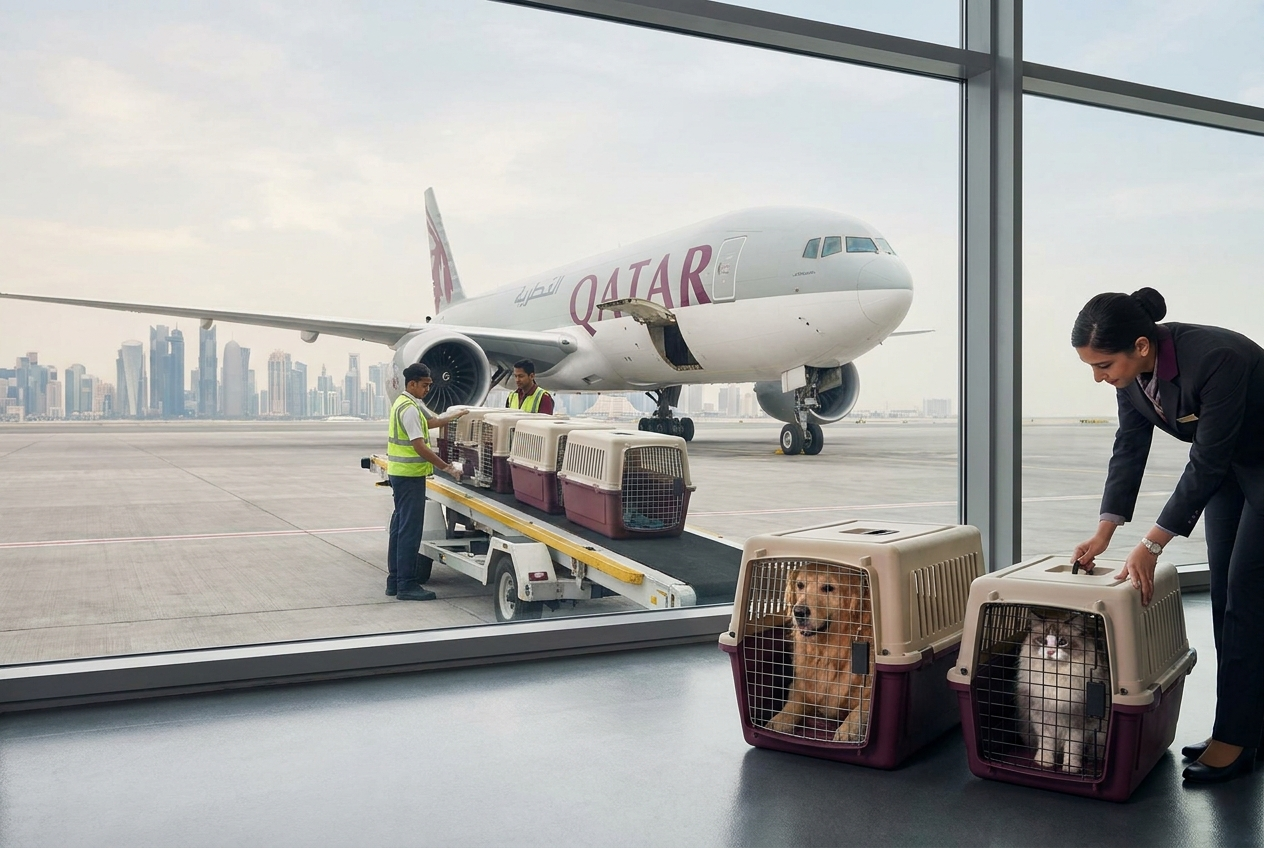
When mapping out an international relocation across continents, Qatar Airways frequently surfaces as a premium contender. Operating out of the ultra-modern Hamad International Airport in Doha, this Middle Eastern mega-carrier is renowned for luxury passenger spaces. However, if you are looking to book qatar airways pet travel 2026, you must realize that the operational flow is entirely different from Western legacy airlines. Your small lap dog or kitten will not be sitting under the seat in front of you.
This review details the structural mechanics of Qatar airways traveling with pets, distinguishing between their checked baggage allowances and dedicated cargo operations. We will also address the strict temperature caps and the regional documentation requirements you must satisfy. Qatar requires specific export/import health certificates — generate your route-specific checklist at PetHolidayClub.com to secure compliance before booking.
The In-Cabin Reality: Falcons, Service Dogs, and No Cats or Dogs
The absolute first rule of the qatar pet policy is that domesticated cats and dogs are banned from the passenger cabin. It does not matter if your pet fits into a tiny soft carrier or weighs less than 2 kg; they are legally restricted from entering civilian seating zones.
However, the airline features two highly specific exceptions for upper-deck travel:
1. The Falconry Custom
In alignment with cultural traditions across the Gulf region, Qatar Airways allows passengers to bring one falcon into the Economy Class cabin.
Logistical Limits: A maximum of six falcons are permitted per aircraft cabin across the entire Economy layout.
In-Flight Rules: The birds must be securely hooded and safely tethered to the passenger's seat or armrest throughout the journey. Rates for falcons range from $115 to $630 depending on the destination.
2. Trained Service Dogs
Trained service and psychiatric service animals are permitted inside the cabin free of charge on select, legally protected flight tracks—primarily routes to or from the United States, Canada, Australia, Georgia, and EU Member States. Emotional support animals do not qualify for this exemption and are processed via regular hold procedures.
Checked Baggage vs. Manifest Cargo Hold Formats
Because standard companion pets are restricted to the lower deck, Qatar Airways separates live animal transport into two distinct operational systems based entirely on weight and size metrics.
1. Traveling as Checked Baggage (AVIH)
If your companion dog, cat, or domestic bird, combined with the total weight of their transport container and food, stays under 75 kg (165 lbs), they can travel on your ticket as checked baggage.
The structural cost for this tier is determined by two clear size classes:
Size Tier | Weight Boundaries | Rates (To/From Qatar) | Rates (All Other Routes) |
Medium | Up to 32 kg (70 lbs) | $200 USD / $260 CAD | $350 USD / $455 CAD |
Large | 32 kg to 75 kg (70–165 lbs) | $300 USD / $390 CAD | $450 USD / $590 CAD |
2. Traveling as Manifest Cargo
Your pet must step up to the Qatar Airways Cargo tier if they hit any of the following operational limits:
The combined weight of the pet and container exceeds 75 kg (165 lbs).
The total linear dimensions of the crate exceed 118 inches (300 cm).
The animal is traveling entirely unaccompanied or connecting onto an itinerary operated by a separate airline company.
The destination country legally mandates live animals to enter strictly as manifest cargo (such as routes to the United Kingdom, Australia, or New Zealand).
Strict Structural Sizing and "Nose-Proof" Crate Rules
Qatar Airways operates with an absolute zero-tolerance policy at check-in counters regarding crate dimensions and structural durability. If a kennel shows signs of weakness or lacks sufficient space, your pet will be grounded immediately.
       [ Height: Head cannot touch the ceiling when standing ]
  [ Width: Must be double the animal's shoulder-to-shoulder width ]
  [ Length: Must allow full 360-degree rotation without restriction ]
The Paw and Nose-Proof Mandate
In addition to standard IATA Live Animal Regulations, Qatar mandates that all openings on the transport carrier must be completely nose and paw-proof. This means the ventilation grids and metal doors must feature tightly spaced mesh patterns—specifically 19 mm x 19 mm for cats and 25 mm x 25 mm for dogs. This prevents any part of the animal's snout or paws from protruding through the exterior bars, protecting them from injury during ground loading.
Feeding and Watering Infrastructure
You must install food and water bowls that firmly bolt to the inside of the metal mesh door. Crucially, these containers must feature top-access funnels or exterior filling ports so airport staff can replenish water or food from the outside without opening the crate door. Written feeding instructions and a supply of food must be securely attached to the top outer surface of the container.
The 21°C Climate Embargo and Snub-Nosed Bans
Operating a massive international aviation hub in the middle of the Arabian Desert introduces severe environmental variables. Middle Eastern summer heat waves create dangerous conditions on open airport tarmac environments.
The 21°C (69.8°F) Risk Window
Qatar Airways explicitly warns that specific breeds face an elevated risk of heat stroke when ambient outside temperatures pass 21°C (69.8°F). While the aircraft cargo holds are fully air-conditioned and pressurized to match passenger deck environments, the brief loading window across the outdoor concrete runways exposes crates to raw surface heat.
Because of this, the airline enforces seasonal restrictions and terminal delays during peak summer months. Ground crews utilize specialized, climate-controlled transfer vehicles to move animals from the terminal to the aircraft belly as quickly as possible.
Permanent Brachycephalic Breed Bans
Because snub-nosed animals feature shortened respiratory pathways that easily collapse under high ambient heat or elevated stress, Qatar Airways completely prohibits the transport of the following breeds in the hold:
Cats: Persian, Exotic Shorthair, and Shirazi variants.
Dogs: Bulldogs (all variations), Boxers, Boston Terriers, Pit Bulls, Staffordshire Bull Terriers, Chow Chows, King Charles Spaniels, English Mastiffs, Cane Corsos, Dogo Argentinos, and Presa Canarios.
Expert Recommendation: Qatar Airways strongly recommends that owners of mixed-breed pets secure a signed veterinary statement certifying that the animal's genetic background does not contain any of these restricted brachycephalic lineages.
Transiting Doha: The 3-Hour Ground Protocol
If your long-haul route features a layover at Hamad International Airport (DOH), the duration of your connection dictates how your animal is cared for behind the scenes.
[Arrival at DOH Hub] ➔ [Evaluated by Ground Handlers]
➔ [Layovers > 3 Hours: Moved to Specialized Facility]
➔ [Crates Deep Cleaned / Dogs Walked] ➔ [Priority Reloading onto Connecting Flight]
For connections that run longer than 3 hours, Qatar Airways activates a mandatory ground comfort protocol handled by dedicated live-animal teams:
Animals are carefully removed from their travel crates and placed into larger, comfortable holding kennels within a climate-controlled transit facility.
Ground handlers check the animals for any visible signs of stress, fatigue, or illness.
Dogs are walked in secure zones, and cats are given time to stretch out.
Travel crates are deep cleaned, soiled absorbent padding is replaced, and fresh water is provided.
GCC Country Compliance and Documentation Windows
Moving a pet through the Gulf Cooperation Council (GCC) geographic zone or across global networks requires strict chronological document tracking.
The 60-to-1 Day Booking Window
You cannot make last-minute additions to your itinerary. Qatar Airways requires all checked baggage pet requests to be formally submitted through their online portal no earlier than 60 days and no later than 24 hours before departure. Requests falling outside this mandatory window are systematically rejected.
Core Paperwork Checklist
To clear customs checkpoints in Doha or final regional destinations, you must present the following records:
Fit-to-Fly Health Certificate: A formal veterinary document signed and dated within 10 days of your departure flight.
Microchip Proof: An ISO 11784/11785 compliant 15-digit electronic transponder.
Age Limits: Animals must be at least 12 weeks old for general international transit, or a minimum of 7 months old if Qatar is your final destination.
CDC US Restrictions: If your destination is the United States, note that dogs coming from or transiting through high-risk rabies countries face strict CDC import rules, which may require specialized routing through cargo.
Qatar requires specific export/import health certificates — generate your route-specific checklist at PetHolidayClub.com to align your dates perfectly.
The Verdict: Is Qatar Airways Right for Your Pet?
Your Travel Configuration | Final Operational Recommendation |
Small Lap Dogs or Cats (In-Cabin) | Completely Incompatible. Because standard pets are banned from the passenger cabin, owners wanting to stay with their animals must choose a different airline. |
Large Breeds up to 75 kg (Checked Baggage) | Highly Recommended. The 75 kg checked baggage allowance is more generous than most European carriers, keeping your pet on your passenger ticket. |
Long-Haul Intercontinental Relocation | Excellent Cargo Network. For multi-leg global moves, the mandatory 3-hour transit care facility at Hamad International ensures excellent safety and hydration. |
Brachycephalic / Snub-Nosed Breeds | Prohibited. Severe, unyielding breed bans mean these animals must look toward surface transportation or alternative airlines. |
Frequently Asked Questions
Can pets travel in cabin on Qatar Airways?
No, standard companion pets like dogs and cats are never allowed in the passenger cabin on Qatar Airways, regardless of size. Only certified service dogs on select routes and one falcon per passenger in Economy Class are permitted upstairs.
What is the maximum weight for a pet as checked baggage on Qatar?
The maximum weight limit for a pet to travel as checked baggage is 75 kg (165 lbs), which includes the combined weight of the animal, the kennel, and any food. Animals over this limit must travel as manifest cargo.
What are Qatar Airways' unique "nose-proof" crate rules?
Qatar Airways requires all kennel ventilation holes to be paw and nose-proof to protect animals from injury. Mesh openings must not exceed 19 mm x 19 mm for cats, or 25 mm x 25 mm for dogs.
What happens to pets during long layovers in Doha?
For transfers longer than 3 hours at Hamad International Airport, ground staff move pets to a specialized transit facility. Animals are let out to stretch, dogs are walked, and crates are thoroughly cleaned and refreshed.
Can I fly a puppy or kitten on Qatar Airways?
Yes, but they must meet strict age limits. Pets must be at least 12 weeks old for standard international flights, and a minimum of 7 months old if they are entering Qatar as their final destination.
Frequently Asked Questions
Written by
Anano Gudushauri
SEO & Content Strategy Specialist at Pet Holiday Club