Pet Travel to the USA in 2026: CDC Rules, Rabies Vaccination & APHIS Requirements
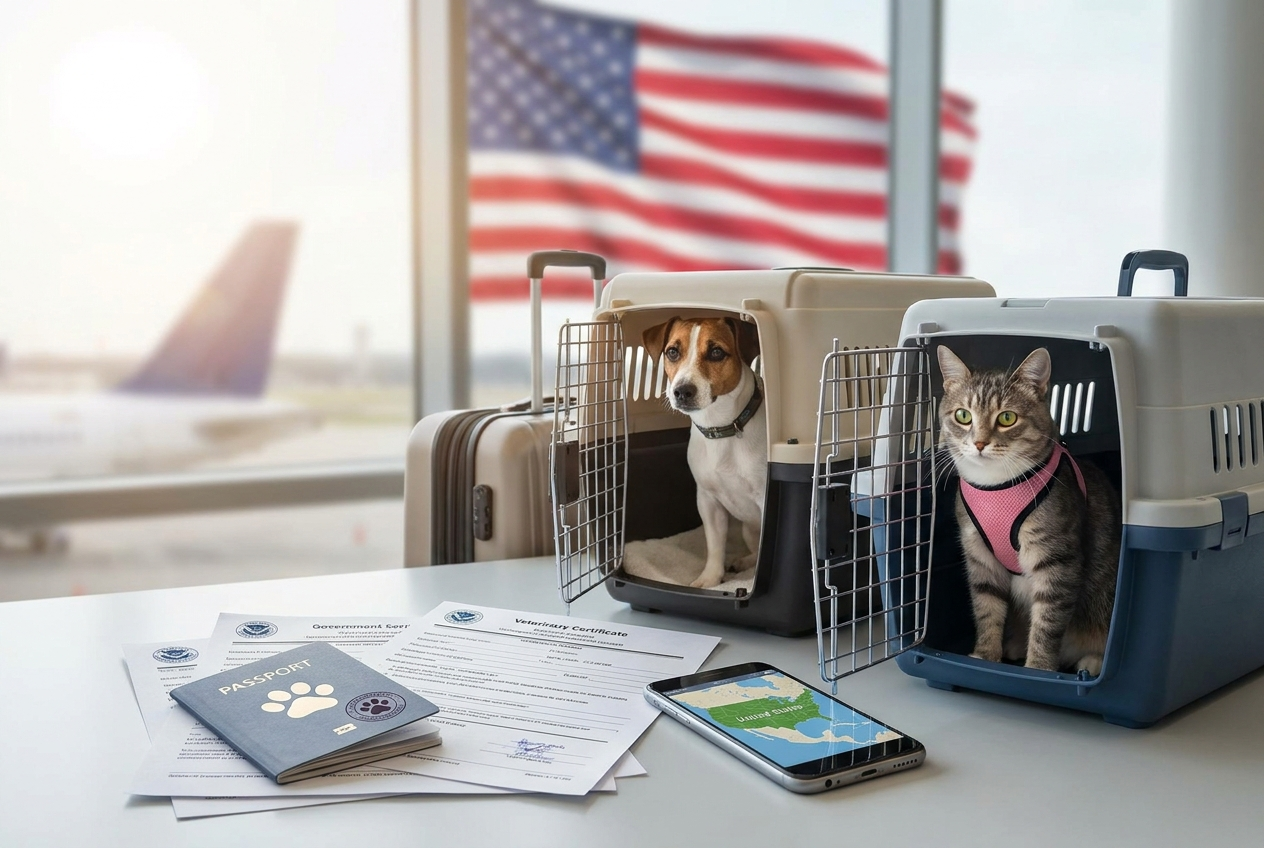
Relocating an animal or vacationing with a pet across United States borders has fundamentally changed. Following sweeping policy overhauls by the Centers for Disease Control and Prevention (CDC), the U.S. has transitioned into a highly standardized, proof-based compliance system designed to permanently eliminate canine rabies variants. The days of casual international pet arrivals with basic veterinary records are over.
Navigating this regulatory environment requires understanding the distinct roles of the CDC, which regulates disease vector control for dogs, and the United States Department of Agriculture’s Animal and Plant Health Inspection Service (USDA APHIS), which manages agricultural biosecurity and livestock protection. US entry rules changed in 2023 and affect dogs from 100+ countries — check your route at PetHolidayClub.com to secure an accurate, personalized timeline before purchasing airline tickets.
Part 1: The New Baseline—Core Requirements for Every Dog
Whether your dog is a small lapdog flying in an airplane cabin or a large dog traveling via manifest cargo, the CDC enforces a strict set of foundational entry rules regardless of the origin country's rabies classification.
1. The Strict 6-Month Age Rule
The U.S. enforces a minimum age requirement of 6 months at the time of border crossing. Puppies under 6 months old are systematically denied entry, even if arriving from a verified rabies-free nation. This age constraint ensures the dog is physically old enough to receive a primary rabies vaccine and complete the necessary biological waiting periods before entering the country.
2. Universal ISO Microchip Compliance
All dogs must be individually identified by a scannable, 15-digit ISO 11784/11785 compliant microchip.
Critical Timing Rule: The microchip must be implanted before or on the exact same day as the primary rabies vaccination. If a dog receives a rabies vaccination prior to being microchipped, that specific vaccine is legally invalid for U.S. customs entry, and the dog must be re-vaccinated after the chip is placed.
3. Submission of the CDC Dog Import Form
Every importer—including returning U.S. citizens—must submit an electronic CDC Dog Import Form online before boarding their flight.
The Receipt: Upon successful submission, the system generates a PDF confirmation receipt.
Presentation: You must present a digital or printed copy of this receipt to your airline during check-in and to U.S. Customs and Border Protection (CBP) officers at the port of entry.
Validity: For low-risk routes, this receipt is completely free and valid for 6 months from the date of issuance, allowing for repeated entries as long as the dog has not visited a high-risk rabies zone in the interim.
  [Implant 15-Digit ISO Microchip] ➔ [Administer Rabies Vaccine]
  ➔ [Wait for Required Validity] ➔ [Submit CDC Online Form] ➔ [Print Receipt for Boarding]
Part 2: Categorization—Low-Risk vs. High-Risk Rabies Pathways
Your primary planning milestone is determining whether your dog has spent any time in a CDC-designated high-risk rabies country during the 6 months prior to its planned arrival in the United States.
                                     [Has your dog been in a High-Risk Country in the last 6 months?]
                                                    /                                \
                                                 YES                                  NO
                                                 /                                      \
                     -----------------------------------------             -----------------------------------
                    /                                         \            | Only requires:                  |
         [U.S.-Vaccinated Dog]                     [Foreign-Vaccinated Dog]        | 1. Minimum age 6 months         |
                  |                                           |            | 2. ISO Microchip                |
     - CDC Import Form Receipt                   - CDC Import Form Receipt         | 3. CDC Import Form Receipt      |
     - USDA-Endorsed U.S. Rabies Form            - Foreign Rabies Cert Form        -----------------------------------
     - Entry via any airport                     - Rabies Titer Test Result
                                                 - Must land at 1 of 6 ACF Airports
Pathway A: Traveling from Dog Rabies-Free or Low-Risk Countries
If your pet has been exclusively located in a low-risk or rabies-free region (such as Western Europe, Canada, or Japan) for the consecutive 6 months prior to travel, your documentation pipeline is streamlined. You generally only need to show the baseline items: proof of age, a matching microchip record on all documents, and the active CDC Dog Import Form receipt.
Pathway B: Traveling from CDC-Designated High-Risk Countries
If your dog has transited or resided in any country on the CDC's active high-risk rabies list within the prior 6 months, the import process branches based on where the animal received its current rabies vaccine.
Scenario 1: The Dog is U.S.-Vaccinated
If your dog was originally vaccinated in the United States by a licensed veterinarian and its booster remains continuously active, it can enter through any international airport. You must present:
The standard CDC Dog Import Form receipt.
A formal Certification of U.S.-Issued Rabies Vaccination form, which must be officially endorsed by USDA APHIS prior to your initial departure from the United States.
Scenario 2: The Dog is Foreign-Vaccinated
If the animal received its rabies vaccine from a non-U.S. veterinarian outside American borders, the regulations are much stricter. You must navigate four critical criteria:
Certification of Foreign Rabies Vaccination and Microchip form: Completed by an authorized official veterinarian in the export country.
The Rabies Titer Blood Test (FAVN): The pet must have a valid blood titer sample drawn at an approved laboratory. The blood must be drawn at least 30 days after the primary rabies vaccination and at least 28 days before entering the United States.
Mandatory 28-Day Quarantine alternative: If the dog does not possess a valid rabies titer result from an approved laboratory, it is subject to a mandatory 28-day quarantine at a CDC-registered facility upon arrival, completely at the owner's expense.
Designated Ports of Entry: Foreign-vaccinated dogs from high-risk countries cannot fly into just any airport. They are legally restricted to landing at one of six designated U.S. airports equipped with a CDC-registered Animal Care Facility (ACF):
Airport Location | CDC-Registered Animal Care Facility (ACF) Provider |
John F. Kennedy International Airport (JFK) | The ARK Pet Oasis |
Los Angeles International Airport (LAX) | Kennel Club LAX / Rue's Kennels |
Miami International Airport (MIA) | Pet Limo |
Hartsfield-Jackson Atlanta International Airport (ATL) | Dandie Scottie Kennel |
Washington Dulles International Airport (IAD) | Pender Pet Retreat |
Philadelphia International Airport (PHL) | Gateway Animal Care Center |
An advanced, paid reservation must be secured at the matching ACF facility prior to booking your airline flight segments.
Part 3: USDA APHIS Mandates—Screwworm & FMD Protocols
While the CDC focuses entirely on rabies vectors, USDA APHIS steps in to enforce secondary health safety restrictions if a dog is arriving from areas known to harbor specific agricultural threats.
1. Screwworm Freedom Certification
If your pet dog is coming from an area or country where screwworm is known to exist (including large portions of South America, Central America, Africa, and the Middle East), it requires specific veterinary screening.
The Timeline: The dog must be thoroughly inspected by an official government veterinarian within 5 days prior to shipment to the U.S.
The Health Statement: You must provide an official export health certificate signed by the originating country's veterinary authority stating that the dog has been inspected and found free of screwworm infestation.
2. Foot-and-Mouth Disease (FMD) Precautions
If a dog is arriving from a nation affected by Foot-and-Mouth Disease (FMD), no separate official certificate form is required, but you must adhere to physical biosecurity protocols upon arrival:
The dog's fur coat, paws, and travel bedding must be completely free of excessive dirt, straw, hay, or organic farm debris.
The pet must be thoroughly bathed immediately upon arriving at its final U.S. destination.
The dog must be kept entirely separate from all domestic livestock for a minimum of 5 days post-entry.
Part 4: State-Level Rules—The Hawaii Quarantine Framework
Passing through federal CDC and USDA entry checks at a U.S. border airport does not grant automatic access to every corner of the country. Individual states retain the constitutional right to enforce localized biosecurity rules. The most prominent example is the state of Hawaii, which remains the only rabies-free state in the nation.
To protect its unique ecosystem, Hawaii bypasses standard federal guidelines and enforces its own strict Rabies Quarantine Program. If you fly a dog directly into Hawaii without completing their unique state protocol, your pet will face an immediate, mandatory 120-day quarantine at an island holding station at your expense.
The 5-Day-or-Less Quarantine Pathway
To bypass the 120-day isolation, pet parents must execute Hawaii's specialized "5-Day-or-Less" checklist well in advance:
Multiple Rabies Vaccines: The dog must have at least two documented rabies vaccinations administered at least 30 days apart in its lifetime.
The Hawaii FAVN Titer Test: A blood sample must be submitted specifically to an approved laboratory (such as Kansas State University or DOD labs). The passing result ($\ge 0.5 \text{ IU/mL}$) must be received by the Hawaii Department of Agriculture at least 30 days prior to arrival.
The Documentation Packet: You must submit a completed Form AHR-2000, original ink-signed health certificates, and full payment of state processing fees at least 30 days before landing.
Direct Airport Release: You must book a flight that lands during designated daytime veterinary inspection hours at Honolulu (HNL), Kahului (OGG), Kailua-Kona (KOA), or Lihue (LIH).
Complete USA Dog Import Checklist
When heading to your departure airport for a flight bound for the United States, ensure you have organized your physical travel binder with these items:
Document Target | Low-Risk Origin Check | High-Risk Origin Check |
CDC Dog Import Form Receipt | Required (Valid for 6 months) | Required (Must match exact route) |
ISO Microchip Number | Required (15-digit scanned verification) | Required (Must match vaccine records) |
Rabies Documentation | Recommended on hand | Required (U.S. Cert or Foreign Cert Form) |
FAVN Titer Lab Report | Not Required | Required (For foreign-vaccinated pets to avoid 28-day quarantine) |
ACF Facility Booking Confirmation | Not Required | Required (For foreign-vaccinated pets landing at designated hubs) |
USDA APHIS Certificates | Only if FMD/Screwworm route applies | Only if FMD/Screwworm route applies |
Summary of Core Requirements
Age Limit: Minimum of 6 months old for all imports, across all global routes.
Microchip Sequence: Microchip must be implanted before the current rabies vaccine is given.
CDC Entry Form: Completely digital, submitted online prior to airport check-in.
Airport Restrictions: Foreign-vaccinated dogs from high-risk zones are legally restricted to 6 specific ACF hub gateways.
State Exceptions: Hawaii maintains independent, strict local quarantine processing rules separate from federal guidelines.
US entry rules changed in 2023 and affect dogs from 100+ countries — check your route at PetHolidayClub.com to quickly configure your mandatory deadlines.
Frequently Asked Questions
What do I need to bring a dog to the United States in 2026?
To bring a dog to the United States in 2026, you must ensure the animal is at least 6 months old, has an ISO-compliant microchip, appears clinically healthy, and has an online CDC Dog Import Form receipt submitted prior to travel. Additional rabies certifications and veterinary check-ins apply if traveling from a high-risk rabies country.
Does the CDC require a rabies titer test for all dogs entering the US?
No. Rabies antibody titer tests are only required for foreign-vaccinated dogs arriving from countries classified as high-risk for dog rabies variants. Dogs coming from low-risk or rabies-free countries do not need a titer test for federal entry.
Can I bring an 8-week-old puppy into the United States?
No. Under current CDC safety regulations, all dogs entering the United States must be a minimum of 6 months old at the time of entry. This age minimum applies universally to all imports, including personal pets from low-risk countries.
What happens if I fly to a non-approved airport with a foreign-vaccinated dog?
If you attempt to land at a non-approved port of entry with a foreign-vaccinated dog coming from a high-risk country, your pet may be denied entry by Customs and Border Protection and returned to the country of origin at your expense. These animals must enter through one of the 6 designated airports with an active Animal Care Facility reservation.
Do cats face the same CDC import restrictions as dogs?
No. These updated CDC import mandates apply specifically to dogs. Cats are not subject to the 6-month age requirement, the CDC Dog Import Form, or mandatory microchip registration under federal CDC rules, though they must still appear healthy on arrival and satisfy individual destination state health requirements.
Frequently Asked Questions
Written by
Anano Gudushauri
SEO & Content Strategy Specialist at Pet Holiday Club