IATA Approved Dog Crate Requirements: The Complete 2026 Guide
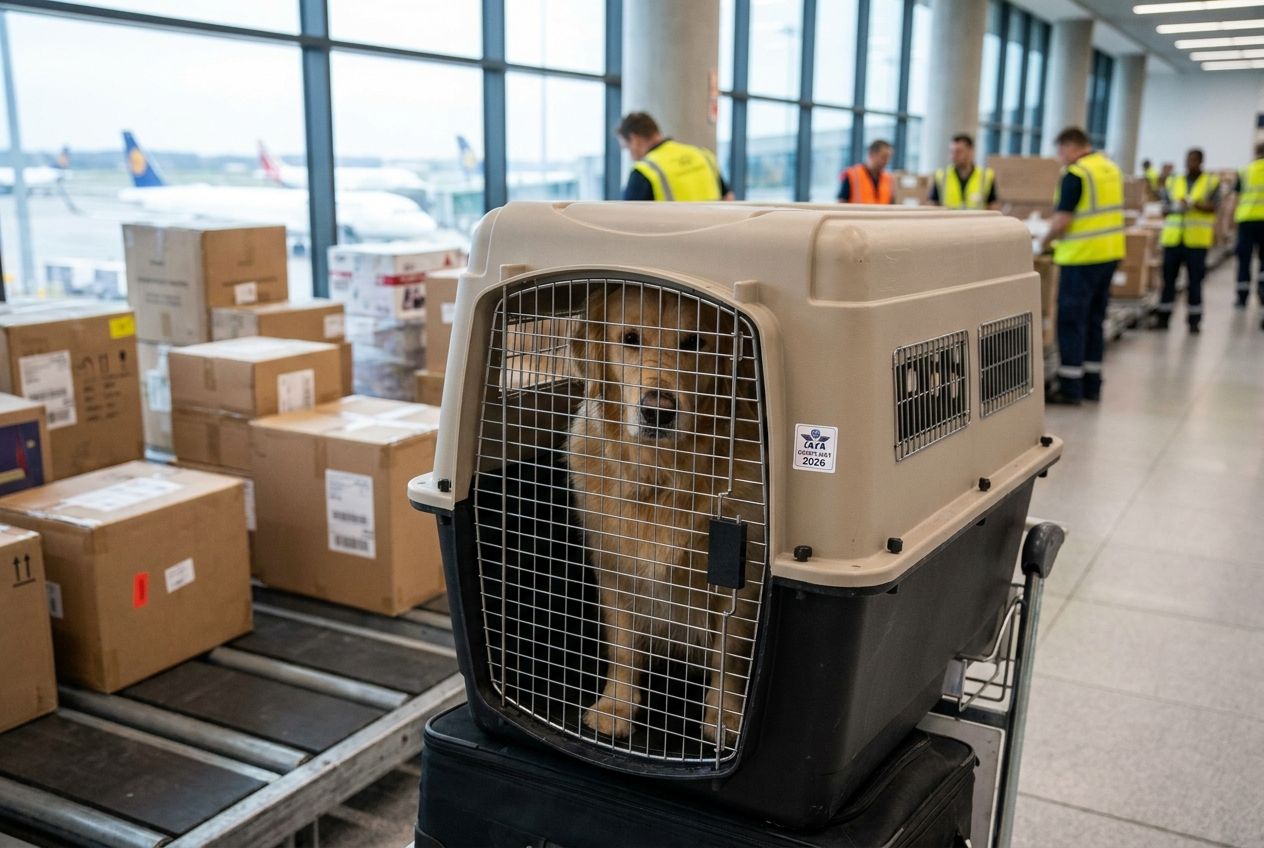
Every year, dogs are turned away at airport check-in for one reason: the wrong crate. Not the wrong documents. Not the wrong vaccinations. The wrong crate. The International Air Transport Association (IATA) sets the global standard for how dogs travel by air - and over 95% of commercial airlines operating today follow the Live Animals Regulations (LAR) of IATA. If your dog's crate doesn't meet these standards, your dog doesn't fly. It's that simple.
This guide covers everything you need to know about IATA approved dog crate requirements for 2026 - from materials and size to ventilation, labelling, and the exact formula for measuring your dog.
What Is an IATA Approved Dog Crate?
An IATA approved dog crate — also called a Container Requirement 1 (CR1) crate — is a travel kennel that meets the structural, spatial, and safety standards set by the International Air Transport Association in their Live Animals Regulations (LAR).
IATA does not legally certify or endorse specific crate brands. What matters is whether your crate meets the written standards — regardless of brand or where you bought it.
IATA Crate Requirements 2026: The Full Checklist
✅ Materials
Your dog's crate must be made of one of the following materials: fibreglass, metal, rigid plastic, welded wire mesh, solid wood, or plywood.
Containers made entirely of welded wire mesh are not suitable and must not be used for air transport. Soft-sided bags are not permitted for cargo travel — only for in-cabin travel.
If your crate is rigid plastic assembled from a top and bottom half, plastic clips alone are not sufficient. Metal nuts and bolts must be used in every hole.
✅ Size
This is where most people get it wrong. Your dog must be able to sit, stand, turn around, and lie down comfortably inside the travel kennel. If a gate agent believes the crate is too small, they will refuse your dog at check-in.
Use the IATA formula to calculate the correct internal dimensions:
Measure your dog:
A = length from tip of nose to base of tail
B = height from ground to elbow joint
C = width across shoulders or widest point
D = height from top of head or ear tip to floor (whichever is higher)
Minimum internal dimensions:
Length = A + ½B
Width = C x 2
Height = D + bedding height
One important note: if you have a snub-nosed (brachycephalic) breed such as a pug, bulldog, or boxer, you will generally need to select the next size larger than the formula indicates. IATA specifically requires a 10% larger container for snub-nosed breeds.
✅ Ventilation
Ventilation is one of the most specific — and most overlooked — requirements. The total ventilated area must be at least 16% of the total surface area of the four sides. Ventilation must be provided on all four sides of the container, with openings placed over the upper two-thirds of the sides.
The whole of one end of the container must be made of welded wire mesh — this is typically the door.
All openings must be nose and paw-proof. For cats and small dogs, a second layer of welded wire mesh may be required.
✅ Door
The door must be constructed of plastic, wood, plywood, or welded/cast metal — strong enough that your dog cannot bend or distort it. For containers with locking pins, the pins must engage the container by at least 1.6 cm.
For rigid plastic crates, the door should be further secured with cable ties at all four corners of the door frame.
✅ Floor and Roof
The floor must be solid and leak-proof. The roof must be solid, though ventilation openings are permitted provided they don't reduce the structural integrity.
✅ Water and Food Bowls
The crate must have two separate dishes — one for food, one for water — attached securely to the inside of the metal door, accessible from the outside so airline staff can refill water without opening the door. Water bottles or dispensers attached outside are not accepted as a substitute for open water containers.
✅ Labelling
A green "Live Animal" label is mandatory on all sides. "This Way Up" labels must be placed on at least two opposite sides. Your contact details and your dog's destination must be clearly marked on the outside of the crate.
✅ Wheels
If your crate has wheels, they must be removed or rendered completely inoperable before travel.
✅ Bedding
Absorbent bedding appropriate for your dog must be provided inside the crate.
In-Cabin vs Cargo: Different Rules
The requirements above apply to dogs travelling in the cargo hold. If your dog travels in the cabin with you, the rules are different:
The container does not need to be rigid
Spacers are not required
Water and food containers are not required
Soft-sided bags are permitted
However, a Live Animal label is still mandatory, and it must not block any ventilation openings.
Can Two Dogs Share a Crate?
Yes — under specific conditions. Two adult dogs of comparable size may share one crate if each weighs no more than 14 kg and they are used to living together. Dogs over 14 kg must travel individually.
For puppies: up to three puppies from the same litter may share a crate if each is under six months old and weighs no more than 14 kg.
What Airlines Check at the Airport
Check-in staff are responsible for ensuring the container meets IATA LAR requirements. If the container does not meet the minimum standards, the animal must not be accepted for travel.
The most common reasons dogs are rejected at check-in:
Crate too small
Soft-sided bag presented for cargo travel
Missing Live Animal stickers
No water bowl attached
Wheels not removed
Plastic clips only — no metal bolts
One Rule to Remember
If your dog cannot comfortably stand up, turn around, and lie down inside the crate — it is too small. Measure your dog before you buy. The formula exists for a reason.
Check Your Full Pet Travel Requirements Before You Fly
Crate compliance is just one part of flying with your dog. Every country has different documentation requirements — health certificates, vaccinations, microchipping standards, import permits — and the rules change constantly.
At Pet Holiday Club, we guide pet owners through the complete requirements for international travel to 190+ countries. Check your destination's full pet travel requirements at petholidayclub.com before you book. 🐾