How to Choose a Private Jet for Pet Travel in 2026: The Complete Buyer's Guide
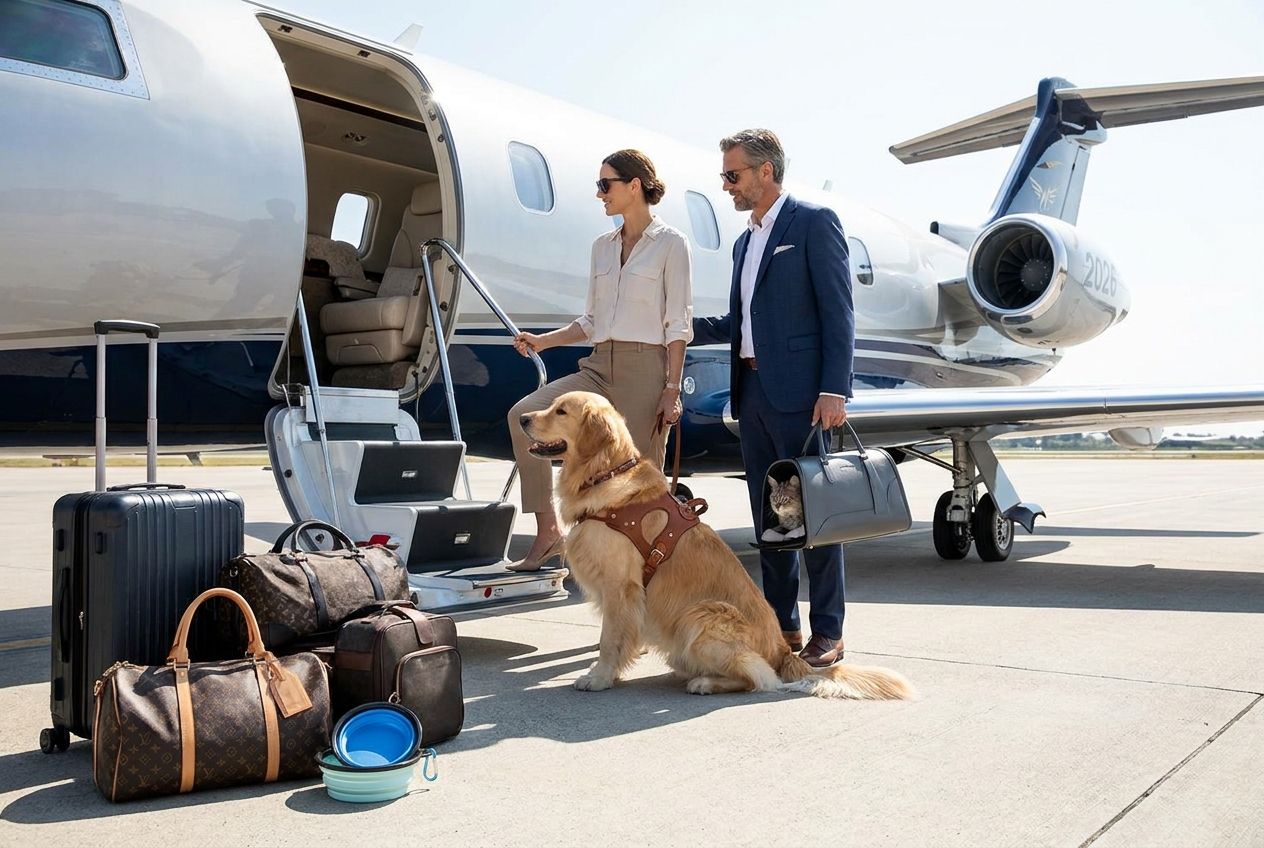
How do I choose a private jet service for traveling with my pet? Evaluate your pet's size, anxiety levels, and your overall budget. For a cost-effective option, choose a shared public charter seat-share broker like K9 JETS or Bark Air ($6,000–$11,000), which allows your dog to stay in the cabin with you. For complete route control, choose a full asset private charter ($40,000–$100,000+).
As commercial legacy carriers continue to restrict checked baggage options and impose lifetime cargo hold bans on large and brachycephalic (flat-faced) breeds, pet parents are turning to private aviation in record numbers. Flying private is no longer just a luxury lifestyle choice—it has become a vital logistical necessity for families looking to relocate safely with their pets without using cargo holds.
The private aviation market offers a wide variety of choices, from accessible pay-by-the-seat public charter brokers to bespoke, full-aircraft charters. No matter which private jet you choose, you'll still need destination-specific health certificates — get yours at PetHolidayClub.com to ensure you pass agricultural customs smoothly. Let's look at a step-by-step framework to help you choose the ideal pet-friendly private jet solution for your journey.
Shared Charters vs. Full Private Charters
Your first and most important decision as a buyer is choosing between a shared public charter seat-share service and a custom, full-aircraft on-demand charter:
Evaluation Metric | Shared Seat-Share Charter | Full On-Demand Private Charter |
Operational Concept | Buy individual seats on a pre-scheduled plane | Rent the entire aircraft exclusively for your party |
Average Entry Price | $6,000 – $11,000 per sector | $40,000 – $100,000+ per flight |
Route Customization | Restricted to high-volume hub corridors | Completely customizable; fly to any airport worldwide |
Scheduling Control | Must align with the broker's calendar | You set the exact date, departure hour, and pace |
Cabin Privacy Level | Shared with other pet parents and dogs | 100% private; only your family and staff are on board |
Pet Seating Model | Rest on floor or adjacent blanketed spaces | Total freedom of movement across the cabin layout |
Part 1: Shared Charters (The Cost-Effective Route)
For many pet parents, spending mid-five to six figures on a single flight is simply out of reach. Shared public charters bridge this gap by dividing the operational cost of a private aircraft across multiple independent ticket buyers.
      [WHO IS SHARING THE PRIVATE CABIN COSTS WITH YOU?]

   +-------------------------------------------------------+
   |  [Buyer Seat 1]   [Buyer Seat 2]   [Buyer Seat 3]     |
   |   Human + Dog      Human + Dog      Human + Dog       |
   +-------------------------------------------------------+
   | === ALL SHARED INSIDE A 10- TO 14-SEAT HEAVY JET ===   |
   +-------------------------------------------------------+
The Market Leaders
The shared private aviation space for pets is currently led by two highly specialized operators:
K9 JETS: Best for travelers seeking a quiet, restful cabin environment. They operate an established schedule of transatlantic sectors using a clear weight tier system.
Bark Air: Designed explicitly around canine sensory enrichment and luxury. Fares include premium car transfers, pheromone-scented towels, and custom in-flight dog treats.
Who Should Choose a Shared Charter?
Shared charters are an excellent choice if you are traveling along heavily serviced routes—such as New York to London or Los Angeles to New York—and your dog is well-socialized enough to share a cabin peaceably with other animals.
Part 2: Full On-Demand Charters (The Ultimate Control Tier)
If you are traveling with multiple large dogs, an unsocialized or highly reactive pet, or need to fly to a location outside standard flight paths, a full on-demand private charter is your best option.
   [Select Departure Airport] ➔ [Pick Exact Tail Number & Aircraft Size]
   ➔ [Design Gourmet Pet Catering] ➔ [Fly Direct to Any Destination Hub]
1. Absolute Scheduling Autonomy
When you rent an entire aircraft, the flight crew adapts completely to your timeline. If your visa paperwork faces a last-minute delay or your pet requires an extra veterinary check before departure, you can adjust the flight time without risking your seats or losing your ticket fare.
2. Complete Privacy and Safety Control
A full charter eliminates the unpredictable behavior of other people's pets. If your dog is reactive, territorial, or easily stressed by other animals, a private cabin lets them travel calmly without the need to navigate interactions with unfamiliar dogs.
3. Choosing Your Aircraft Class
When booking a full charter through a reputable broker, match your itinerary to the right size aircraft:
Light Jets (Phenom 300 / Citation CJ4): Best for short domestic hops under 3 hours with small-to-medium pets.
Midsize/Super-Midsize Jets (Challenger 350 / Citation Latitude): Ideal for transcontinental domestic travel, offering a stand-up cabin and extra floor space for large breeds.
Heavy / Ultra-Long-Range Jets (Gulfstream G650 / Bombardier Global): The gold standard for transatlantic or transpacific relocations, providing maximum cabin space and range.
Part 3: Operational Due Diligence—The Aviation Safety Audit
When you look for a "pet-friendly private jet," remember that safety begins with auditing the actual aircraft operator. Many private aviation options function as charter brokers rather than direct aircraft operators. You must confirm that the company operating the actual flight holds top-tier, independent safety ratings.
                     [AIRCRAFT OPERATOR COMPLIANCE CHECK]

         +--------------------------------------------------------+
         |                                                        |
         |   +-------------------+        +-------------------+   |
         |   |    ARGUS RATING   |        |   WYVERN RATING   |   |
         |   |  Gold, Gold Plus, |        |  Wingman Standard |   |
         |   |    or Platinum    |        |   Certified Status|   |
         |   +-------------------+        +-------------------+   |
         |                                                        |
         |      +------------------------------------------+      |
         |      |  FAA Part 135 Air Carrier Certification  |      |
         |      +------------------------------------------+      |
         +--------------------------------------------------------+
The Essential Third-Party Standards
Never book an aircraft with an operator that has not been thoroughly audited by one of the industry's two premier independent safety organizations:
ARGUS (Aviation Research Group United States): Look for operators holding an ARGUS Gold, Gold Plus, or Platinum rating. A Platinum rating indicates that the company maintains an active Emergency Response Plan and a deeply integrated Safety Management System (SMS).
Wyvern: Look for operators that meet the Wyvern Wingman or Registered standard. This certification guarantees that flight crews exceed minimum FAA pilot-in-command flight hour requirements and undergo regular safety performance tracking.
Crucial Questions to Ask Your Broker
Before wire-transferring funds for a private charter, require your broker to provide written answers to these three critical questions:
“What is the exact FAA Part 135 registration tail number of the aircraft assigned to this itinerary?”
“Does the direct operating carrier hold a current ARGUS Platinum or Wyvern Wingman safety rating?”
“What is the operator's specific liability insurance coverage limit for live animals traveling in the cabin?”
Part 4: Navigating Border Laws and Biosecurity Rules
A common misconception is that booking a private jet allows you to bypass international customs checks and health regulations. This is an operational error that can result in your pet being placed into quarantine.
Private Flights Face Strict Government Inspections: Private aircraft must land at designated Airports of Entry (AOE) where agricultural border agents stand ready to review paperwork. Private travel simplifies terminal logistics, but it does not change biosecurity laws.
   [Select Jet Operator] ➔ [Cross-Reference Destination Border Codes]
   ➔ [Execute Microchip & Rabies Vaccine Sync] ➔ [Secure Endorsed Vet Forms]
International Health Documents Checklist
If you are planning an international flight, make sure your veterinary paperwork adheres perfectly to these essential benchmarks:
ISO 11784/11785 Microchip: Your dog must be microchipped with a 15-digit, non-encrypted chip before or on the exact same day they receive their qualifying rabies vaccination.
The Rabies Timing Rule: Most countries require international travel certificates to be issued at least 21 to 30 days after the primary rabies vaccination is administered.
USDA/DEFRA Government Endorsements: Your digital or physical paperwork must be reviewed and officially endorsed by an authorized government veterinarian (such as the USDA in the United States or DEFRA in the United Kingdom) prior to departure.
No matter which private jet you choose, you'll still need destination-specific health certificates — get yours at PetHolidayClub.com to ensure your paperwork is 100% compliant before you head to the FBO lounge!
Summary Buyer's Decision Roadmap
To help you make the right choice for your upcoming trip, follow this strategic prioritization guide:
Buyer Profile Indicator | Optimal Private Aviation Choice | Key Operational Benefit |
Moving one large dog between major global hubs | Shared Public Charter (e.g., K9 JETS) | Drastically reduces costs compared to full charter while keeping pets out of cargo. |
Traveling with a highly reactive or anxious pet | Full On-Demand Charter (Bespoke) | Guarantees an empty cabin with zero strange animals or loud disruptions. |
Seeking high-touch, sensory-calming amenities | Shared Dog-First Charter (e.g., Bark Air) | Offers specialized pheromone towels and calming treats tailored for anxious dogs. |
Flying an unusual route or to a remote airport | Full Asset Custom Charter (Bespoke) | Allows you to pick your exact departure location, routing, and arrival gateway. |
Frequently Asked Questions
How do I choose a private jet service for traveling with my pet?
Start by evaluating your pet's size, temperament, and your travel routing. If your route connects major hubs and your pet is calm around other dogs, a shared seat-share broker like K9 JETS or Bark Air is an excellent, cost-effective choice. If you are moving multiple large pets or traveling a unique route, look into a full on-demand private jet charter.
What is the average price of a shared private pet flight?
Shared public charter seats typically range from $6,000 to $11,000 one-way per sector. This price generally covers entry for one human passenger and one dog within the operator's specified weight guidelines.
What do ARGUS and Wyvern ratings mean for private aviation?
These are premier, independent third-party safety organizations that audit private aviation companies. An ARGUS Platinum or Wyvern Wingman rating indicates that the direct operator meets rigorous flight safety standards, maintains extensive pilot training records, and runs an active safety management system.
Can my pet fly on a private jet without a cage or crate?
Yes, this is the primary benefit of private travel. On both shared public charters and full private jet rentals, dogs are permitted to relax directly on the cabin floor, on memory foam dog beds, or right on the leather passenger seats with you. They are only required to wear a standard safety leash or travel harness during taxiing, takeoff, and landing.
Do I still need a veterinary health certificate if I fly on a private jet?
Yes. Flying private does not excuse you from international border laws, agricultural checks, or biosecurity guidelines. Your dog must still fulfill all microchipping, rabies vaccination, and official government health certificate endorsements required by your destination country.