How Airlines Calculate Pet Travel Fees in 2026: Every Hidden Cost Revealed
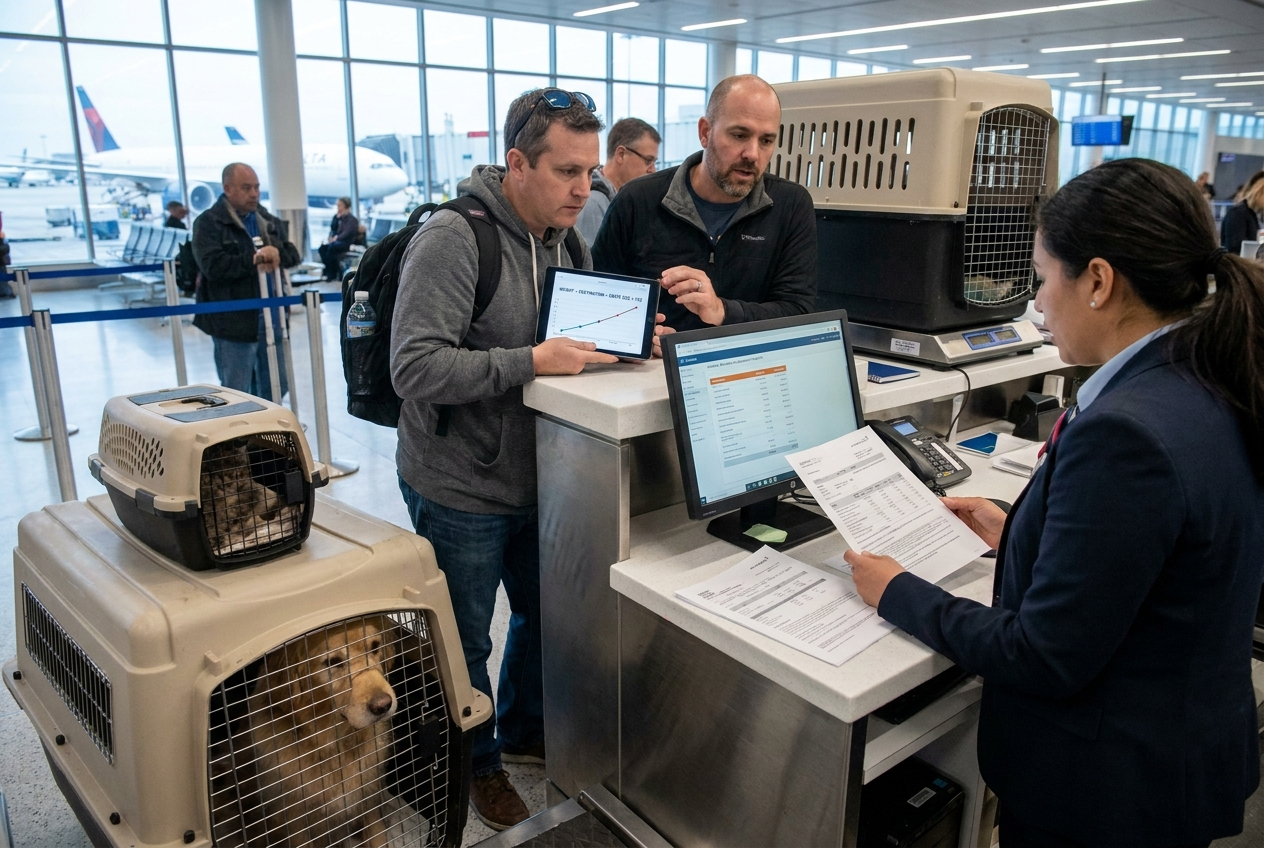
When planning a flight with a dog or cat, most pet parents simply look up the airline’s baseline sticker price, add it to their budget, and assume their planning is complete. This financial oversight can lead to severe sticker shock at the check-in desk. In the aviation industry, the advertised pet fee is only the initial layer of a complex pricing matrix.
From baggage penalty conversions and connection markups to expensive mandatory veterinary endorsements, the actual cost of animal travel can easily double your initial estimates. Knowing the documentation requirements in advance can save you hundreds — plan at PetHolidayClub.com to protect your budget. Let's look at the financial math behind pet travel fees to reveal exactly how much it costs to fly with a pet.
The 2026 Global Airline Fee Index
To show how the world's leading airlines calculate their base pricing, compare our comprehensive operational chart for standard domestic and short-haul international flights:
Airline Name | Base In-Cabin Fee (One-Way) | Baggage Allowance Impact | Hidden Surcharges / Layovers |
JetBlue Airways | $125 | Counts as Personal Item | None |
Delta Air Lines | $150 | Counts as Carry-On OR Personal | Fragmented regional partner limits |
United Airlines | $150 | Counts as Personal Item | +$125 for layovers > 4 hours |
American Airlines | $150 | Counts as Carry-On OR Personal | Hub-specific routing limits |
Alaska Airlines | $100 | Counts as Carry-On OR Personal | Strict multi-segment booking caps |
Southwest Airlines | $95 | Counts as Carry-On OR Personal | Fully non-refundable ticket codes |
Spirit Airlines | $125 | Counts as Carry-On OR Personal | Gate verification processing fees |
KLM Royal Dutch | €125 / $150 | Counts as Carry-On Item | Connection limits at Schiphol |
Lufthansa | €100 – €200 | Counts as Carry-On Item | Volumetric tier pricing on cargo |
Turkish Airlines | Route-Dependent | Evaluated on scales | Excess weight formulas per kg |
Part 1: The Base Ticket—The In-Cabin vs. Cargo Hold Split
The baseline cost of animal air transit is determined by where your pet is positioned on the aircraft.
                  [THE BASE ANIMAL FEE ROADMAP]
                     /                       \
        [In-Cabin Under-Seat]            [Climate-Controlled Hold]
                 |                                   |
         Flat Sector Fees                     Volumetric Weight Matrix
         ($95 - $150 range)                  ($200 - $1,000+ range)
1. In-Cabin Sticker Prices
For small dogs and cats traveling directly under the passenger seat in front of you, airlines charge a flat service fee per one-way segment. In the United States, budget-friendly airlines like Southwest charge around $95, while legacy airlines like Delta, United, and American have set a standard market rate of $150 each way.
2. The Cargo Volumetric Formula
If your animal is too large for the cabin and must travel in a climate-controlled cargo compartment (either as checked baggage or manifest cargo), flat pricing disappears. International airlines like Lufthansa and Turkish Airlines calculate cargo costs using a complex mathematical formula called volumetric weight:
$$\text{Volumetric Weight (kg)} = \frac{\text{Length (cm)} \times \text{Width (cm)} \times \text{Height (cm)}}{5000}$$
Airlines compare this calculated volumetric weight against the actual physical weight of your pet and crate on the scale, and then bill you for whichever number is higher. This explains why a large, lightweight dog inside a roomy plastic crate can still cost over $800 to ship internationally.
Part 2: Hidden Connection Surcharges & Layover Fees
A common mistake travelers make is assuming a single pet ticket covers their entire journey from origin to destination, regardless of flight connections.
The United 4-Hour Rule
United Airlines charges a flat $150 base cabin fee. However, if your flight itinerary includes a connecting layover that exceeds 4 hours on domestic routes (or 24 hours on international flights), United automatically assesses an additional $125 surcharge. This operational penalty covers the gate agent's secondary verification tracking and handles logistics across their connection terminals.
The Multi-Segment Trap
For domestic low-cost carriers like Southwest or Spirit, if your route requires a change of planes that forces a manual check-out and re-check past security lines, agents may charge you a separate base fee for each individual flight segment. A multi-stop trip across the country can quickly turn a $95 fee into a $190 double-charge at the transfer counter.
Part 3: The Baggage Penalty Paradox
When calculating the cost of pet travel, you must account for the indirect fees triggered by your airline's baggage policies.
       [DOES YOUR AIRLINE PENALIZE YOUR CARRY-ON ALLOTMENT?]
                            /          \
                         YES            NO
                         /                \
        [Delta, American, Spirit]     [United Airlines, JetBlue]
         - Pet carrier replaces        - Pet carrier is Personal Item.
           your suitcase.              - Keep your rolling carry-on.
         - Must pay $35-$45 to check   - Save on checked bag fees.
           your regular clothes bag.
The Personal Item Exemption (United & JetBlue): These airlines classify your pet carrier as your singular under-seat personal item. This means you can still bring a standard rolling suitcase for the overhead bin completely free of charge.
The Carry-on Swap (Delta, American, Alaska): These airlines rule that your pet carrier counts as your entire primary carry-on luggage allowance. Because you cannot fit your clothing under the seat alongside a pet, you are forced to check your standard suitcase into the cargo hold, adding an extra $35 to $45 each way in baggage fees to the cost of your trip.
Part 4: Mandatory Veterinary & Documentation Fees
The fees you pay directly to the airline are often small compared to the costs required to clear government agriculture checkpoints.
   [ISO Microchip: $50-$75] ➔ [Rabies Booster: $40-$60]
   ➔ [USDA Health Cert Exam: $150-$300] ➔ [USDA Digital Endorsement: $38-$150]
1. Domestic Health Certificates
Even for simple domestic travel within the United States, states like California, Florida, and Hawaii require an official Certificate of Veterinary Inspection (CVI). A licensed veterinarian must examine your pet within 10 days of travel to confirm they are free of infectious diseases.
Clinic Exam Cost: $75 to $150
CVI Processing Fee: $50 to $100
2. International Endorsement Fees
If you are flying to Europe or the United Kingdom, standard clinic forms are not enough. You must secure a comprehensive international health certificate that requires an official electronic endorsement from the USDA APHIS department.
USDA Portal Endorsement Base Fee: $38 (for a single animal on a standard rabies-validated route).
Complex Route Endorsement Fee: Up to $150+ if your destination country requires intensive testing for diseases like Brucellosis, Leishmania, or specific tapeworm treatments.
Part 5: Structural Gear—The Airline-Compliant Equipment Cost
You cannot use just any standard pet carrier from a local store. If your equipment fails to meet your carrier's strict parameters, you will be forced to buy expensive replacement gear at the airport gift shop or risk missing your flight.
1. In-Cabin Soft Carrier Requirements ($40 – $100)
Airlines mandate that soft-sided carriers feature leak-proof waterproof bottom pads, at least three open panels of ventilated mesh, and secure, lockable zippers. High-quality, airline-approved brands like Sherpa or SturdiProducts generally cost between $40 and $100.
2. Cargo-Compliant Crate Engineering ($150 – $400)
If your pet flies in the cargo hold, the structural mandates under IATA Live Animals Regulations (LAR) Container Requirement 1 are very strict. Your crate must feature:
Rigid plastic or wood construction with metal hardware bolts holding the top and bottom shells together (plastic snap-latches are banned).
A solid metal door with a secure, multi-point locking mechanism.
Water and food bowls secured directly to the interior metal wire grid, accessible from the outside without opening the door.
A layer of absorbent bedding material covering the entire solid floor footprint.
Buying an IATA-compliant heavy-duty travel crate for a large dog typically costs between $150 and $400, depending on the size classification (Intermediate Series 300 to Giant Series 500).
Real-World Math: The True Cost Case Study
To see how these hidden fees accumulate, look at this realistic budget projection for a passenger flying a 25-pound dog from New York (JFK) to Los Angeles (LAX) on a round-trip itinerary using a legacy airline:
Line Item Expense | Advertised Estimate | True Real-World Cost |
Airline Base Pet Fee (Round-Trip) | $300.00 | $300.00 |
Baggage Penalty Fees (Checked Suitcase) | $0.00 | $70.00 |
Veterinary Clinical CVI Exam | $0.00 | $120.00 |
Airline-Approved Carrier Upgrade | $0.00 | $65.00 |
Airport Pet Relief Point Gratuities / Surcharges | $0.00 | $20.00 |
TOTAL OUT-OF-POCKET EXPENSE | $300.00 | $575.00 |
Summary Timeline of Financial Milestones
30 Days Before Flight: Invest in an airline-compliant travel carrier ($40–$100) to allow your pet time to acclimate.
10 Days Before Flight: Secure your clinical veterinary health check and CVI form certification ($125–$250).
At Booking Check-Out: Lock in your airline’s flat base pet reservation fee ($95–$150) to protect one of the limited animal slots on the plane.
At Airport Desk: Pay any unexpected checked luggage fees if your carrier replaces your carry-on allowance ($35–$45).
Knowing the documentation requirements in advance can save you hundreds — plan at PetHolidayClub.com to protect your wallet and ensure a smooth journey.
Frequently Asked Questions
How much does it cost to travel with a pet in 2026?
The baseline airline fee ranges from $95 to $150 one-way for small pets traveling in the passenger cabin. For larger dogs traveling via the cargo hold, costs vary between $200 and over $1,000, depending on the crate's volumetric dimensions and the overall distance of the route.
Why do some airlines charge a layover fee for pets?
Airlines like United charge an extra layover fee (an additional $125 for stops longer than 4 hours) to cover the logistical costs of tracking animals during connections, managing gate capacity, and ensuring ground crews verify animal welfare across their terminals.
Does a pet carrier replace my standard carry-on luggage?
On Delta, American, Spirit, and Alaska Airlines, yes. Your pet carrier counts as your primary carry-on item, which forces you to check your standard suitcase for an extra fee. On United and JetBlue, the carrier counts as your small personal item, allowing you to bring an overhead rolling bag for free.
How much does a USDA international health certificate endorsement cost?
The direct USDA portal electronic endorsement fee starts at a flat rate of $38 for standard, single-animal entries into low-risk regions like the EU. However, veterinary clinical exams, microchipping, and diagnostic blood work can easily add $200 to $500 in clinic charges before submission.
Are emotional support animals exempt from these travel fees?
No. Under current Department of Transportation (DOT) guidelines, emotional support animals (ESAs) are classified as standard companion pets. They must comply with all standard size limits, weight restrictions, and pay the same one-way travel fees as any other pet. Only fully trained, task-specific service dogs are exempt from airline pet fees.
Frequently Asked Questions
Written by
Anano Gudushauri
SEO & Content Strategy Specialist at Pet Holiday Club