Hawaii Pet Travel 2026: The Quarantine-Free Pathway & What It Actually Requires
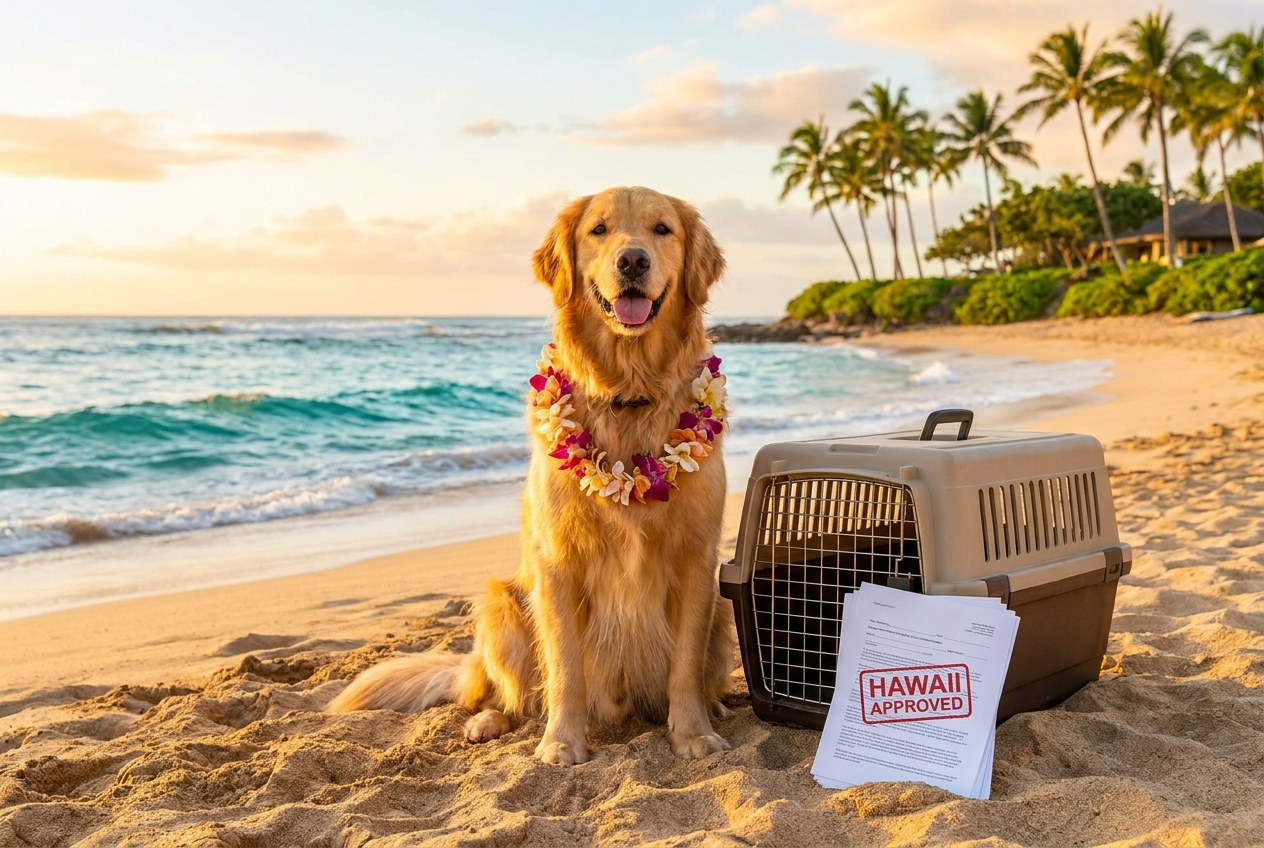
Hawaii is a stunning paradise of volcanic peaks, lush rainforests, and world-famous surf breaks, making it a dream destination for relocating families and long-term travelers. But if you plan to bring your dog or cat along to share in the island life, you have to face a very unique legal landscape. Geographically isolated in the middle of the Pacific Ocean, Hawaii is the only state in the U.S. that has successfully maintained a rabies-free status. To protect this fragile ecosystem, the Hawaii Department of Agriculture (HDOA) enforces an exceptionally strict animal import screening program.
If you arrive without preparation, your pet will be subjected to a devastating, mandatory 120-day facility quarantine at a state-run kennel in Halawa Valley, costing you thousands of dollars and months of separation. Fortunately, Hawaii provides an alternative track: the Direct Airport Release (DAR) and 5-Day-or-Less programs. This allows healthy pets with verified medical records to completely bypass isolation and head straight to the beach with you. However, this pathway has strict timing requirements — start your 6-month preparation at PetHolidayClub.com to ensure your paperwork is flawless. Let’s break down exactly what this pathway requires this year.
The Core 2026 Hawaii Pet Import Framework
To bypass the baseline 120-day isolation period, your pet must clear several high-stakes veterinary and administrative thresholds:
Import Metric | Direct Airport Release (DAR) Protocol Requirements |
Baseline State Quarantine | 120 Days (Fully waived only if DAR milestones are met flawlessly) |
Microchip Requirement | 15-digit ISO 11784/11785 standard (Must be read before any testing) |
Rabies Vaccine History | Minimum 2 lifetime shots (Given more than 30 days apart) |
Blood Titre Requirement | FAVN Test only (Result must be $\ge 0.5\text{ IU/mL}$) |
Post-Titre Waiting Window | 90 Days mandatory stand-down from laboratory receipt date |
Approved Ports of Entry | Honolulu (HNL), Kahului (OGG), Kona (KOA), Lihue (LIH) |
Part 1: The Chronological Medical Blueprint
Hawaii’s import protocol is entirely dependent on a strict chronological sequence. If a veterinarian performs these steps out of order, your paperwork will be voided by state inspectors.
   [1. Verify/Implant ISO Chip] ➔ [2. Rabies Vaccine #1] ➔ [3. Rabies Booster #2 (30+ Days Later)]
   ➔ [4. FAVN Blood Draw] ➔ [5. Mandatory 90-Day Wait Clock Starts]
1. The Microchip Foundation
Your pet must be identified by a 15-digit microchip that complies with ISO Standards 11784 or 11785. Your veterinarian must physically scan and record this microchip number prior to or on the exact day that any rabies vaccinations or blood draws occur. If a vaccine predates the documented microchip implantation date, HDOA will reject that vaccine.
2. The Two-Vaccine Rule
Your pet must have an official lifetime history of at least two rabies vaccinations using OIE-approved killed or recombinant viral products.
The second booster shot must be administered at least 30 days after the primary shot.
The most recent rabies booster must be active and given within the manufacturer’s designated coverage window (1-year or 3-year labels are both accepted), but it must be administered at least 30 days before your flight landing date.
3. The FAVN Blood Titre Test
Once the two-vaccine foundation is established, your veterinarian must draw a blood sample for a Fluorescent Antibody Virus Neutralization (FAVN) test. Hawaii only accepts samples processed by three authorized institutions: Kansas State University (KSU), Auburn University, or the U.S. Military Food Analysis and Diagnostic Laboratory.
To pass, your pet’s blood serum must register an antibody level of at least $0.5\text{ IU/mL}$.
Part 2: Navigating the Mandatory 90-Day Stand-Down
Achieving a passing score on the FAVN test does not mean you can immediately board a flight to the islands. This is where many pet parents encounter costly logistical delays.
   [Lab Receives Blood Sample] ➔ [Mandatory 90-Day Wait Period Instantly Begins]
                                           │
         +---------------------------------+---------------------------------+
         |                                                                   |
   ARRIVE BEFORE DAY 90                                             ARRIVE ON OR AFTER DAY 90
   - Pet is legally disqualified from DAR.                         - Pet qualifies for Direct Release.
   - Forced quarantine at $14.30/day until day 90.                  - Clears customs inside airport terminal.
   - High administrative penalty fees apply.                        - Total freedom on landing day.
The moment the authorized laboratory receives your pet’s blood sample, a mandatory 90-day post-titre waiting clock begins.
Arriving Early: If you land in Hawaii before this 90-day window has completely expired, your pet is legally disqualified from immediate airport release. They will be taken by state handlers and held at the Halawa Valley Quarantine Station, charging you a daily rate of roughly $14.30 per day until the 90-day countdown officially ends.
The Validation Window: Your pet's passing FAVN test results remain valid for exactly 36 months from the date the blood was drawn.
Part 3: The Pre-Arrival Paperwork Pipeline
Exactly 30 days before your travel date, you must physically mail your complete application packet to the Animal Quarantine Station in Honolulu via certified mail.
Your document package must include:
Completed Form AQS-279 (Dog and Cat Import Form), which must be formally notarized.
An official cashier's check or money order covering the state processing fees ($185 for Direct Airport Release, or $244 for the 5-Day-or-Less track).
Hard copies of your pet's two official rabies vaccination certificates signed by an accredited veterinarian.
A completed Form AQS-73 or a comprehensive veterinary health summary detailing your pet's microchip scanning history.
Important Tick Treatment Window: Within 10 days of your flight departure, your pet must visit an accredited vet for a physical final checkup and a mandatory application of an approved, long-acting external parasite treatment (such as Frontline or Revolution). The specific product name and application date must be explicitly written on the final health certificate.
Part 4: The Island Arrival and Airport Clearance Guide
Clearing biosecurity smoothly in Hawaii depends on your flight routing and your arrival time at the terminal.
                      [HAWAII ISLAND ARRIVAL CLEARANCE]
                                       |
         +-----------------------------+-----------------------------+
         |                                                           |
   HONOLULU AIRPORT (HNL) ARRIVALS                             OUTER ISLAND DIRECT ARRIVALS
   - Head to Airport Quarantine Facility.                     - Must secure an Neighbor Island Inspection Permit.
   - Open daily from 8:00 AM to 5:00 PM.                     - Requires hiring an approved private contractor vet.
   - Land by 3:30 PM to guarantee same-day DAR.              - Fly direct into OGG, KOA, or LIH.
1. Landing at Daniel K. Inouye International Airport in Honolulu (HNL)
Honolulu remains the primary, centrally integrated portal for pet arrivals. Once you step off your flight, airline personnel will transport your pet directly to the Airport Animal Quarantine Holding Facility (located near the E gates across from the main terminal).
The facility is staffed daily from 8:00 AM to 5:00 PM. However, because inspecting documentation, scanning microchips, and examining your pet for ticks takes significant time, you must land by 3:30 PM to guarantee same-day release. If your flight lands after 3:30 PM, your pet will spend the night at the airport facility and will be released the following morning.
2. Landing via Neighbor Island Direct Flights (OGG, KOA, LIH)
If you want to fly directly into Maui, Kona, or Kauai without stopping in Honolulu, you must navigate an extra layer of bureaucracy:
You must submit your application materials at least 30 days in advance to request a specialized Neighbor Island Inspection Permit.
Because outer island airports do not maintain full-time, state-run pet isolation facilities inside their terminals, you are legally required to independently contract an HDOA-approved private local veterinarian. This contractor must meet you at your arrival gate to perform the microchip verification and tick examination right on the tarmac.
Step-by-Step Hawaii Journey Roadmap
Keep your veterinary milestones completely aligned using this 6-month operational timeline:
Planning Phase Timeline | Required Action Milestone Checkpoint | Strategic Biosecurity Purpose |
180 Days Before Flight | Scan the 15-digit ISO microchip and administer the primary rabies vaccine shot. | Establishes the legally verified medical foundation required by the state. |
150 Days Before Flight | Return to your vet to administer the secondary rabies booster shot (minimum 30 days after the first). | Satisfies the mandatory lifetime two-dose requirement for rabies immunization. |
120 Days Before Flight | Complete the FAVN blood draw and have your clinic rush the sample to an approved laboratory (e.g., KSU). | Verifies your pet's rabies antibody levels are at or above the passing $0.5\text{ IU/mL}$ threshold. |
90 Days Before Flight | Track the official lab receipt date to launch your mandatory 90-day stand-down period. | Bypasses the 120-day state facility quarantine by waiting out the biosecurity clock at home. |
30 Days Before Flight | Mail your notarized application, fees, and vaccine certificates to the Honolulu AQS office. | Provides state inspectors ample time to pre-verify your documentation in their master registry. |
Within 10 Days of Flight | Complete your final vet health exam and apply a topically approved, long-acting tick treatment. | Prevents invasive external parasites from breaching Hawaii's fragile island ecosystem. |
Flight Arrival Day | Touch down before 3:30 PM at an approved terminal to complete your microchip scan and walk out free. | Grants immediate Direct Airport Release, avoiding overnight stays at the holding facility. |
Hawaii's pathway has strict timing requirements — start your 6-month preparation at PetHolidayClub.com to coordinate your paperwork perfectly.
Frequently Asked Questions
How do I avoid Hawaii pet quarantine in 2026?
You must follow the strict Direct Airport Release track. This requires verifying a 15-digit ISO microchip, documenting at least two rabies vaccines given 30+ days apart, achieving a $0.5\text{ IU/mL}$ or higher score on a FAVN blood titre test, completing a 90-day waiting period at home, and submitting your notarized paperwork 30 days before you fly.
What happens if my flight arrives in Honolulu after 4:00 PM?
Because inspections and microchip verifications require significant processing time, the airport facility stops clearing pets for immediate release at 3:30 PM. If your plane lands later in the afternoon or evening, your pet will spend the night in a clean, secure kennel at the HNL airport facility and will be released to you the following morning.
Can my pet fly in the passenger cabin on flights directly to Hawaii?
Yes, but this is entirely dependent on your chosen airline’s corporate pet policies. While several major domestic carriers allow small cats and dogs to fly in the cabin to mainland destinations, they often restrict in-cabin travel on long-haul routes to Hawaii due to biosecurity gate setups. Be sure to confirm cabin availability with your airline before booking your flight ticket, or consider a private jet charter for seamless cabin access.
What happens if my pet's FAVN test result is below 0.5 IU/mL?
A score below $0.5\text{ IU/mL}$ is considered a failing result by the state of Hawaii. If this occurs, your pet will not qualify for the Direct Airport Release pathway. You will need to administer another rabies booster shot, wait at least 30 days for their immune system to respond, draw a new blood sample, and pay to have it re-tested by an authorized lab.
Are there any specific dog breeds banned from entering Hawaii?
Hawaii does not enforce a broad, breed-specific ban on purebred domestic dogs. However, the state strictly prohibits wild animal hybrids, meaning any wolf-dog hybrids or cross-bred wild cats (such as early-generation Savannah or Bengal cats) are completely banned from entering or living in the state.
Frequently Asked Questions
Written by
Anano Gudushauri
Pet Holiday Club