Hardest Countries to Enter With a Pet in 2026: Australia, New Zealand, Japan & More
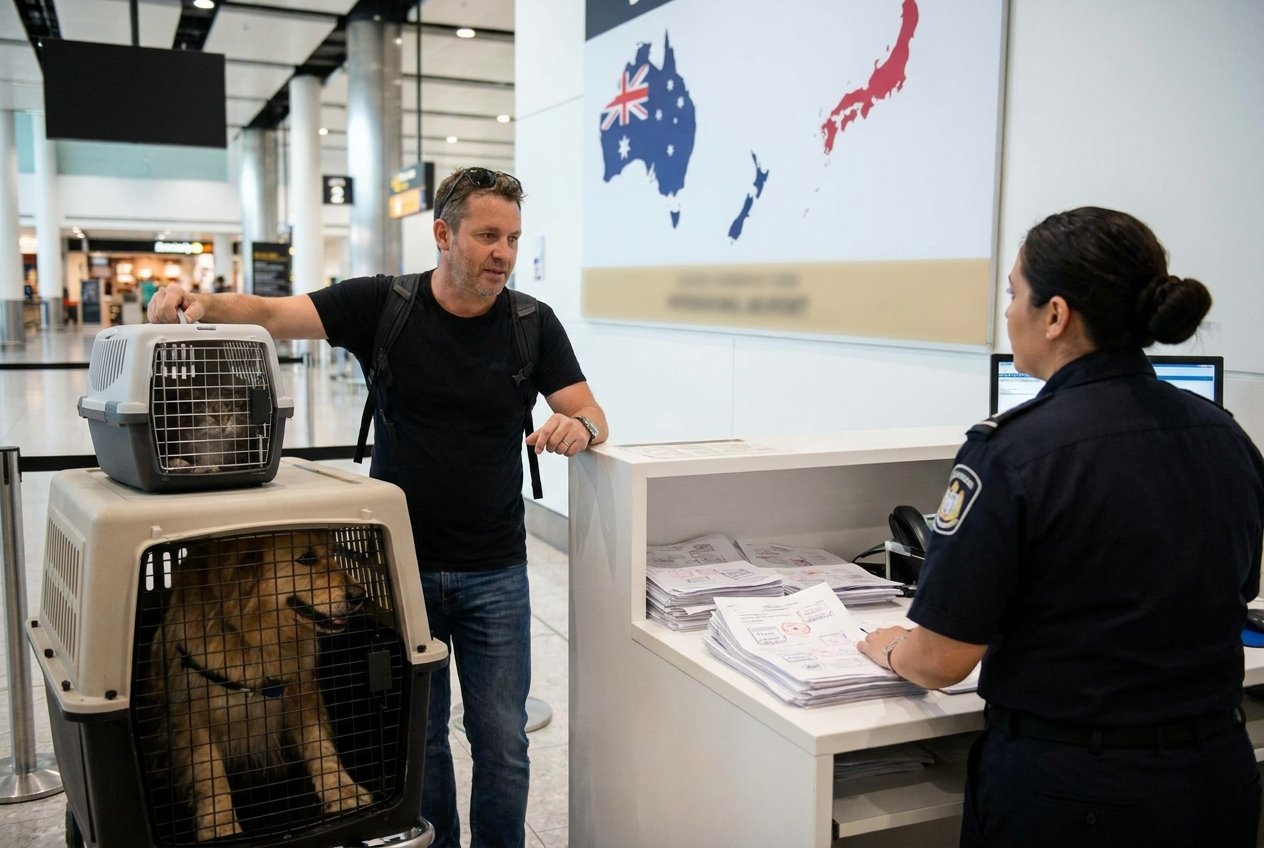
For modern pet parents, international relocation or long-term travel with a companion animal is an incredibly exciting milestone. However, crossing international borders with a dog or cat involves navigating a complex web of global biosecurity frameworks. While moving a pet between continental European nations can be as simple as updating an electronic passport, entering certain regions requires an intense, multi-month logistical operation.
The common denominator among the world's most difficult destinations is geographic isolation. Island nations that are legally recognized as rabies-free enforce incredibly strict preventative defenses to safeguard their native wildlife and agricultural sectors from external viral exposure. A single clerical error, an unapproved laboratory stamp, or an incorrectly timed vaccine will result in your pet being denied boarding at the origin airport, facing immediate deportation, or undergoing forced extension of high-cost government quarantine. Check your destination's difficulty score and required timeline at PetHolidayClub.com to secure your timeline early. Let's break down the most challenging pet travel destinations in 2026.
The 2026 Global Pet Entry Difficulty Index
Our proprietary difficulty index scores destinations across four core vectors out of 25 points: Timeline Lead Time, Financial Relocation Cost, Documentation Complexity, and Quarantine Severity. A higher score represents a more challenging entry barrier:
Rank | Destination Jurisdiction | Lead Time Score (25) | Financial Cost (25) | Documentation (25) | Quarantine Severity (25) | Total Difficulty Score (/100) |
1 | 🇦🇺 Australia | 25 | 25 | 25 | 24 | 99 |
2 | 🇳🇿 New Zealand | 25 | 25 | 24 | 24 | 98 |
3 | 🇯🇵 Japan | 25 | 21 | 23 | 12 | 81 |
4 | 🇸🇬 Singapore | 22 | 22 | 22 | 15 | 81 |
5 | 🇮🇸 Iceland | 24 | 23 | 21 | 13 | 81 |
6 | 🇺🇸 Hawaii (US State) | 20 | 18 | 21 | 14 | 73 |
7 | 🇬🇧 United Kingdom | 15 | 18 | 20 | 10 | 63 |
Deep-Dive Analysis of the Most Restrictive Biosecurity Zones
   [Rank 1-2: The Australasian High-Quarantine Tier] ➔ Mandatory 10-Day Minimum Facility Stays
   [Rank 3-5: The 180-Day Structural Wait Zones] ➔ Heavy Up-Front Laboratory Milestones
   [Rank 6-7: Strict Isolated Island Outliers] ➔ Island Rules Requiring Precise Parasite Clearance
1. Australia (Difficulty Score: 99/100) — The Ultimate Biosecurity Fortress
The Department of Agriculture, Fisheries and Forestry (DAFF) enforces what is universally recognized as the most demanding pet import protocol on earth. Because mainland Australia has successfully kept out rabies and several exotic tick-borne pathogens, their border screening is legendary for its strictness.
The Preparation Runway: If you are importing a dog or cat from a listed country like the United States or Canada, you must begin the physical preparation path at least 180 days before travel. This runway centers around the mandatory Rabies Neutralising Antibody Titre Test (RNATT).
The Quarantine Reality: All dogs and cats entering Australia—excluding those directly coming from New Zealand—must complete a mandatory minimum 10-day stay at the state-of-the-art Post-Entry Quarantine (PEQ) facility located in Mickleham, Melbourne. Booking slots at Mickleham must be secured months in advance, and the base cost for a single pet routinely exceeds $2,500 AUD, excluding shipping and third-party veterinary testing fees.
2. New Zealand (Difficulty Score: 98/100) — Zero Tolerance for Pathogens
Right alongside its neighbor, New Zealand’s Ministry for Primary Industries (MPI) operates an elite-tier biosecurity checkpoint to protect its unique, isolated island ecosystem.
Strict Document Audits: New Zealand requires explicit internal testing for complex canine conditions, including Babesia gibsoni, Brucella canis, Dirofilaria immitis (Heartworm), and Leishmania infantum. MPI custom officers inspect veterinary lab reports meticulously; a single illegible signature or a date mismatch can cause immediate entry refusal.
Quarantine Infrastructure: Like Australia, pets must enter via a mandatory minimum 10-day facility quarantine at an MPI-approved private station. When combined with mandatory manifest cargo flight routing, relocating a dog to New Zealand generally requires a financial investment of $5,000 to $10,000 USD per pet.
3. Japan (Difficulty Score: 81/100) — The 180-Day Chronological Puzzle
Japan's Animal Quarantine Service (AQS) is world-renowned for its hyper-precise chronological rule compliance. Japan does not compromise on its step-by-step framework.
The Chronological Trap: Your pet must receive their 15-digit ISO microchip first, followed by a primary rabies shot, followed by a booster rabies shot, and then a blood draw for an approved FAVN rabies titre test. The day the lab draws the blood marks the official start of a mandatory 180-day stay-home waiting window.
The Consequence: If your pet arrives in Tokyo (HND/NRT) even one single day before that 180-day countdown has fully expired, they will be taken by customs and placed inside an AQS airport kennel facility for the remaining balance of the days at your expense.
4. Singapore (Difficulty Score: 81/100) — Multi-Tier Category Sorting
The National Parks Board (NParks) and Animal & Veterinary Service (AVS) of Singapore carefully sort importing nations into specific Risk Categories (A, B, C, and D) based on local disease prevalence.
Category Constraints: For individuals moving from Category C or D nations (which includes the United States and large portions of Europe), pets are subject to strict mandatory quarantine bookings at the Sembawang Animal Quarantine Station (SAQS).
Space Limitations: Due to the massive influx of corporate expats moving to Singapore, open spots at SAQS are notoriously difficult to secure during peak moving months, often forcing families to delay their career relocations for up to half a year.
                        [MID-TIER STRICT ENTRY ANALYSIS]
                                       |
         +-----------------------------+-----------------------------+
         |                                                           |
   ICELAND & HAWAII                                           UNITED KINGDOM
   - Total geographical isolation protocols.                  - Zero internal rabies tolerances.
   - Heavy focus on tick/tapeworm windows.                    - Strict manifest cargo routing required.
   - Multi-week import permits are mandatory.                 - Streamlined only for active EU Passports.
5. Iceland (Difficulty Score: 81/100) — North Atlantic Isolation
The Icelandic Food and Veterinary Authority (MAST) maintains strict control over animal imports to preserve the unique health status of Iceland's domestic livestock and equine populations, which have been isolated for centuries.
The Entry Window: Iceland only opens its borders for pet imports during highly specific operational windows each month.
Quarantine Mandate: All arriving pets must spend a mandatory 2 weeks in isolation at an approved government facility located near Keflavík International Airport (KEF). This isolation cannot be waived or reduced, regardless of your origin country.
6. Hawaii (Difficulty Score: 73/100) — The United States Archipelago Outlier
While Hawaii is an official US state, it is the only island archipelago in the nation that remains completely free of rabies. Because of this, it completely bypasses standard domestic airline travel rules.
The Direct Airport Release (DAR) Pipeline: To bypass a harrowing 120-day state facility quarantine, pet owners must target the highly technical Direct Airport Release path. This requires completing two active rabies vaccines, an official microchip scan, and an early FAVN blood titre test.
Arrival Mechanics: The final documentation package must physically arrive at the Animal Quarantine Station in Honolulu at least 30 days before landing. Pets must land specifically at Daniel K. Inouye International Airport (HNL) during designated daytime inspection hours to secure immediate release from the airport.
7. United Kingdom (Difficulty Score: 63/100) — The Commercial Manifest Cargo Rule
While post-Brexit changes mean the United Kingdom has transitioned away from the unified EU Pet Passport framework for incoming non-EU citizens, it maintains incredibly strict maritime island biosecurity walls.
The Cargo Monopolization: Unlike mainland Europe, where pets can fly inside the cabin with their owners, the UK legal code dictates that all pets entering via commercial aviation must arrive strictly as Manifest Cargo under a commercial airway bill.
The Financial Barrier: This layout effectively bans the use of standard in-cabin or checked baggage travel methods on flights into London (LHR/LGW). Flying a pet into the UK as cargo routinely adds $1,500 to $3,000 USD in airline cargo handling fees, pushing many premium travelers to choose private jet charters to safely skirt this restriction.
Technical Order of Operations for High-Difficulty Entry
To prevent entry denials or quarantine stays, your veterinary clinic must execute every medical milestone in a flawless chronological sequence:
  [Step 1: 15-Digit ISO Microchip] ➔ [Step 2: Rabies Vaccine #1] ➔ [Step 3: Rabies Booster #2]
                                                                          │
  [Step 6: Import Permit Approval] ⮘ [Step 5: 180-Day Stand Down] ⮘ [Step 4: FAVN Blood Draw]
ISO Microchip Placement: The 15-digit microchip must be verified and scanned before any medical treatments begin.
Primary Rabies Vaccination: Administered immediately following successful microchip validation.
Rabies Booster Injection: Typically given 30 days after the primary shot to build a robust antibody response.
FAVN Blood Titre Draw: Blood must be drawn at least 30 days after the booster and processed by an authorized government laboratory (such as Kansas State University or Rabies Laboratory UK).
The Stand-Down Window: The official wait clock (ranging from 90 to 180 days depending on your destination) begins the exact day the blood is drawn.
Import Permit Acquisition: Apply for your formal government clearance papers using your passing laboratory reports.
Operational Roadmap for Strict Border Clearances
Keep your long-term planning milestones aligned with this comprehensive checklist:
Planning Phase Timeline | Required Action Milestone Checkpoint | Strategic Biosecurity Purpose |
7 Months Before Travel | Map out your destination's exact timeline requirements and schedule the ISO microchip placement. | Builds a solid, stress-free foundation for complex international requirements. |
6 Months Before Travel | Execute your pet's rabies booster shot and schedule the official FAVN blood titre test draw. | Launches the mandatory 180-day countdown required by strict jurisdictions like Japan. |
4 Months Before Travel | Submit your certified laboratory reports and official applications to secure your Import Permit. | Guarantees your pet has a reserved spot at target entry customs checkpoints. |
3 Months Before Travel | Secure your booking slot at mandatory state quarantine facilities (such as Mickleham or SAQS). | Avoids flight delays caused by limited space at isolation facilities. |
Within 14 Days of Flight | Visit an accredited vet to complete your final internal/external parasite treatments. | Clears the mandatory pest and parasite thresholds required for island entry. |
Within 10 Days of Flight | Obtain an official endorsement stamp on your health certificates from your country's federal animal agency. | Finalizes the formal legal validation of your paperwork for customs officials. |
Check your destination's difficulty score and required timeline at PetHolidayClub.com to align your milestones perfectly.
Frequently Asked Questions
Which countries are hardest to enter with a pet?
The hardest destinations are island nations and territories, led by Australia, New Zealand, Japan, Singapore, Iceland, and Hawaii. These locations maintain strict rabies-free environments and require comprehensive testing, long preparation windows, and mandatory facility quarantine.
What happens if my pet fails their rabies blood titre test?
If your pet's blood sample yields an antibody level below the mandatory 0.5 IU/mL threshold, they have failed the test. You will need to administer an additional rabies vaccine booster, wait 30 days, and pay to have a fresh blood sample drawn and tested by the lab.
Why do some countries require pets to fly specifically as manifest cargo?
Island nations like the United Kingdom and Australia legally mandate manifest cargo shipping to ensure all arriving live animals are delivered directly into secure, government-bonded customs facilities. This setup prevents animals from entering the general public spaces of airport terminals without undergoing an initial biosecurity inspection.
Can I shorten the mandatory 10-day quarantine stay in Australia?
No. The 10-day facility stay at the Mickleham Post-Entry Quarantine station is a strict federal mandate for pets arriving from Category 3 countries (such as the US and Canada). It cannot be shortened, bypassed, or substituted with home isolation under any circumstances.
Is the 180-day waiting window spent in a quarantine facility?
No. For destinations like Japan and Hawaii, the 180-day stand-down period is spent in your home country. As long as you begin your veterinary preparation early enough, your pet can comfortably wait out the countdown at home before boarding their flight.
Frequently Asked Questions
Written by
Anano Gudushauri
Pet Holiday Club