Flying with Your Pet on a Private Jet: Everything You Need to Know in 2026
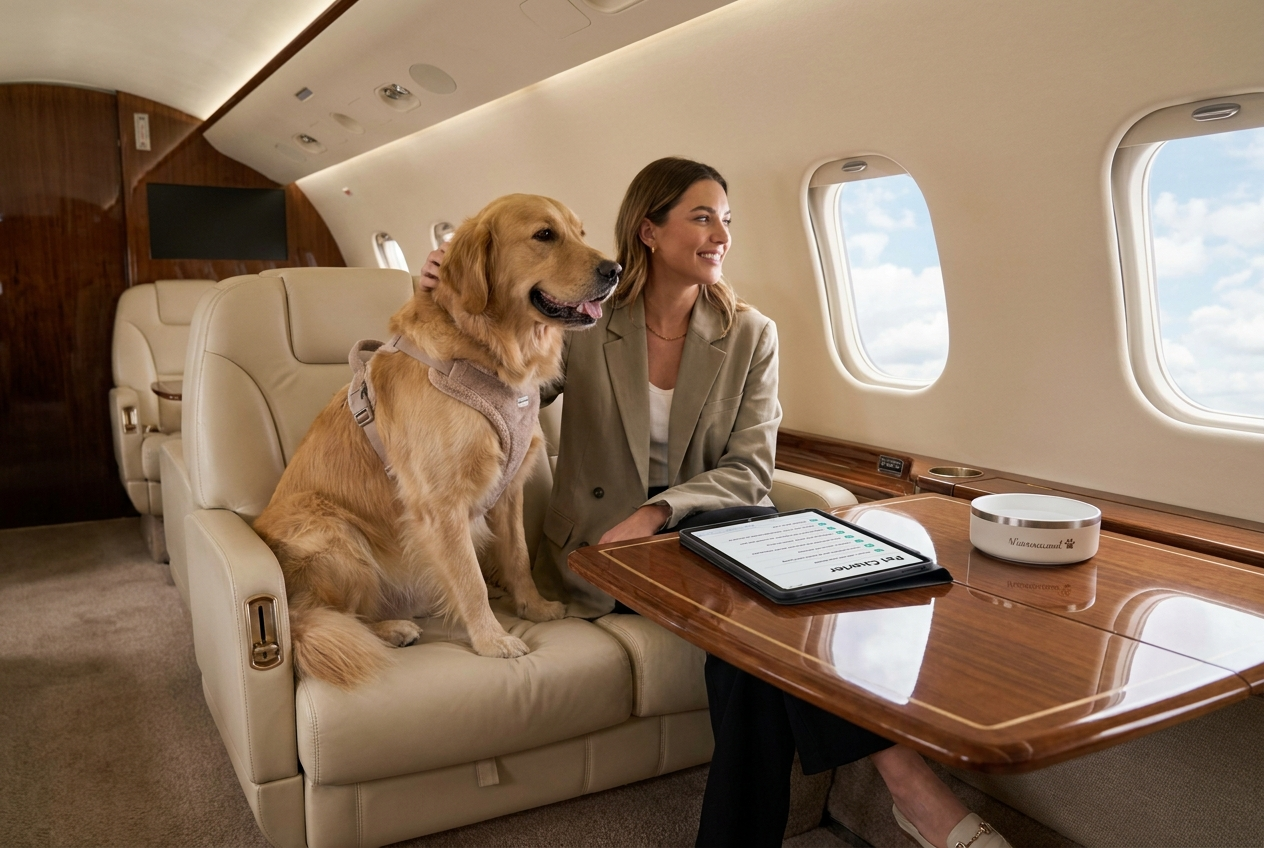
Private jet pet travel has grown 42% year-on-year in 2026. Entire airlines have launched dedicated to pets flying in-cabin.
This guide covers everything you need to know about flying with a pet on a private jet in 2026 - from costs and operators to the documentation that most people overlook until it is too late.
Why Private Aviation for Pet Travel Is Booming
The growth in private jet pet travel is not happening in isolation. It is a direct response to commercial aviation becoming progressively more restrictive for animals.
Commercial airlines restrict most pets by weight, breed, and season. Brachycephalic breeds — French bulldogs, pugs, Boston terriers — are banned from cargo on many carriers due to respiratory risk. Large dogs over 8kg are typically refused from the cabin entirely. Heat embargoes during summer months can ground a pet booking with days' notice. And on many of the world's most popular long-haul routes, pets simply cannot travel in the cabin at all.
Private aviation removes almost all of these barriers. On a private jet, your dog sits beside you regardless of size. There are no breed restrictions in the cabin. Departure times flex around your schedule. And the entire experience is built around your comfort — and your pet's.
What People Are Asking About Private Jet Pet Travel
Social listening across forums, Facebook groups, and aviation communities reveals five questions that come up repeatedly when people discuss flying privately with their pets.
1. How much does it actually cost?
Private jet charter costs range from approximately $2,000 to $14,000+ per flight hour depending on aircraft size and route. A short domestic trip on a light jet can total $10,000–$15,000 all-in. A transatlantic flight on a heavy jet can exceed $100,000.
However, the per-person calculation changes significantly with groups. A light jet at $12,000 for a domestic route divided across six passengers costs approximately $2,000 per person — comparable to commercial business class on the same route, but with your pet in the cabin beside you and no security queues.
For pet-specific shared charter services, costs are significantly lower — between $775 and $9,000 per seat depending on the route — because the aircraft is shared across multiple pet-owning passengers.
Empty leg flights — repositioning flights sold at 30% to 75% discount — are also growing in popularity among pet owners who can travel with flexibility on timing.
2. Can any size dog fly in the cabin?
On a private jet — yes, in most cases. Unlike commercial airlines where cabin pets are restricted to animals under approximately 8kg that fit under the seat, private jets allow dogs of any size to travel in the cabin beside their owners. Dogs over 50lbs may require a larger aircraft due to weight-and-balance aviation regulations, but this is a logistical consideration, not a prohibition.
Most private operators require advance notification of any pet and may charge a post-flight cleaning fee of between £250 and $2,500 depending on the operator. These fees should be confirmed at booking.
3. Do I still need documentation?
This is the most common misconception in private pet aviation — and the most dangerous one.
Flying private does not remove international border requirements. USDA APHIS, DEFRA, EU, and destination-country import rules apply regardless of how you travel. A health certificate is still required. Your pet's microchip must still comply with ISO standards. Rabies vaccinations must still be current and correctly sequenced. Tapeworm treatment must be administered within specific windows for UK entry.
The aircraft changes. The documentation does not.
Top concerns among private jet pet owners, according to 2026 industry data: temperature control (38% of owners), space availability (29%), and documentation (22%). That 22% is significantly underrepresented — documentation failure at a private terminal is as serious as at a commercial one.
4. Which routes are the most complex?
The routes that generate the most questions — and the most problems — are the same regardless of whether you fly commercial or private:
🇯🇵 Japan: 180 days of preparation. Titre test at an approved laboratory. Government pre-approval. One wrong date means the entire process restarts.
🇦🇺 Australia: Mandatory quarantine on arrival. Titre test required. Preparation typically takes 4–6 months minimum.
🇸🇬 Singapore: Mandatory quarantine. Licensed kennel must be pre-booked before departure. Import permit required.
🇬🇧 UK: Animal Health Certificate required for non-EU residents. Tapeworm treatment required 24–120 hours before arrival. Strict DEFRA compliance.
🇦🇪 UAE: Government-endorsed paperwork required. Processing times can be extended — plan several weeks in advance.
5. What is an empty leg flight and can I use it for pet travel?
An empty leg is a repositioning flight — when a private jet travels without passengers to collect a client or return to its home base. These flights are sold at 30% to 75% discounts and represent the most cost-effective way to access private aviation.
Empty legs can absolutely be used for pet travel, subject to the operator's pet policy. The limitation is that routes and timing are fixed — you cannot change the departure time or destination. For pet owners with schedule flexibility, they are a genuine opportunity.
The Documentation Problem — And How to Solve It
Private aviation excels at solving the physical experience of pet travel. The documentation layer remains exactly as complex as it is for commercial travel — and in some ways more so, because private jet clients often fly to more unusual and demanding destinations.
The routes private jet clients fly most frequently — Japan, Australia, Singapore, Hong Kong, the UAE, South America — are disproportionately represented among the world's most complex pet entry systems. A client flying London to Tokyo on a private jet needs the same 180 days of preparation as anyone else. A dog flying Dubai to Sydney still needs a titre test and mandatory quarantine, regardless of the aircraft.
Our Global Pet Travel Preparedness Index 2026 ranked 190+ countries on how easy it is to travel internationally with a pet. The global average was 54 out of 100. The most popular private jet destinations scored significantly below that average.
Pet Holiday Club covers 190+ countries with personalised, government-sourced, vet-verified documentation checklists — delivered in under two minutes. The same tool that helps a commercial traveller prepares private jet passengers for every route they fly. petholidayclub.com
What to Look For in a Pet-Friendly Private Jet Operator
Safety certification: Look for operators with ARGUS Gold/Platinum or Wyvern Wingman ratings. These are the industry's most rigorous third-party safety audits.
Transparent pet fees: Post-flight cleaning fees, pet handling fees, and aircraft-specific weight-and-balance surcharges should be confirmed in writing before booking — not added to the invoice after the flight.
Documentation support: The best operators and brokers will ask about your pet's documentation proactively — not at check-in. If an operator does not ask about health certificates during the booking process, that is a red flag.
Aircraft suitability: Quieter cabins reduce pet stress. Modern jets — Cessna Citation Longitude, Dassault Falcon 8X, Phenom 300 — have superior noise-reducing technology. Ask your broker specifically about cabin noise levels if your pet is anxious.
Pet amenities: Premium operators will accommodate your pet's favourite food, bedding, and comfort items. This is not a luxury — a familiar-smelling blanket and a known treat significantly reduce travel anxiety.
Frequently Asked Questions
Is it safe for my dog to fly on a private jet?
Yes. Private jets fly at the same certified safety standards as commercial aircraft. Pets travel in the pressurised, temperature-controlled cabin rather than cargo, which eliminates the primary welfare risks associated with commercial pet cargo travel. Always book with an ARGUS or Wyvern-certified operator.
Do private jets require pets to be in a crate?
Most private jet operators do not require pets to be crated, unless the owner prefers it. Pets typically travel unsecured beside their owners. Some operators may request a crate for take-off and landing for safety reasons — confirm the policy at booking.
What documents does my pet need to fly internationally on a private jet?
The same documents required for commercial international travel: a valid health certificate issued within 10 days of departure, current rabies vaccination, ISO-compliant microchip, and any destination-specific requirements including titre tests or import permits. Flying private does not waive any import or export regulations. Use Pet Holiday Club's free tool at petholidayclub.com for a personalised checklist for your specific route.
Can I fly my cat on a private jet?
Yes. Most private jet operators welcome cats as well as dogs. Cats are typically required to travel in carriers even on private jets, both for their own security and for the comfort of other passengers. Confirm the carrier policy with your operator before booking.
What happens if my pet's documentation is wrong at a private terminal?
The same thing that happens at a commercial border — your pet may be refused entry, held in quarantine, or returned to the country of origin. Private aviation does not provide any exemption from border inspection. Documentation must be correct, complete, and correctly sequenced regardless of how you travel.
How far in advance should I book a private jet for pet travel?
For standard routes, 2–4 weeks is typically sufficient. For complex routes — Japan, Australia, Singapore — the documentation preparation alone requires 3–6 months of advance planning. Start with the documentation timeline first, then book the aircraft around it.