Flying With Pets to Estonia 2026: Complete Guide
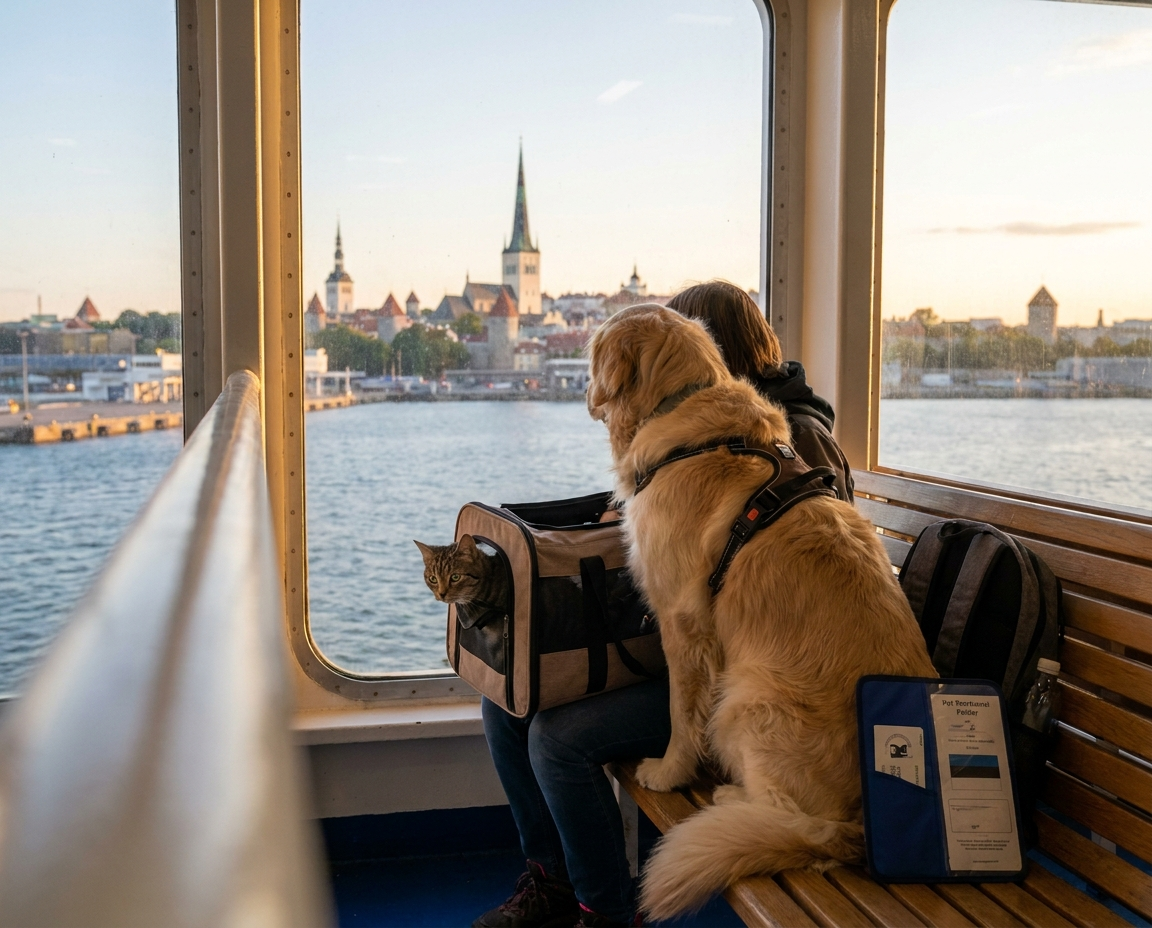
This is a complete guide to flying with a dog or cat to Estonia in 2026, covering pet travel requirements for importing into Estonia and exporting from Estonia: EU rules, AHC vs EU pet passport, young pet derogation, and the Helsinki–Tallinn ferry. Picture it: Tallinn’s medieval Old Town under soft northern light, your dog sniffing the Baltic air, and ferries from Helsinki gliding into port. Estonia is an EU member state, so EU pet travel rules apply, but 2026 has brought document changes owners must not miss.
What Documents Does Your Dog or Cat Need to Travel to Estonia?
Your dog or cat needs a readable microchip, valid rabies vaccination, and the correct travel document: either an EU pet passport or an Animal Health Certificate Estonia route certificate, depending on where you live and where your pet’s document was issued. Estonia’s official pet authority is the Estonian Agriculture and Food Board, and its guidance confirms the core EU rules for dogs, cats, and ferrets.
The microchip must be implanted, or read and recorded, before or on the same day as the rabies vaccination. It should meet ISO 11784 and ISO 11785 standards, using HDX or FDX-B technology; if it does not, you may need to bring your own scanner.
Rabies vaccination must be given when the pet is at least 12 weeks old. A first rabies vaccination becomes valid after the immunity period, no later than 21 days after vaccination, and boosters count only if there is no gap in validity.
An EU pet passport is for eligible EU-resident owners and EU-origin pets, issued by an authorised EU vet. An Animal Health Certificate is normally used for non-EU pets entering Estonia, including many UK and US travellers; US owners should also check USDA APHIS Estonia, while UK owners should check DEFRA.
From 22 April 2026, EU Regulation EU 2026/131 updated rules on non-commercial pet movement, including passports, certificates, identification, and number limits. From 1 October 2026, new animal health certificate formats apply, so do not reuse an old template without checking it.
But if you want a personalised pet travel checklist to Estonia, you can get it here - Pet Holiday Club | International Pet Travel Requirements for 194+ Countries
Importing Pets INTO Estonia — Step-by-Step Requirements
For Estonia pet import requirements, start with the route. EU-to-Estonia travel usually means microchip, rabies vaccine, and EU pet passport; non-EU-to-Estonia travel usually means microchip, rabies vaccine, official veterinary certificate, and a non-commercial movement declaration.
Use this practical order:
Check your pet’s microchip first. The chip must be readable and recorded correctly.
Confirm rabies timing. If it is a primary vaccine, plan around the 21-day wait.
Choose the right document. EU residents generally use an EU pet passport; non-EU travellers use an animal health certificate.
Book the certificate close to travel. For non-EU entry, the certificate is generally valid for 10 days from issue for entry into Estonia; sea travel may extend that by the voyage duration.
Carry supporting papers. Bring rabies records, microchip proof, declaration forms, and any titre test if required.
Enter through an open international border point. Estonia allows non-commercial pet entry through border stations open for international passenger traffic, supervised by the Estonian Tax and Customs Board.
If the wrong document is presented, your pet may be delayed, refused travel, or held while officials decide what action is needed. Airlines and ferry companies can also deny boarding if documents are missing or incomplete, so check before you leave home.
Estonia's Young Pet Rule — Can You Travel With a Puppy or Kitten?
Yes, but only in narrow cases. Estonia applies the EU young pet derogation for some puppies, kittens, and ferret kits travelling from eligible European territories, but unvaccinated young pets from non-EU countries cannot enter Estonia under this exception.
Under the Article 9-style derogation, Estonia may allow young pets that are under 12 weeks and not vaccinated, or 12–16 weeks and vaccinated but not yet fully valid because 21 days have not passed. This is the key young puppy Estonia travel rule.
The pet must have a microchip and EU pet passport. If travelling without the mother, the owner must sign a declaration confirming the animal has had no contact with wild animals susceptible to rabies from birth until travel.
If the young animal travels with its mother, the mother’s document must show that she had a valid rabies vaccination before the young animal was born. Some other EU countries apply similar young-pet rules, but each country decides for itself, so never assume transit countries will allow it.
Exporting Pets FROM Estonia — What You Need Before You Leave
There is no routine export quarantine for pets leaving Estonia when documents are correct. For travel from Estonia to another EU country, dogs, cats, and ferrets usually travel on an EU pet passport.
If you are leaving Estonia for the UK or another non-EU destination, the required paperwork depends on your destination country. In many cases, you may need an Animal Health Certificate, export certificate, or destination-specific veterinary document rather than only an EU passport.
Tapeworm treatment is not required to enter Estonia, but it is required for dogs travelling from Estonia to Finland, Ireland, Northern Ireland, Malta, or Norway. The treatment must be given by a vet 24–120 hours before entry and recorded in the passport or certificate.
Ferry Travel to Estonia With Your Pet — Helsinki to Tallinn
For many owners, the Estonia ferry with dog option is calmer than flying. The Helsinki–Tallinn route is short, frequent, and keeps you close to your pet rather than handing them over as cargo.
Tallink allows pets in pet-friendly cabins, kennels, or suitable carriers, and notes that pet-friendly cabins can take up to three pets. Small pets in carriers may be allowed in many passenger areas, but not restaurants, bars, or children’s areas, so book the right space before travelling.
Eckerö Line also welcomes pets, but pet spaces must be booked in advance. Small pets in carriers can travel in permitted passenger areas, while larger pets usually travel in the car or in a special pet cabin where available; Eckerö also warns that car decks may be hot in summer or cold in winter.
Good ferry habits make the crossing easier:
Book a pet cabin early, especially in summer.
Bring water, wipes, a familiar blanket, and poop bags.
Exercise your dog before boarding.
Keep cats in secure carriers at all times.
Check Finland return rules if going back, because tapeworm treatment may be needed.
The April 2026 EU Regulation Change — What Estonia Pet Owners Must Know
EU Regulation EU 2026/131 took effect on 22 April 2026 for non-commercial movement of pet animals. Estonia says the changes affect pet numbers, passports, certificates, identification, and accompanying documents, while the basic rabies-and-microchip foundation remains.
The big practical change affects UK residents. An EU pet passport may only be issued for an animal whose owner has their main residence in an EU Member State, so UK residents should expect to use an Animal Health Certificate for EU entry unless a specific exemption applies.
There is also a limit of five dogs, cats, or ferrets per traveller, and from 2026 Estonia applies the number limit per means of transport for non-commercial movements. If you exceed the limit, you need to prove an eligible event purpose, such as a competition or exhibition, and pets must be over six months old.
From 1 October 2026, new pet health certificate formats are introduced. From 1 January 2028, a new EU pet passport model is planned, though earlier valid passports do not need automatic replacement.
Is Estonia Pet-Friendly? Tallinn and Beyond With Your Dog
Tallinn dog travel is a pleasure if you like walkable cities, sea air, and outdoor breaks. Tallinn’s Old Town is a UNESCO World Heritage Site and is described by UNESCO as a well-preserved medieval northern European trading city on the Baltic Sea.
Dogs are common in parks and on promenades, and many cafés with outdoor seating are relaxed about well-behaved dogs. Always ask first, keep your dog close, and expect indoor rules to vary by venue.
Beyond Tallinn, Lahemaa National Park and Soomaa National Park are beautiful choices for dogs who love forests, bog trails, and quiet paths. In protected areas, dogs should be kept on a leash, and beach rules can change by season and location, so check signs before letting paws hit the sand.
Pet Holiday Club’s Estonia guide sums it up well: “Estonia is a reliable destination for EU pet travellers with predictable requirements.” It also notes that pet-friendly hospitality may be less developed outside Tallinn than in parts of Western Europe.
If you already have documents and want to check them for free, learn more here - Check Pet Travel Documents Online | Pet Holiday Club
Which Airlines Fly Pets to Estonia?
Flying with a dog to Estonia usually means arriving at Tallinn Airport, but direct routes are limited compared with larger European hubs. Many owners connect through Helsinki, Frankfurt, Riga, Stockholm, Warsaw, Amsterdam, or another EU airport, depending on airline schedules.
Before booking, confirm:
Whether pets are accepted in cabin, as checked baggage, or as cargo.
The weight and carrier size limits.
Whether your breed is restricted, especially snub-nosed dogs and cats.
Whether your connection requires entering another country.
Where document checks happen.
Estonia does not have a broad national banned-breed rule like some countries, but airlines may apply their own breed and crate restrictions. For travelling to Estonia with a dog, airline policy can be just as important as government paperwork.
Frequently Asked Questions About Flying With a Pet to Estonia
Do I need an Animal Health Certificate or EU pet passport for Estonia?
If you live in the EU and your pet has a valid EU pet passport, that is usually the right document. If you are travelling from a non-EU country, including many UK and US routes, you usually need an Animal Health Certificate or official veterinary certificate for Estonia.
Can I take a young puppy or kitten to Estonia?
Sometimes, but mainly from eligible EU or EU-aligned territories. Estonia may allow young pets under 12 weeks without rabies vaccination, or 12–16 weeks with a not-yet-valid vaccine, if strict declaration or vaccinated-mother conditions are met.
Can I take my dog on a ferry to Estonia?
Yes. Tallink and Eckerö Line both carry pets on Helsinki–Tallinn services, but you must book the correct pet space, cabin, carrier option, or vehicle arrangement before travel.
Is there quarantine for pets entering Estonia?
There is no routine quarantine for dogs and cats entering Estonia with correct paperwork. Problems usually happen when the rabies record, microchip order, certificate, or route-specific document is wrong.
Do I need tapeworm treatment to enter Estonia?
No. Dogs do not need Echinococcus tapeworm treatment to enter Estonia, but they do need it when travelling from Estonia to Finland, Ireland, Northern Ireland, Malta, or Norway.
Check Your Pet's Documents Before You Fly to Estonia
Before flying with a dog to Estonia or planning pet travel Estonia by ferry, check every document line by line:
Microchip number matches every document.
Rabies vaccine was given after microchipping.
Primary rabies vaccine has passed the 21-day wait.
EU pet passport is valid and owner-signed.
Animal Health Certificate is issued in the correct format.
Non-commercial declaration is included if required.
Tapeworm treatment is planned for Finland, Ireland, Northern Ireland, Malta, or Norway.
Airline or ferry pet booking is confirmed.
If you want a route-specific plan, get your personalised pet travel checklist for Estonia - Pet Holiday Club | International Pet Travel Requirements for 194+ Countries. If you already have papers and want peace of mind, check your existing pet travel documents before you fly - Check Pet Travel Documents Online | Pet Holiday Club
The Baltic Sea has a way of making a journey feel bigger than paperwork. Once the forms are done, the reward is simple: medieval towers above you, salt air around you, and your dog beside you, ready for the first slow walk through Tallinn.