Flying With a Dog or Cat to Denmark — Complete 2026 Pet Travel Requirements Guide
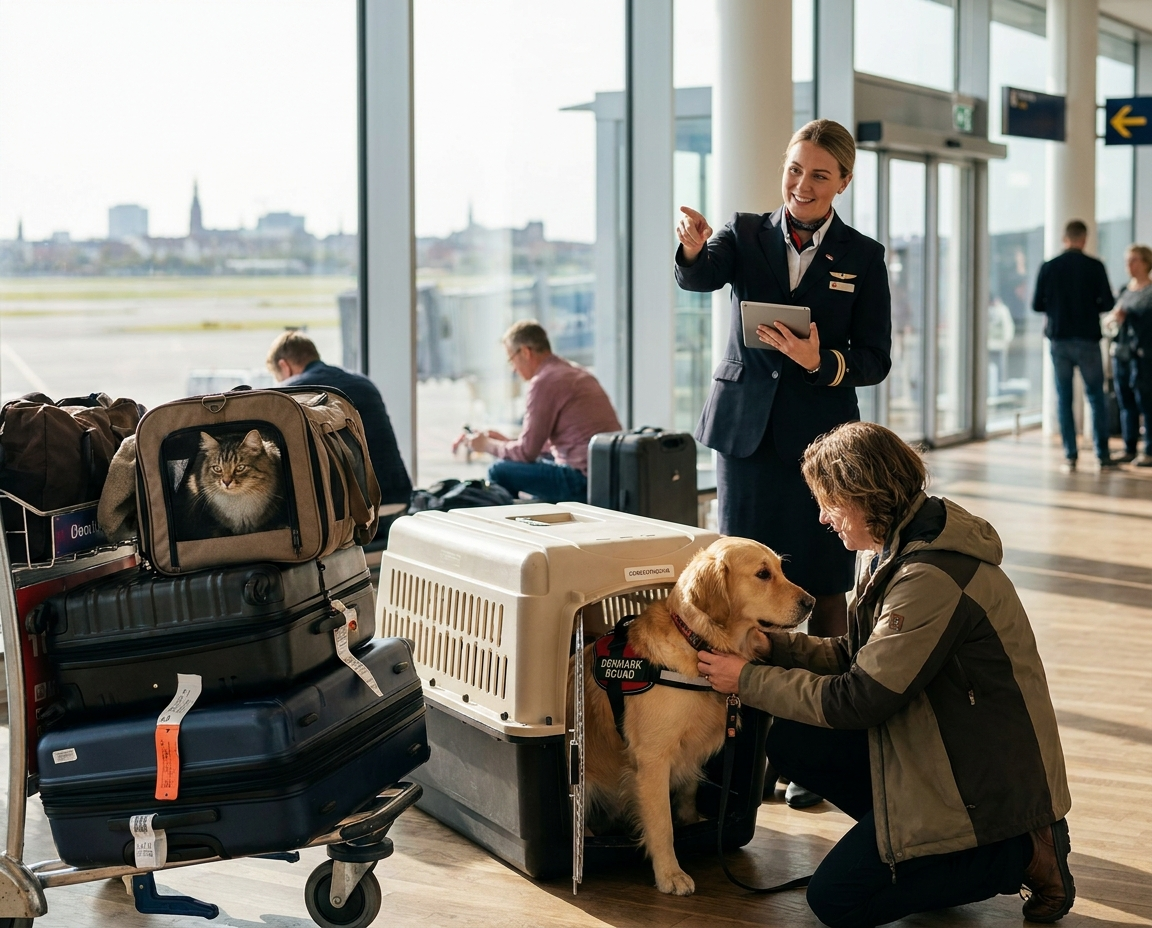
Imagine strolling past the colorful 17th-century townhouses along Copenhagen’s Nyhavn harbor, the crisp Nordic breeze carrying the scent of fresh baked cardamom buns while your dog trots happily beside you. Picture embracing true Danish hygge inside a warm cafe after an afternoon exploring the royal gardens of Rosenborg Castle. Denmark is a clean, beautiful, and welcoming Scandinavian destination for animal lovers, but crossing its borders requires navigating strict European Union health directives and one of the most uncompromising breed bans on the continent.
Whether you are flying into Copenhagen for a holiday or relocating long-term, this definitive guide details every veterinary mandate, paperwork timeline, and transit rule for seamless pet travel to Denmark in 2026.
At a Glance: Denmark Pet Import Requirements Matrix 2026
Origin Region | Required Health Document | Microchip Sequence Rule | Rabies Vaccine Timeline | Banned Breeds Allowed? | Tapeworm Required? |
|---|---|---|---|---|---|
UK (Great Britain) | Animal Health Certificate (AHC) | ISO 11784/11785 (Pre-vaccine) | Min. 21 days before travel | STRICT NO (13 breeds banned) | No (Skipped for Denmark entry) |
USA & Canada | USDA / CFIA Endorsed EU Certificate | ISO 11784/11785 (Pre-vaccine) | Min. 21 days before travel | STRICT NO (13 breeds banned) | No (Skipped for Denmark entry) |
EU Member States | Active EU Pet Passport | ISO 11784/11785 (Pre-vaccine) | Active booster on record | STRICT NO (13 breeds banned) | No (Skipped for Denmark entry) |
Non-Listed Third Countries | EU Certificate + FAVN Titer Test | ISO 11784/11785 (Pre-vaccine) | Titer 30d post-vax + 3mo wait | STRICT NO (13 breeds banned) | No (Skipped for Denmark entry) |
What Documents Does Your Dog or Cat Need to Travel to Denmark?
According to the Pet Holiday Club Global Pet Travel Preparedness Index 2026 — the only data-driven ranking of 194 countries for pet travel readiness — Denmark is an accessible EU destination for standard domestic pets, but carries high enforcement risks regarding paperwork timelines and breed restrictions.
Get your petsonalised pet travel checklist - Pet Holiday Club | International Pet Travel Requirements for 194+ Countries
As a founding European Union member state, Denmark enforces standardized EU animal health laws. National veterinary oversight and agricultural import compliance are governed by the Danish Veterinary and Food Administration (DVFA), known locally as Fødevarestyrelsen.
Every dog or cat entering Denmark must be identified with an ISO 11784/11785 compliant 15-digit microchip. The microchip must be implanted or officially read and recorded before any rabies vaccine is administered. If your veterinarian administers a rabies shot prior to scanning or implanting the microchip, European border authorities will consider that vaccination legally invalid for international transit.
Your pet must also carry a valid rabies vaccination administered at least 21 days before departure. The primary rabies vaccine can only be administered once the pet reaches at least 12 weeks of age, establishing 15 weeks as the absolute legal minimum age for pets entering Denmark.
The exact health documentation required depends on your origin country:
EU Residents: A valid EU Pet Passport issued by an authorized European veterinarian, containing active rabies booster records.
UK Residents (Great Britain): An official Animal Health Certificate (AHC) issued within 10 days of travel into the EU by an Official Veterinarian (OV).
USA & Canadian Residents: An official EU Health Certificate signed by an accredited vet and officially endorsed by USDA APHIS or CFIA.
Non-Listed Third Countries: An official EU Health Certificate accompanied by a successful FAVN rabies antibody titer test result (showing at least 0.5 IU/ml).
The April 22, 2026 EU regulation update (EU2026/131) reaffirmed that UK-issued EU pet passports are strictly invalid for entering European countries. UK pet owners residing in Great Britain must obtain a new single-use AHC for every separate entry into Denmark.
Crucially, travelling to Denmark with a dog does not require a tapeworm treatment (Echinococcus multilocularis). Tapeworm medication is only mandatory when travelling to rabies-free island nations like Ireland, Malta, or Northern Ireland, as well as Finland and Norway.
Importing Pets INTO Denmark — Step-by-Step DVFA Requirements
Importing a dog or cat into Denmark requires following a strict chronological sequence. Denmark pet import requirements permit non-commercial pet travel for up to 5 pets per owner without requiring a commercial import permit.
Follow this official step-by-step checklist to ensure total compliance with Fødevarestyrelsen border controls:
Step 1: ISO Microchip Scanning & Verification
Visit your vet to scan or implant an ISO 11784/11785 15-digit microchip. Ensure the exact 15-digit microchip number and the date of reading or implantation are clearly logged on your pet's official medical record.
Step 2: Rabies Vaccination
Administer the primary rabies vaccination on the same day as or any date after the microchip verification date. Wait out the mandatory 21-day incubation period before crossing the Danish border.
Step 3: Health Certificate Completion & Endorsement
Within 10 days of your scheduled arrival date, have an accredited vet complete the official non-commercial EU Health Certificate or UK AHC. US travelers must submit paperwork through the VEHCS portal for digital or physical endorsement from USDA APHIS Denmark.
Step 4: Airline Booking & Cargo Reservation
Ensure your flight lands at a designated international border inspection post, primarily Copenhagen Airport (Kastrup — CPH). Confirm that your airline permits pets in-cabin (PETC) or as checked baggage (AVIH), as passenger flights strictly limit live animal quotas.
Step 5: Border Inspection Point Clearance
Upon landing in Copenhagen from outside the EU, report directly to customs or the airport veterinary control point. Official inspectors from Fødevarestyrelsen will scan your pet's microchip, verify vaccine timestamps, and audit your paper certificates.
If your paperwork is fully compliant, Denmark does not impose quarantine on incoming pets. However, if paperwork is missing, chronologically invalid, or missing official endorsement signatures, border officials will place your pet into mandatory quarantine at your expense, order immediate re-shipment to your origin country, or, in severe legal breaches involving banned breeds, order euthanasia.
Denmark's Strict Breed Ban — 13 Banned Dog Breeds
Denmark enforces one of the strictest breed-specific legislations (BSL) in Europe under the Danish Act on Dogs (Hundeloven). Understanding banned dog breeds Denmark laws is critical before planning any travel.
It is illegal to import, breed, sell, or bring 13 specific dog breeds—and any cross-breeds involving them—into Denmark.
The 13 Banned Breeds in Denmark:
Pitbull Terrier
Tosa Inu
American Staffordshire Terrier (Amstaff)
Fila Brasileiro
American Bulldog
Boerboel
Kangal
Central Asian Shepherd Dog (Ovcharka)
Caucasian Shepherd Dog (Ovcharka)
South Russian Ovcharka
Tornjak
Šarplaninac (Illyrian Shepherd)
Cross-breeds of any of the above listed breeds
What Happens If You Bring a Banned Breed to Denmark?
If you attempt to enter Denmark with any of these 13 breeds or their mix-breeds, border authorities will deny entry immediately. If an illegal dog enters the country undetected, police and veterinary authorities have the legal mandate to confiscate the animal. Unless you can conclusively prove the dog is not a banned breed, the animal will be humanely euthanized at the owner's expense.
The "Similar Appearance" Rule & Documentation
If your dog physically resembles any of the banned breeds (e.g., a rescue dog with a muscular build, wide jaw, or short coat), the burden of proof rests entirely on you. You must carry official pedigree paperwork, bloodline documentation, or a certified veterinary declaration proving your dog’s purebred non-banned lineage.
Exception for Transit by Road or Train
Dogs of banned breeds (except Pitbull Terriers and Tosa Inus) are permitted to transit through Denmark by car or train on direct journeys between other countries, provided the dog remains inside the vehicle or on a short leash with a secure muzzle during brief comfort stops. However, they cannot remain in Denmark for tourism or overnight stays.
Exporting Pets FROM Denmark — Rules & Airport Transit Exceptions
Departing Denmark with your pet is straightforward, but destination rules dictate your pre-departure preparations. Denmark itself does not enforce exit quarantines or charge export fees for departing pets.
If you are returning to another EU member state, you simply need your active EU Pet Passport updated by a licensed Danish vet showing valid rabies booster records.
If you are travelling FROM Denmark to Ireland, Northern Ireland, Malta, or Norway, you must visit a licensed vet in Denmark between 24 and 120 hours (1 to 5 days) before arrival. The vet must administer an approved tapeworm treatment containing Praziquantel and log the exact date, time, and product details in your pet's passport or AHC.
The exact same 24-to-120-hour Praziquantel tapeworm treatment is mandatory when exporting a dog from Denmark directly to Great Britain, following guidance from DEFRA UK.
Crucial Transit Exception: Flying Through Denmark to Finland
Finland mandates a pre-entry tapeworm treatment (Praziquantel) administered 24 to 120 hours before arrival. However, pet owners frequently ask what happens if they fly from a non-tapeworm country (like the US or UK) and transit through Copenhagen Airport (CPH) en route to Helsinki.
The Official Rule: If your dog transits through Copenhagen Airport on a single ticket and does NOT exit the international customs transit area, you are NOT required to administer a tapeworm treatment during your Danish layover. The tapeworm requirement is assessed based on your final entry into Finland, meaning you must complete the treatment prior to starting your journey if traveling from an unexempted area, but transiting airside in Denmark does not trigger an additional Danish border intervention.
Always double-check transit connections when booking layovers to ensure baggage and pets are checked straight through to your final Scandinavian destination.
The April 2026 & October 2026 EU Regulation Changes
European animal transport frameworks updated under Regulation EU2026/131, which took full legal effect on April 22, 2026. This directive harmonized animal movement auditing across all 27 EU member states, including Denmark.
The key structural shifts include:
UK EU Passports Invalid: EU pet passports issued in Great Britain or historic EU passports held by non-EU residents are strictly invalid for entering Denmark. UK residents must secure a fresh Animal Health Certificate (AHC) within 10 days of departure for every trip.
October 1, 2026 Health Certificate Updates: European authorities have introduced new non-commercial health certificate templates effective October 1, 2026. Health certificates issued under previous formats can be officially endorsed up to September 30, 2026, remaining valid for their standard 4-month duration.
Transition Period: From October 1, 2026 onward, all health certificates issued in third countries (including the US, Canada, and Australia) must utilize the revised layout. A formal transition period will extend through March 2027 to allow global veterinary agencies time to adjust fully.
US pet owners preparing for autumn 2026 travel should verify certificate version updates directly with their accredited vet or through official USDA APHIS portals.
Is Denmark Pet-Friendly? Copenhagen and Beyond With Your Dog
Denmark is an orderly, clean, and highly pet-conscious society, but local dog etiquette is governed by clear social rules. Copenhagen Airport pet travel and urban transit are smooth once you know the local system.
Public Transportation in Denmark
Public transit networks across Denmark—including Copenhagen’s Metro, S-trains (S-tog), and buses operated by DOT—are exceptionally dog-friendly:
Small Pets: Small dogs and cats inside travel bags or carriers travel free of charge across all public transit networks.
Large Dogs: Larger dogs on a leash require a child-fare transit ticket. Large dogs must be kept on a short leash and sit on the floor, never on passenger seats.
Muzzle Rules: While muzzles are not legally required on trains under normal circumstances, transit staff hold the authority to request a muzzle if a train car is overcrowded or an animal shows signs of stress.
Restaurants and Dining Etiquette
Under Danish hygiene laws, animals are generally not allowed inside indoor dining areas where food is prepared. However, dogs are warmly welcomed at outdoor outdoor terrace seating across Copenhagen, Aarhus, and Odense. Cafe staff will often bring out fresh water bowls without being asked.
Dog Parks and "Hundeskove" (Dog Forests)
In public urban spaces and on beaches (between April and September), dogs must remain strictly on a leash. However, Denmark features hundreds of dedicated off-leash areas called Hundeskove (Dog Forests). These fenced, natural woodland parks allow dogs to run, play, and socialize safely off-leash.
Which Airlines Fly Pets to Denmark?
The primary international gateway for air travel to Denmark is Copenhagen Airport (CPH). Choosing an airline experienced in live animal transport ensures a smooth journey.
Airlines classify pet travel into three distinct options:
In-Cabin (PETC): Reserved for small dogs and cats weighing under 8 kg (17.6 lbs) including their soft-sided carrier. Scandinavian Airlines (SAS), Norwegian Air, Lufthansa, Air France, and KLM permit small pets in the cabin on flights into Copenhagen.
Checked Baggage (AVIH): For medium-sized pets traveling in climate-controlled cargo compartments on the same flight as their owner. SAS, Lufthansa, and KLM handle checked baggage pet transport into Copenhagen Airport.
Manifest Cargo: Required for large animals, long-haul international flights, or un-accompanied pets. Dedicated live-animal cargo services operate directly into Copenhagen Airport's cargo terminal.
Always confirm pet slot availability directly with the airline before booking passenger tickets. Carriers enforce strict animal limits per flight.
Keep in mind that commercial airlines enforce summer heat embargoes between June and August. If tarmac ground temperatures at connecting hubs exceed safety thresholds (typically 29°C to 35°C), airlines will refuse cargo-hold pet transit to protect animal welfare.
How Long Does It Take to Prepare for Pet Travel to Denmark?
Preparation timelines depend on your origin country and your pet's medical history. Starting early prevents last-minute panic over vet signatures or endorsement delays.
UK Travelers: Allow 3 to 4 weeks. While the AHC must be signed within 10 days of departure, booking an Official Veterinarian appointment and checking rabies records requires lead time.
EU Travelers: Allow 3 to 7 days. EU residents with valid pet passports simply require a routine fit-to-fly health check and active rabies boosters.
USA & Canadian Travelers: Allow 6 to 8 weeks. You must account for rabies vaccination timelines, USDA/CFIA endorsement turnaround times, and potential October 2026 certificate template updates.
High-Risk / Non-Listed Countries: Allow 4 to 5 months. The rabies antibody titer test requires a 30-day post-vaccination wait, followed by a mandatory 3-month waiting period before entering Denmark.
If you are unsure where your timeline stands, checking your travel schedule against official government guidelines prevents unexpected border issues.
Frequently Asked Questions About Flying With a Pet to Denmark
Do I need an Animal Health Certificate or EU pet passport to travel to Denmark?
If you are an EU resident, a valid EU Pet Passport is sufficient for entry into Denmark. If you reside in Great Britain or another non-EU country (such as the US or Canada), an EU Pet Passport cannot be used for entry under 2026 regulations. You must obtain an official Animal Health Certificate (AHC) or an endorsed EU Health Certificate.
Which dog breeds are banned in Denmark?
Denmark bans 13 specific breeds and their cross-breeds: Pitbull Terrier, Tosa Inu, American Staffordshire Terrier, Fila Brasileiro, American Bulldog, Boerboel, Kangal, Central Asian Shepherd, Caucasian Shepherd, South Russian Ovcharka, Tornjak, Šarplaninac, and any mixes of these. They cannot enter the country and risk confiscation and euthanasia if brought in illegally.
Do I need a tapeworm treatment to enter Denmark with a dog?
No, tapeworm treatment (Echinococcus multilocularis) is not required to enter Denmark. Tapeworm medication is only required when exporting a dog from Denmark to Ireland, Northern Ireland, Malta, Finland, Norway, or Great Britain.
What are the rules for transiting through Copenhagen Airport to Finland?
If you fly into Copenhagen Airport (CPH) and remain inside the international airside transit area without clearing Danish customs, you do NOT need a separate tapeworm treatment at the Danish transit point. You only need to fulfill Finland's standard entry rules upon arrival in Helsinki.
What is the minimum age for a puppy or kitten to enter Denmark?
The minimum age is 15 weeks. Pets must be at least 12 weeks old to receive their primary rabies vaccination, followed by a mandatory 21-day incubation waiting period before crossing the Danish border. Denmark does not accept unvaccinated puppies under derogation rules.
Check Your Pet's Documents Before You Fly to Denmark
A single clerical error—like a transposed microchip digit or an incorrect vaccine timeline—can ruin your travel plans at the airport check-in desk. Before heading to the terminal, make sure to check your existing pet travel documents before your fly - Check Pet Travel Documents Online | Pet Holiday Club
Pet Holiday Club utilizes an intuitive four-colour verdict system to give you instant clarity on your readiness:
Green (Ready to Fly): Every document, microchip record, and vaccination timeline fully complies with Danish DVFA and EU regulations.
Yellow (Ready in 2 Weeks): Minor timing windows or administrative steps need final adjustments before departure.
Orange (Ready in 3 Months): Your pet requires rabies boosters, titer tests, or mandatory waiting windows before crossing the border.
Red (Not Ready): Core legal requirements—such as an ISO microchip, non-banned breed proof, or valid health certificate—are missing or invalid.
If you are just beginning your travel preparation, take a moment to get your personalised pet travel checklist for Denmark - Pet Holiday Club | International Pet Travel Requirements for 194+ Countries
Exploring the bike-friendly streets, coastal paths, and cozy spots of Denmark with your pet is a wonderful experience. Taking the time to handle requirements correctly ensures a smooth, stress-free journey. Safe travels!