Flying Large Dogs Transatlantic in 2026: Private Jet vs. Cargo — Real Cost Comparison
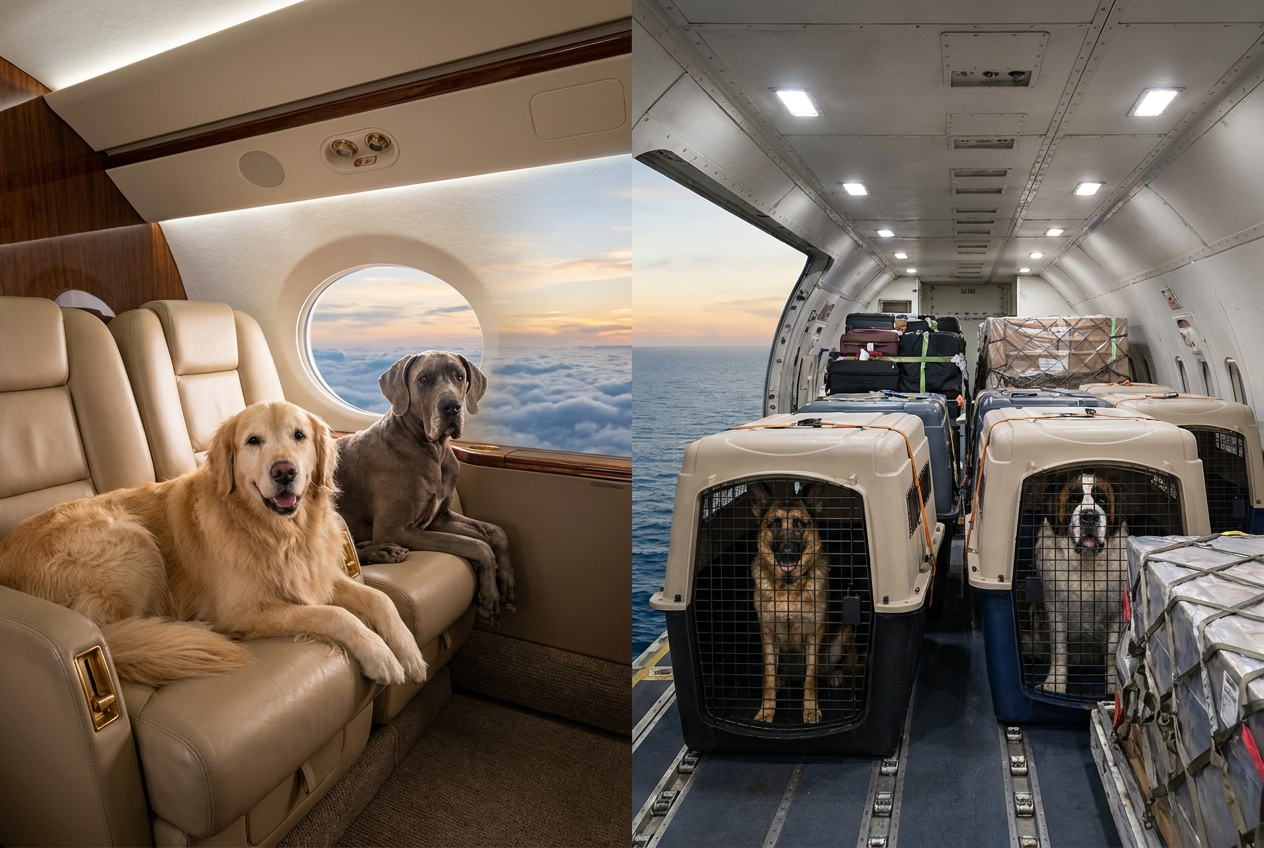
What is the best way to fly a large dog across the Atlantic in 2026? The safest and most stress-free method is booking a shared private jet seat through operators like K9 JETS ($9,000–$11,000), which allows large breeds to rest in the cabin beside you. The traditional alternative is shipping via an IPATA-certified manifest cargo agent ($3,000–$6,000).
Moving across the Atlantic is a major life transition, but if you are making that journey with a large dog, the logistical hurdles can be overwhelming. Because large breeds cannot fit under a commercial passenger seat, they face a shrinking pool of travel options.
With legacy commercial airlines enforcing permanent cargo bans on snub-nosed breeds and tightly restricting traditional checked-baggage pet options, owners are forced to choose between two completely different methods: commercial manifest cargo or shared private aviation. Transatlantic travel for dogs requires import permits, microchip records, and rabies titres — check your route at PetHolidayClub.com to secure your paperwork. Let's look at a transparent, side-by-side cost and operational comparison to help you choose the best option for your dog.
The Transatlantic Big Picture: Private Jet vs. Manifest Cargo
While private travel represents a major financial commitment, commercial manifest cargo involves hidden professional fees that narrow the price gap considerably:
Financial & Operational Metrics | Shared Private Jet (e.g., K9 JETS) | Commercial Manifest Cargo |
Core Flight Model | In-cabin seat-share on luxury aircraft | Under-belly temperature-controlled hold |
Average Base Cost Range | $9,000 – $11,000 per sector | $3,000 – $6,000 total agency project |
Crate Requirements | None (Dog rests on seat or floor) | Strict, custom CR-82 or IATA Container |
Seasonal Temperature Bans | None (Climate-controlled cabins) | Strict summer and winter tarmac locks |
Airport Terminal Experience | 15-minute private FBO lounge check-in | 4-to-6 hour commercial freight facility |
Anxiety & Safety Risk Profile | Low; pet remains right by your side | Higher; isolated noise, movement, and darkness |
Part 1: Shared Private Jets—The Real Cost of In-Cabin Luxury
For owners who refuse to let their dogs travel isolated in a cargo hold, companies like K9 JETS have established a dependable "seat-share" model on premier long-haul routes.
       [SHARED PRIVATE JET COST ARCHITECTURE]

   +---------------------------------------------+
   |  Base Single Ticket (1 Human + 1 Large Dog) | -> $9,000 to $11,000
   |  FBO Terminal Operations Fees               | -> Included
   |  In-Flight Pet Amenities & Treats           | -> Included
   +---------------------------------------------+
   |  TOTAL COST DIRECTION: $9,000 – $11,000      |
   +---------------------------------------------+
Understanding the Seat Ticket Math
When you purchase a transatlantic seat ticket (such as New York Teterboro to London Biggin Hill), your premium base price covers one human passenger and one dog weighing over 51 pounds. Your dog is allocated the floor space directly in front of your wide leather club chair or relaxes on the adjacent seating space.
The Real Financial Advantages
While a price tag around $9,000 to $11,000 is undeniably premium, it represents a flat rate. There are no hidden handling fees, surprise fuel surcharges, or custom crate requirements. If you are relocating a massive breed—like a 110-pound Bernese Mountain Dog or a Great Dane—the price remains identical to traveling with a smaller breed.
Part 2: Commercial Manifest Cargo—Uncovering the Hidden Fees
Many pet parents assume that commercial cargo costs only a few hundred dollars. This is a common error that confuses domestic "checked pet" baggage add-ons with international Manifest Cargo rules. To fly an unescorted large dog internationally on a commercial carrier, you are legally required by most destinations to book through an authorized agent.
       [MANIFEST CARGO SURPRISE TIER EXPENSES]

   +---------------------------------------------+
   |  IPATA Broker Booking & Management Fee      | -> $1,500 – $2,500
   |  Airline Cargo Airfreight Base Bill         | -> $1,200 – $2,500
   |  Custom IATA-Compliant Large Travel Crate   | -> $400 – $1,000
   |  Border Vet Inspection & Clearance Tariffs  | -> $300 – $500
   +---------------------------------------------+
   |  TOTAL REAL WORLD COST: $3,000 – $6,000     |
   +---------------------------------------------+
The IPATA Broker Mandate
Airlines like British Airways, Lufthansa, and KLM typically do not accept direct cargo bookings from retail consumers for international routes. You must contract an IPATA (International Pet and Animal Transportation Association) certified relocation broker. These agencies handle logistics, but their professional management fees regularly range between $1,500 and $2,500 alone.
The Custom Crate Factor
Large dogs require ample space to stand up, turn around completely, and sit erect without their ears touching the ceiling of their container. For extra-large breeds, a standard plastic crate will not suffice; you must purchase an IATA Container Requirement 1 (CR-1) or CR-82 heavy-duty wooden travel box. These custom structural builds add another $400 to $1,000 to your moving budget.
Part 3: Operational Safety and Veterinary Realities
When evaluating private jet options against commercial cargo holds, safety considerations often outweigh purely financial differences.
      [COMPREHENSIVE TRANSLATLANTIC ENVIRONMENTAL SAFETY AUDIT]
                            /          \
               COMMERCIAL CARGO       PRIVATE JET IN-CABIN
                     /                    \
        - Isolation in cargo hold.    - Constant visual contact.
        - Unpredictable flight        - Real-time anxiety
          delays on tarmac.             management.
        - Subject to extreme          - Climate-controlled,
          seasonal temperature bans.    constant cabin flow.
1. Environmental Control and Tarmac Delays
Commercial aircraft cargo compartments are pressurized and temperature-controlled, but risks spike during ground logistics. If a flight suffers an extended tarmac delay during a summer heatwave or a winter freeze, the cargo hold can experience dangerous temperature spikes. This risk forces airlines to implement strict temperature bans, locking out cargo pets whenever temperatures exceed safety limits. Private jets bypass this completely, as pets wait inside private, climate-controlled FBO lounges until boarding.
2. Pet Stress Dynamics
In a manifest cargo environment, your dog experiences loud engine reversals, luggage movement, and absolute isolation in darkness for 8 to 11 hours. For senior dogs or pets with high separation anxiety, this environment can cause severe stress. On a shared private flight, your dog stays right by your side, allowing you to soothe them, offer fresh water, and monitor their breathing in real time.
Part 4: The Rigid Document Standard
A common point of confusion is believing that flying private reduces your paperwork obligations. This is an operational error that can compromise your travel timeline.
Biosecurity Laws Apply Internationally: Private FBO terminals offer streamlined passenger lounges, but border officials inspect pets with the same strict scrutiny applied at commercial cargo centers. A single clerical error can result in quarantine.
   [Secure Flight Solution] ➔ [Verify Destination Import Rules]
   ➔ [Sync Microchip & Rabies Timing] ➔ [Obtain USDA / Government Endorsement]
To guarantee a smooth transatlantic entry, follow this rigid document timeline:
The Identification Check: Your dog's 15-digit ISO microchip must be implanted and read before their qualifying rabies vaccine is administered.
The 21-Day Waiting Period: You cannot board an international flight until a full 21-day safety window has elapsed following your dog's rabies booster.
The Government Signature: Your final international health certificate must be completed by an accredited veterinarian and officially endorsed by a federal authority (such as the USDA or Great Britain's DEFRA) within days of your departure.
Transatlantic travel for dogs requires import permits, microchip records, and rabies titres — check your route at PetHolidayClub.com to ensure your paperwork is flawless before booking.
Final Verdict: Which Transatlantic Option is Best?
If your budget is tight and you own a young, healthy, even-tempered dog whose breed is safely accepted by commercial cargo lines, utilizing an IPATA-certified manifest cargo service can save you thousands of dollars while ensuring your pet travels with professional support.
However, if you own a large snub-nosed breed, manage a pet with severe separation anxiety, or simply want total peace of mind, booking a shared private jet seat is worth every penny. The investment completely eliminates the physical and emotional stress of cargo transit, ensuring your dog arrives safely by your side.
Frequently Asked Questions
What is the safest way to fly a large dog across the Atlantic in 2026?
The safest method is utilizing a shared private jet charter service like K9 JETS. This layout keeps your large dog directly inside the main cabin by your side, completely avoiding the isolation, noise, and temperature variables of a commercial cargo hold.
Why is commercial manifest cargo for a large dog so expensive?
While the airline's raw airfreight fee is moderate, international rules often require you to hire a professional IPATA-certified relocation broker. When you combine agency management fees, mandatory custom wooden crates, airport handling charges, and customs clearance fees, the real cost ranges between $3,000 and $6,000.
Can a large dog sit directly on a seat on a private pet flight?
Yes. On specialized public charter brokers, large breeds are permitted to relax directly on the cabin floor at your feet, rest on specialized memory foam pet beds, or curl up on the leather seats alongside you. They only need to be leashed or harnessed during taxiing, takeoff, and landing.
What are commercial airline temperature restrictions for pets?
Most commercial airlines will cancel pet transit bookings if the outdoor temperature at your departure, connection, or arrival airport is forecast to exceed 85°F (29.4°C) or fall below 45°F (7.2°C). Shared private jet travel is exempt from these bans because pets wait inside climate-controlled private FBO terminals.
Do I need a rabies titer test to fly a large dog from the US to Europe?
If you are flying directly from the United States to the United Kingdom or an EU nation, a rabies antibody titer test is generally not required for entry, provided your dog's rabies vaccines are up-to-date and documented. However, if you are entering from a country deemed high-risk by the EU, a titer test must be completed three months before travel.