Emotional Support Animals and International Travel in 2026: What the Rules Actually Are
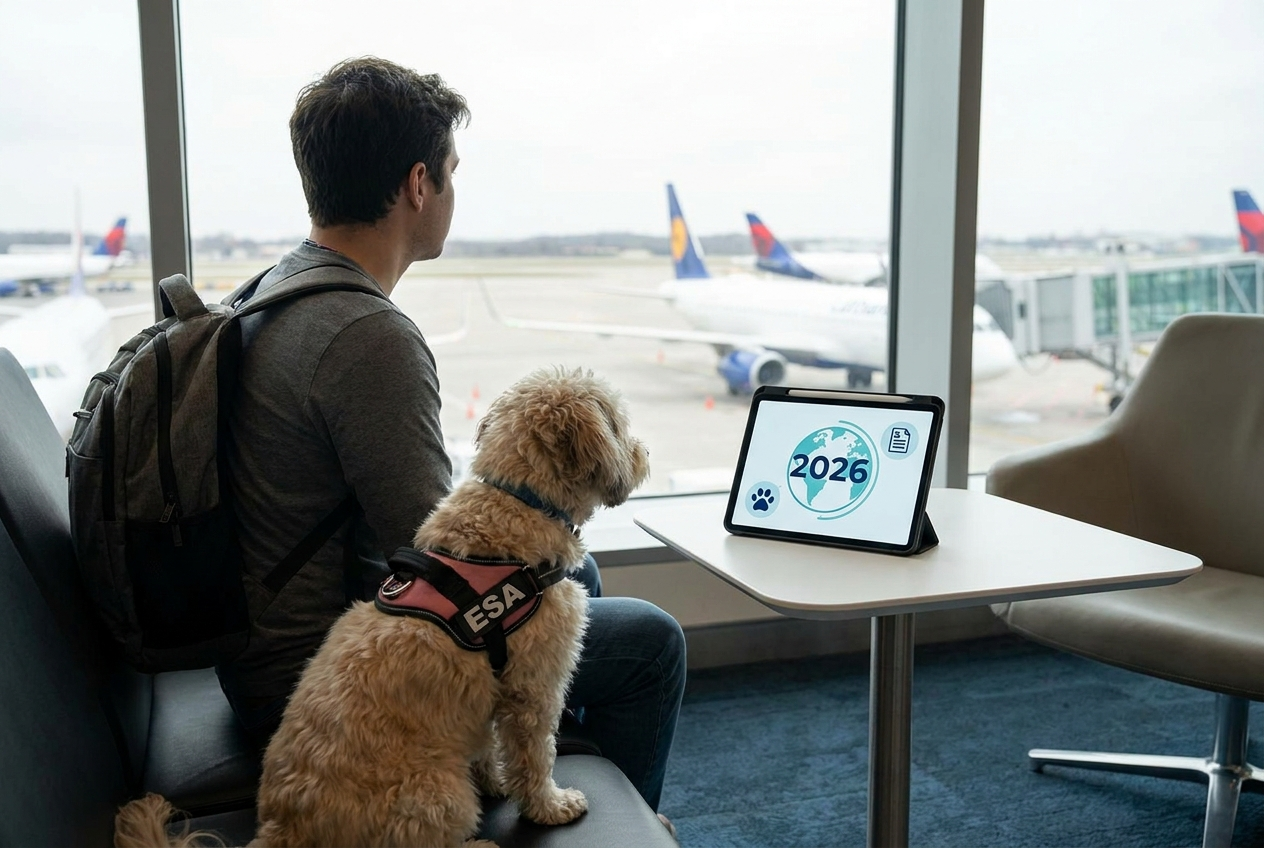
1 in 5 Americans now has an Emotional Support Animal. Most of them are travelling under assumptions that have not been true since 2021.
The rules around ESAs and air travel changed dramatically in December 2020, when the US Department of Transportation revised its Air Carrier Access Act regulations. What was once a protected right - flying with your ESA for free in the cabin - is now essentially gone on US airlines. And internationally, the picture is even more complex.
What Changed in 2021 - And Why It Still Matters in 2026
Before December 2020, airlines were required to accommodate ESAs in the cabin at no extra charge, provided the owner had a letter from a licensed mental health professional. This created a system where almost any animal - dogs, cats, turkeys, peacocks, miniature horses - was flown in the cabin under ESA status.
The US Department of Transportation ended this. The new regulations narrowed the definition of a service animal to only include dogs trained to perform specific tasks for a person with a disability. Emotional support - providing comfort by presence - does not qualify.
As a result, since 2021, most US airlines no longer recognise ESAs as anything other than pets. In 2026, this is the settled standard, not a transitional phase.
"Most airlines - including Delta Air Lines and United Airlines - do not recognise ESAs at all, especially on international routes. Your animal will be treated as a pet and must meet all destination country requirements." - CitizenShipper, 2026
What This Means Practically: Your ESA Is Now a Pet
If you have an ESA and you want to fly in 2026, here is the practical reality:
You will pay pet fees: Standard airline pet fees apply. American Airlines and Southwest Airlines typically charge $95-125 each way for in-cabin pets. Larger animals travelling as cargo can cost $500-1,000 or more.
Size limits apply: Your ESA must fit in a carrier under the seat in front of you to travel in-cabin. If your dog is too large, they go in cargo - with all the same restrictions that apply to any other pet.
Species restrictions apply: Most airlines now only accept cats and dogs. If your ESA is a rabbit, bird, or other animal, you need to check each airline individually. Frontier Airlines accepts rabbits and guinea pigs domestically. Most international carriers do not.
Documentation requirements still apply: For international travel, your ESA needs exactly the same documentation as any other pet - health certificate, vaccination records, microchip, and destination-country import permits.
Which Airlines Still Have ESA-Friendly Policies?
While most US airlines have moved away from ESA recognition entirely, some carriers maintain more nuanced policies.
Southwest Airlines: Accepts trained service dogs only. ESAs are treated as pets.
American Airlines: ESAs welcomed as pets, following standard pet travel requirements. Only cats and dogs accepted, must be kept in a carrier.
Delta Air Lines: Does not recognise ESAs. Treats them as pets. Standard pet fees and policies apply.
United Airlines: Does not recognise ESAs. Standard pet fees and in-cabin size rules apply.
LATAM Airlines: Allows ESAs in-cabin at no extra charge on certain routes including flights to and from Argentina, Mexico, and Colombia, and domestic flights within Colombia. One of the few carriers maintaining an ESA-specific policy.
Volaris and Aeroméxico: May still accept ESAs with proper documentation from a licensed mental health professional on certain routes. Always verify directly before booking.
International Travel With an ESA: Country-by-Country Reality
This is where ESA owners face the most significant surprises. The concept of an Emotional Support Animal is primarily a US legal construct. Most other countries do not have an equivalent classification. When you land abroad with your ESA, the destination country sees one thing: a pet. And that pet needs to comply with their import requirements.
United Kingdom
The UK does not recognise ESA status. Your animal will be processed as a standard pet under UK pet import rules - which since April 2026 require an Animal Health Certificate for all non-EU country residents, a valid rabies vaccination, an ISO-compliant microchip implanted before the vaccination, and compliance with DEFRA regulations.
European Union
No EU country recognises ESA status as a distinct category. Your animal travels as a pet. EU rules require a health certificate (AHC for non-EU residents from April 2026), current rabies vaccination, and ISO-compliant microchip in the correct sequence.
Australia and New Zealand
Some of the strictest pet import rules in the world. Mandatory quarantine on arrival regardless of documentation. No ESA exemption. Preparation typically takes 4-6 months minimum.
Japan
Does not recognise ESA status. Full standard pet import process applies - one of the most demanding in the world, requiring up to 180 days of preparation.
Canada
Canada has no federal ESA travel protection equivalent to the US system. Airlines operating in Canada generally treat ESAs as pets. Documentation for crossing the US-Canada border with a pet is relatively straightforward but still required.
The most important thing to understand about ESA international travel: the ESA letter that gives you protections in the US means nothing at a foreign border. Your animal needs full pet documentation for every country you enter - no exceptions.
What Documentation Does Your ESA Actually Need?
Regardless of your ESA status, for international travel your animal needs:
Health Certificate: Issued by a government-authorised or Official Veterinarian within 10 days of departure. Country-specific format required.
Rabies Vaccination: Current and valid. 21-day waiting period after initial vaccination.
ISO Microchip: Compliant with standards 11784 or 11785. Must be implanted before the rabies vaccination - not after.
Destination-specific requirements: Titre tests, import permits, quarantine bookings, tapeworm treatment - these vary enormously by country. Always check before booking.
The Psychiatric Service Dog Alternative
If your mental health condition means you genuinely need your dog with you when you travel, there is a legally recognised alternative: a Psychiatric Service Dog (PSD).
Unlike an ESA, a PSD is trained to perform specific tasks related to your mental health condition - not simply provide comfort by presence. Examples include recognising and interrupting anxiety attacks, preventing self-harm behaviours, or waking an owner from nightmares. The training is specific, demonstrable, and task-based.
PSDs retain full ADA protections and airline rights under the US DOT regulations. They travel in the cabin at no charge on US airlines. Internationally, different rules apply by country - but a legitimately trained and certified PSD is in a significantly stronger legal position than an ESA.
For a complete, personalised documentation checklist for your ESA or PSD for any international destination, use Pet Holiday Club's free tool at petholidayclub.com. We cover 190+ countries - government-sourced and vet-verified.
Frequently Asked Questions
Do I still need an ESA letter in 2026?
An ESA letter no longer provides airline benefits on most US carriers. However, it may still be useful for housing rights under the Fair Housing Act - which has not changed. For travel purposes, the letter has limited practical value in 2026.
Can I still fly internationally with my ESA?
Yes - but as a pet, not as an ESA. You pay standard pet fees and comply with all destination country import requirements. The ESA designation provides no exemptions at international borders.
My ESA is a rabbit. Can it travel internationally?
A small number of airlines accept rabbits domestically - Frontier Airlines and Alaska Airlines among them. For international travel, very few carriers accept rabbits, and most destination countries have specific import requirements for rabbits that differ from dogs and cats. This requires individual research for each route.
Is there any country that recognises ESA travel rights?
No country outside the US has a direct legal equivalent to the ESA travel right - and that right has effectively ended in the US as well since 2021. Some individual airline policies may be more accommodating, but there is no country-level legal protection for ESA air travel outside US domestic routes that specifically apply.
How do I know if my dog qualifies as a Psychiatric Service Dog?
A PSD must be trained to perform specific, demonstrable tasks related to your diagnosed mental health condition. Training standards vary - there is no single certification body in the US - but legitimate PSDs undergo task-specific training, not just basic obedience. Consult a qualified service dog trainer and your mental health professional together.