Emirates Pet Policy Review 2026: SkyCargo Process, Costs & What to Expect
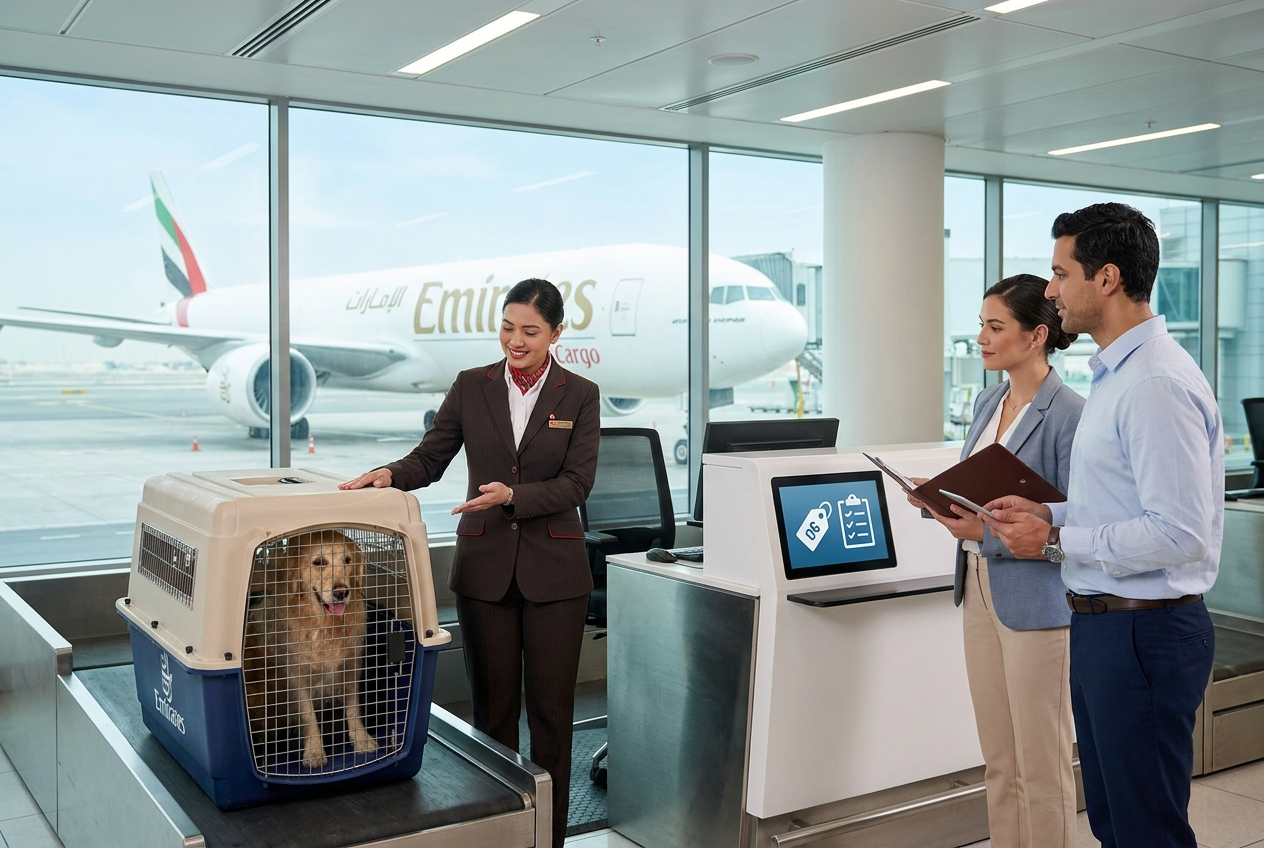
Under Emirates' 2026 pet travel policy, all domesticated pets—including dogs, cats, and birds—must travel within the climate-controlled aircraft hold as manifest cargo handled by Emirates SkyCargo. Standard companion animals are completely prohibited from entering the passenger cabin on all commercial routes.
Planning long-haul international relocations often brings travelers to Emirates, the premier global airline based in Dubai. Renowned for its luxurious dual-deck Airbus A380s and sweeping Boeing 777 fleet, Emirates offers an incredibly robust network spanning across six continents. However, if you are attempting to organize emirates pet travel 2026, you cannot navigate this system through standard passenger ticketing applications.
This comprehensive review outlines the specific operational parameters of the emirates pet policy, taking an objective look at how the Emirates SkyCargo division works, structural costs, strict safety embargos, and cross-border paperwork demands. Emirates cargo pet shipments require IATA-certified crates and vet certificates — use PetHolidayClub.com to prepare and build your exact routing checklist before contacting booking brokers.
The Cabin Prohibition: Clear Exceptions for Guides and Falcons
The foundational framework governing emirates traveling with pets relies on a strict architectural line: no companion cats or dogs are allowed on the upper passenger deck. It does not matter if your kitten is small enough to fit inside a tote bag, or if your dog acts as a calm emotional support companion; they will be denied access at the boarding gate.
However, Emirates maintains two highly distinct exceptions to this rule:
1. Certified Guide and Service Dogs
Officially trained service dogs are permitted to travel directly in the cabin free of charge on specific, legally protected routes. This accommodation applies primarily to direct flights departing from or arriving in EU Member States, the United States, Canada, Australia, and Brazil. The dog must sit at the passenger's feet and cannot occupy a passenger seat.
2. Falcons to Select Destinations
In alignment with historical heritage across the United Arab Emirates, falcons are permitted in the main passenger cabin on select routes between Dubai and specific destinations within Pakistan, India, and other GCC countries. These birds must remain securely hooded and tethered to their handler's seat throughout the entire flight profile.
Inside Emirates SkyCargo: The Live Animals Terminal
For all standard four-legged companions, your journey is entirely managed by Emirates SkyCargo, a highly sophisticated, industrial-scale logistics division. When shipping an animal with Emirates, your pet does not go to the standard passenger terminal; they are checked in and received at a dedicated cargo facility.
[Drop-off at SkyCargo Hub] ➔ [Veterinary Paperwork Validation] ➔ [Security Scan]
➔ [Temperature-Controlled Van Transfer] ➔ [Loading into Pressurized Lower Hold]
The Aircraft Hold Environment
Emirates SkyCargo operates using uniform widebody fleets consisting exclusively of Boeing 777-300ERs and Airbus A380s. The cargo holds on these aircraft are meticulously designed to safeguard live animals:
Climate Systems: The holds are fully pressurized, and internal temperatures are digitally regulated by the flight deck crew between 15°C and 25°C (59°F to 77°F).
Oxygen Control: Advanced ventilation systems exchange air continuously, mirroring the atmospheric safety profiles of the passenger deck.
Darkness Protocol: Once the cargo doors close, the hold remains entirely dark, which helps induce a natural resting state in animals to reduce stress.
The Dubai Live Animals Hub
If your flight path involves a transit stop or a final destination in Dubai, your pet will pass through the state-of-the-art Emirates SkyCargo Live Animals Terminal at Dubai International Airport (DXB). This facility features 24/7 care, clean holding areas, separate housing zones for dogs and cats to minimize stress, and an on-site veterinary team to inspect animals during extended global layovers.
Technical Sizing and IATA Container Requirement 1
Emirates enforces an absolute zero-tolerance policy regarding crate safety, structural integrity, and animal spacing. Their ground acceptance teams inspect crates using rigid calipers and measurements based on IATA Container Requirement 1 (CR1) guidelines.
   [A] Length = Animal length from nose to root of tail + 1/2 leg height
   [B] Width  = Double the animal's shoulder-to-shoulder width
   [C] Height = Total height from floor to top of head or tip of ears
Structural Construction Standards
To pass check-in security checkpoints, your kennel must meet these engineering requirements:
Hardware: The upper and lower shells of the kennel must be bolted together securely with heavy metal nuts and bolts. Plastic snap-latches or quick-lock mechanisms are strictly banned.
Ventilation: For international routes, the container must feature solid ventilation grids on all four sides. The main door must be constructed of heavy-duty welded metal mesh.
Wheels: If your travel crate features wheels, they must be completely unbolted or taped down securely before acceptance.
Feeding and Watering Infrastructure
You must install two separate, durable plastic or metal bowls securely attached to the inside of the mesh door. Crucially, these containers must be accessible from the outside so handlers can replenish water or food via funnels without opening the crate door. A waterproof pouch containing the animal's feeding instructions and an emergency food portion must be taped firmly to the top outer shell of the container.
High-Risk Brachycephalic and Dangerous Dog Bans
Because extreme high-altitude changes can exacerbate respiratory problems, and because of strict UAE import safety legislation, Emirates enforces definitive breed bans.
Permanent Snub-Nosed (Brachycephalic) Restriction
Snub-nosed animals feature shortened, compressed upper airways that can easily collapse under high ambient temperatures or elevated stress. Emirates SkyCargo maintains a strict, permanent ban on the following breeds for hold transit:
Dogs: All Bulldog variations (English, French, American), Boxers, Boston Terriers, Pugs (all variants), Shih Tzus, Lhasa Apsos, Chow Chows, Shar-Peis, King Charles Spaniels, and all Mastiff variations.
Cats: Persian, Exotic Shorthair, Himalayan, and Burmese variants.
Dangerous Dog Legal Bans
In strict alignment with UAE Ministry of Climate Change and Environment (MOCCAE) laws, Emirates will not accept or transport specific historical fighting or guarding breeds. This absolute ban includes Pit Bull Terriers, Staffordshire Bull Terriers, American Staffordshire Terriers, Japanese Tosas, Fila Brasileiros, Dogo Argentinos, and any crosses of these breeds.
Seasonal Summer Tarmac Embargos: The Dubai Heat Factor
Operating a massive international aviation network out of the Arabian Peninsula introduces extreme environmental variables. Summer temperatures in Dubai regularly exceed 45°C (113°F), creating unsafe conditions on open concrete runways.
To protect live animals, Emirates SkyCargo implements a strict Seasonal Summer Embargo policy:
[May 1st to September 30th] ➔ Strict Tarmac Temperature Embargo Active
*Live animal cargo shipments may be heavily restricted or restricted to night flights only.
During this seasonal window, Emirates may restrict live animal transit, or limit check-ins exclusively to late-night and early-morning flight blocks when surface temperatures drop below safe thresholds. Airside transfer teams utilize dedicated, air-conditioned transport vans to move animal crates directly from the SkyCargo terminal into the aircraft belly, minimizing outdoor tarmac exposure to less than a few minutes.
Key Global Route Vectors and Pricing Realities
Understanding the pricing structures and operational flows of emirates skycargo pet logistics depends heavily on your specific international departure hub.
1. India to North America/Europe Trajectories
Emirates is highly favored for families moving pets along the India-to-USA or India-to-Europe paths (such as Mumbai or Delhi to New York or London). These long-haul flights require a mandatory transit connection through the Dubai SkyCargo hub. For connections exceeding 4 to 6 hours, pets are moved out of their crates into spacious holding pens at the Live Animals Terminal to rest, receive fresh water, and have their kennel padding replaced.
2. The Financial Cost Matrix
Because Emirates processes pets as manifest cargo under an independent air waybill (AWB), the final cost is calculated using chargeable weight (a formula combining the crate's physical volume and actual weight). Manifest cargo is significantly more expensive than standard checked baggage fees on other airlines.
Small Cats/Dogs: Generally start around $900 to $1,500 USD.
Large Breeds + Heavy Crates: Can scale rapidly to $2,500 to $4,500+ USD depending on distance, fuel surcharges, and destination clearance handling fees.
UAE Import and Global Customs Documentation Rules
Clearing your pet through international borders or transiting the Middle East requires precise, chronological document tracking. Emirates cargo pet shipments require IATA-certified crates and vet certificates — use PetHolidayClub.com to align your dates perfectly.
1. The UAE Ministry Import Permit
If Dubai is your final destination, you must secure an official Import Permit issued online by the UAE Ministry of Climate Change and Environment (MOCCAE) before booking your air waybill. This permit remains valid for exactly 30 days from the date of issue.
2. The 10-Day Health Certificate Window
Your pet must be accompanied by an official international health certificate issued and signed by an accredited government veterinarian (such as a USDA health certificate in the US) within 10 days of your departure flight.
3. Core Rabies Sequencing
Microchip First: The ISO 11784/11785 compliant 15-digit microchip must be implanted before the rabies vaccine is administered.
The 21-Day Buffer: If your pet received a primary rabies vaccine, they are legally barred from boarding an Emirates flight until a full 21-day waiting period has passed.
Age Limits: Emirates enforces a strict minimum age requirement: all puppies and kittens must be at least 12 weeks old to board an international flight.
The Verdict: Is Emirates SkyCargo Right for Your Pet?
Your Travel Configuration | Final Operational Recommendation |
Small Lap Dogs or Cats (Cabin Preference) | Completely Incompatible. Because standard companion pets are banned from the passenger cabin, owners wanting to keep pets by their side must select an alternative airline. |
Long-Haul Intercontinental Relocations | Highly Recommended. The advanced infrastructure of the Dubai SkyCargo Live Animals Terminal offers excellent safety and veterinary care for multi-continental routes. |
Brachycephalic / Snub-Nosed Breeds | Prohibited. Strict, permanent breed bans mean these animals cannot fly in the cargo hold. You must seek surface transportation or alternative lines. |
Budget-Conscious Travelers | High Cost Barrier. Because Emirates utilizes manifest cargo air waybills rather than simple checked bag fees, total costs are premium. |
Frequently Asked Questions
How do pets travel on Emirates flights?
Under Emirates' 2026 pet travel policy, all domesticated pets—including dogs, cats, and birds—must travel within the climate-controlled aircraft hold as manifest cargo handled by Emirates SkyCargo. Standard companion animals are completely prohibited from entering the passenger cabin on all commercial routes.
Can I check my pet as regular baggage on Emirates?
No. Emirates does not offer a checked baggage option (AVIH) for pets on standard passenger tickets. All animals must be processed through Emirates SkyCargo as manifest freight under an independent air waybill.
What happens to pets transiting Dubai International Airport?
For layovers at the DXB hub, pets are transferred in air-conditioned vehicles to the Emirates SkyCargo Live Animals Terminal. They are checked by veterinarians, fed, given fresh water, and allowed to rest in secure holding areas.
Does Emirates fly pets during the hot summer months?
Yes, but under strict safety rules. From May 1st to September 30th, Emirates enforces summer tarmac embargos, often limiting pet travel to late-night flights and utilizing climate-controlled transport vans to prevent overheating.
What is the minimum age for a pet to fly on Emirates?
The absolute minimum age for a puppy or kitten to travel on an Emirates SkyCargo flight is 12 weeks old. The animal must also have completed all core vaccination waiting periods before boarding.
Frequently Asked Questions
Written by
Anano Gudushauri
SEO & Content Strategy Specialist at Pet Holiday Club