Dog Enrichment: What It Is, Why It Matters, and 10 Ways to Start Today
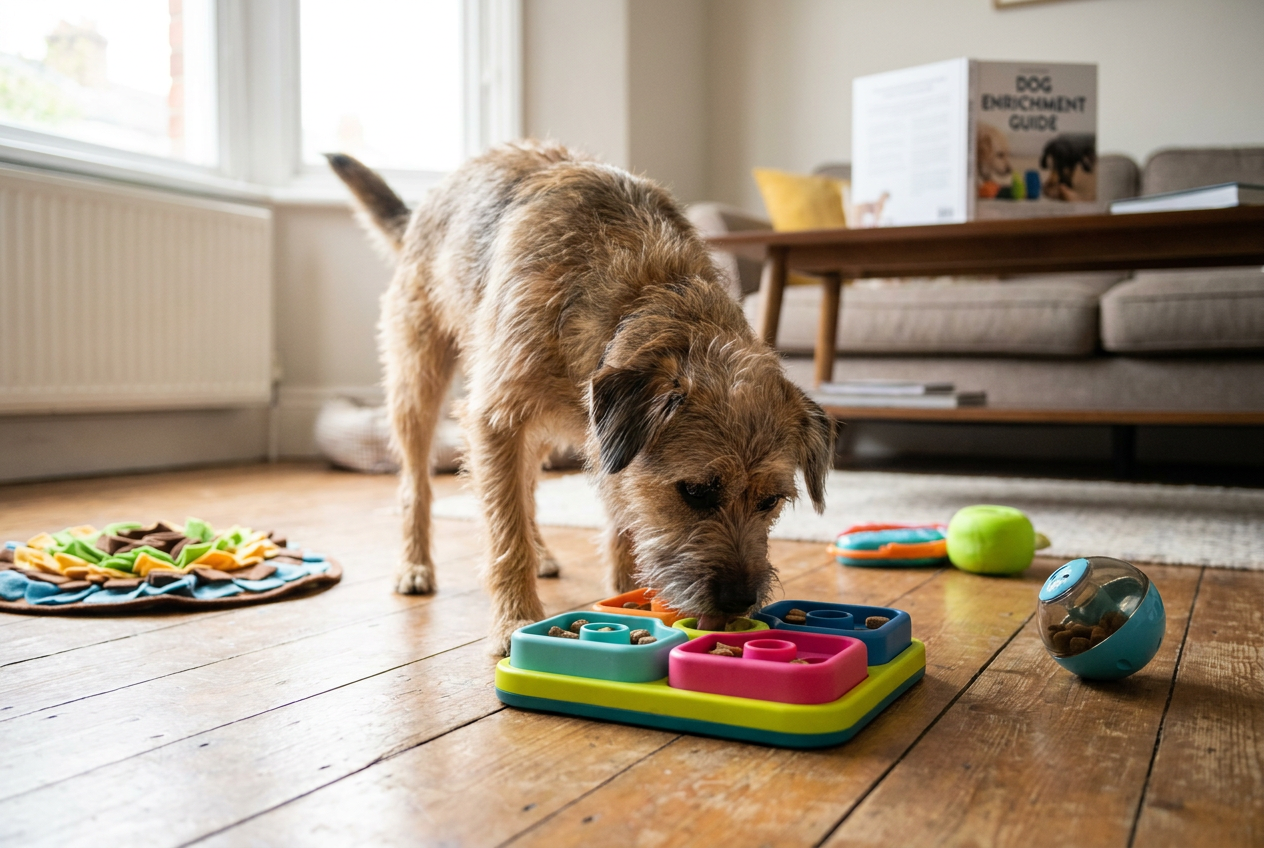
What Is Dog Enrichment?
Enrichment refers to activities that engage a dog's senses, instincts, and problem-solving abilities. The goal is to give dogs an outlet for natural behaviours — foraging, sniffing, exploring, chewing, solving problems — that domestic life often suppresses.
There are five main categories of enrichment:
Sensory enrichment: Activities that engage smell, sight, sound, taste, and touch. Sniff walks, novel scents, and different textures.
Cognitive enrichment: Puzzle feeders, interactive toys, training games, and problem-solving activities.
Social enrichment: Interaction with other dogs, people, and new environments.
Physical enrichment: Varied exercise including swimming, agility, and hiking — not just the same daily walk.
Nutritional enrichment: Delivering food in ways that engage the dog rather than serving it passively in a bowl. Kongs, lick mats, scatter feeding.
What the Science Says
The scientific evidence behind enrichment is substantial and growing.
A peer-reviewed study published in Veterinary Record (Heys et al., 2024) surveyed over 1,600 dog owners about canine enrichment feeding. The findings were striking: 98.2% of respondents agreed that enrichment feeding provides mental stimulation, and 96% said it prevents boredom. The majority also reported that it reduced food-seeking behaviour and improved their dog's overall contentment.
Research published in PMC (NCBI) confirms that environmental enrichment measurably reduces anxiety, stress indicators, and destructive behaviour in domestic dogs — effects previously documented primarily in zoo and shelter animals but now well-established for pet dogs living in homes.
The Human Animal Bond Research Institute (HABRI) published a major report in February 2025 on the role of companion animals for mental health, noting that the strength of the human-animal bond — and therefore the wellbeing of both owner and dog — is directly linked to the quality of enriching interactions between them.
"In 2025, mental enrichment is no longer a bonus — it's a basic need. As our understanding of canine psychology grows, the dog community is stepping up to provide more than just food and fetch." — MyPawsitivePals, 2025
Why This Matters More Than Ever in 2026
Post-pandemic dogs are a significant driver of the enrichment movement. Dogs that were raised during COVID-19 lockdowns — in constant company, with limited exposure to the outside world — are now struggling with separation anxiety, fear of strangers, and reactivity that routine walks alone cannot resolve.
Urban dog ownership has also accelerated the need. City dogs often have less access to off-lead space, unpredictable terrain, and the kind of environmental variety that rural dogs encounter naturally. Enrichment activities are a direct response to that deficit.
Nearly two thirds of UK pet owners said in 2026 that they would be placing greater emphasis on the mental and physical wellbeing of their pets this year — a figure that reflects a genuine shift in how owners understand their responsibility.
10 Evidence-Based Enrichment Activities to Start Today
1. The sniff walk
Replace a portion of your dog's walk with unstructured sniffing time. Let them stop and investigate every smell for as long as they want. Research confirms that sniffing is cognitively exhausting for dogs in the best possible way — a 20-minute sniff walk can tire a dog more effectively than an hour of brisk walking.
2. Scatter feeding
Instead of feeding from a bowl, scatter your dog's dry food across the grass or a snuffle mat. This mimics natural foraging behaviour and extends mealtime from 30 seconds to 10-15 minutes of active engagement.
3. Kong and lick mats
Fill a Kong or lick mat with wet food, peanut butter (xylitol-free), or plain yoghurt and freeze it. The extended licking action is naturally calming — it promotes serotonin release and reduces anxiety.
4. Puzzle feeders
Puzzle feeders require dogs to manipulate objects to release food. Start with simple levels and increase difficulty as your dog learns. The key is to make it achievable — frustration is not enriching.
5. Hide and seek with food or toys
Hide treats or a favourite toy around the house or garden and let your dog use their nose to find them. This is one of the simplest and most effective enrichment activities available — and requires nothing but what you already have.
6. Training new skills
Learning a new behaviour uses significant cognitive resources. Five to ten minutes of positive reinforcement training per day — teaching a new trick or behaviour — is one of the most impactful enrichment activities available.
7. Novel environments
New smells, surfaces, and sounds are inherently enriching. Varying your walking routes, visiting a new park, or simply letting your dog explore a new space provides fresh sensory input that familiar environments cannot.
8. Social time with other dogs
Well-matched play between dogs provides social enrichment that no amount of human interaction can replicate. Doggy daycares, playgroup sessions, and structured playdates with familiar dogs all count.
9. Chewing
Chewing is a natural, self-soothing behaviour for dogs. Appropriate chews — raw bones, bully sticks, deer antlers — provide sustained enrichment and are particularly effective for anxious dogs. Always supervise and choose chews appropriate for your dog's size and chew strength.
10. The cardboard box
One of the most underrated enrichment tools: a cardboard box with treats hidden inside. Let your dog figure out how to get to the treats. Simple, free, and surprisingly engaging.
Enrichment and Travel
One of the most overlooked aspects of international pet travel is enrichment. A dog that is mentally stimulated, calm, and accustomed to novel environments — whether through enrichment activities at home or varied experiences in daily life — travels significantly better than one that has had limited exposure to new situations.
Crate training, which is a form of environmental enrichment in itself, is also essential preparation for any dog travelling internationally in the cargo hold of an aircraft. A dog that has been positively trained to view their crate as a safe and familiar space will experience far less stress during a flight than one encountering a crate for the first time at an airport.
Pet Holiday Club helps pet owners prepare everything their dog needs for international travel — documentation, health certificates, vaccination records, and airline-specific crate requirements — for 190+ countries. petholidayclub.com
Frequently Asked Questions
How long should enrichment sessions last?
Start with 5-10 minutes per session and build from there. Enrichment should be engaging and positive — not frustrating. If your dog loses interest or appears stressed, end the session and try something simpler. Several short sessions throughout the day are more effective than one long one.
Can enrichment help with separation anxiety?
Enrichment can significantly reduce the severity of separation anxiety when used as part of a broader management plan. Frozen Kongs left before departure, snuffle mats, and lick mats are particularly effective. For severe separation anxiety, always consult a qualified behaviourist alongside enrichment strategies.
Is enrichment suitable for older dogs?
Yes — in fact, enrichment is particularly important for senior dogs. Cognitive decline in older dogs is well-documented, and regular mental stimulation has been shown to slow its progression. Adjust the difficulty to your dog's physical and cognitive ability.
Can too much enrichment be a problem?
Over-stimulation is possible — particularly in anxious dogs. Balance active enrichment with rest and downtime. A dog that is constantly stimulated without adequate rest periods can become more reactive, not less. Aim for enrichment that engages without overwhelming.
Is enrichment different for cats?
Yes. Cats have different natural behaviours and motivations. Feline enrichment focuses heavily on hunting simulation — feather wands, puzzle feeders, elevated perches, and opportunities to stalk, chase, and pounce. Many principles overlap, but the implementation differs significantly.
Frequently Asked Questions
Written by
Anano Gudushauri
SEO & Content Strategy Specialist at Pet Holiday Club