How to Crate Train Your Dog: A Complete, Vet-Backed Guide
Why Crate Training Matters
Dogs are den animals by instinct. In the wild, wolves and their ancestors sought out small, enclosed spaces to sleep and rest — spaces with a single entrance that offered a sense of security. A properly introduced crate taps directly into this instinct.
A crate is not a cage or a punishment. When introduced correctly, most dogs come to view their crate as a safe, comfortable space — somewhere to retreat when the world feels overwhelming. The American Kennel Club describes it as giving your dog "their own space" that "can calm anxiety."
For pet owners planning international travel, crate training is also a practical necessity. Airlines require dogs travelling in the cargo hold to be in an approved crate for the entire journey. A dog that has never spent time in a crate before a long-haul flight is a dog that will experience significant stress. One that has been trained to love their crate will often sleep through the whole thing.
"Acclimation is key. The best thing you can do for your pet's safety is to make their crate feel like a safe den at home — weeks before the flight." — Starwood Pet Travel, 2026
How Long Does Crate Training Take?
This is the question most owners want answered first — and the honest answer is: it depends. According to veterinary guidance from Dogster, most dogs take between one and four months to become fully crate trained.
The American Kennel Club recommends preparing for at least six months of consistent training, noting that "there will be ups and downs since dogs aren't linear learners."
Several factors influence the timeline:
🐾Age: Puppies generally learn faster than adult dogs. Older dogs with no crate history, or rescue dogs with negative associations, may take longer.
🐾Temperament: Some dogs are naturally more den-seeking. Others need more time and patience.
🐾Past experiences: A dog that has had a negative experience with confinement — being crated as punishment, or being left too long — will require extra patience and a slower approach.
🐾Consistency: Training that happens every day, in a calm and positive way, produces faster results than sporadic sessions.
The introductory phase — getting your dog comfortable approaching and entering the crate — typically takes between two and seven days. The next stage, building comfort with the door closed, usually takes one to two weeks. Getting your dog comfortable being alone in the crate for extended periods can take anywhere from one week to several months.
Step-by-Step: How to Crate Train Your Dog
1. Choose the right crate
Your dog's crate should be large enough for them to stand up, turn around, and lie down comfortably — but not so large that they could use one corner as a toilet. For puppies that will grow significantly, buy a crate sized for their adult body and use a divider to reduce the space while they are young.
Two main types are widely used: plastic airline-style crates (more enclosed, better for dogs who prefer darkness) and wire crates (more ventilation and visibility). For international travel, IATA-approved plastic airline crates are required for cargo travel on most airlines.
2. Introduce the crate positively
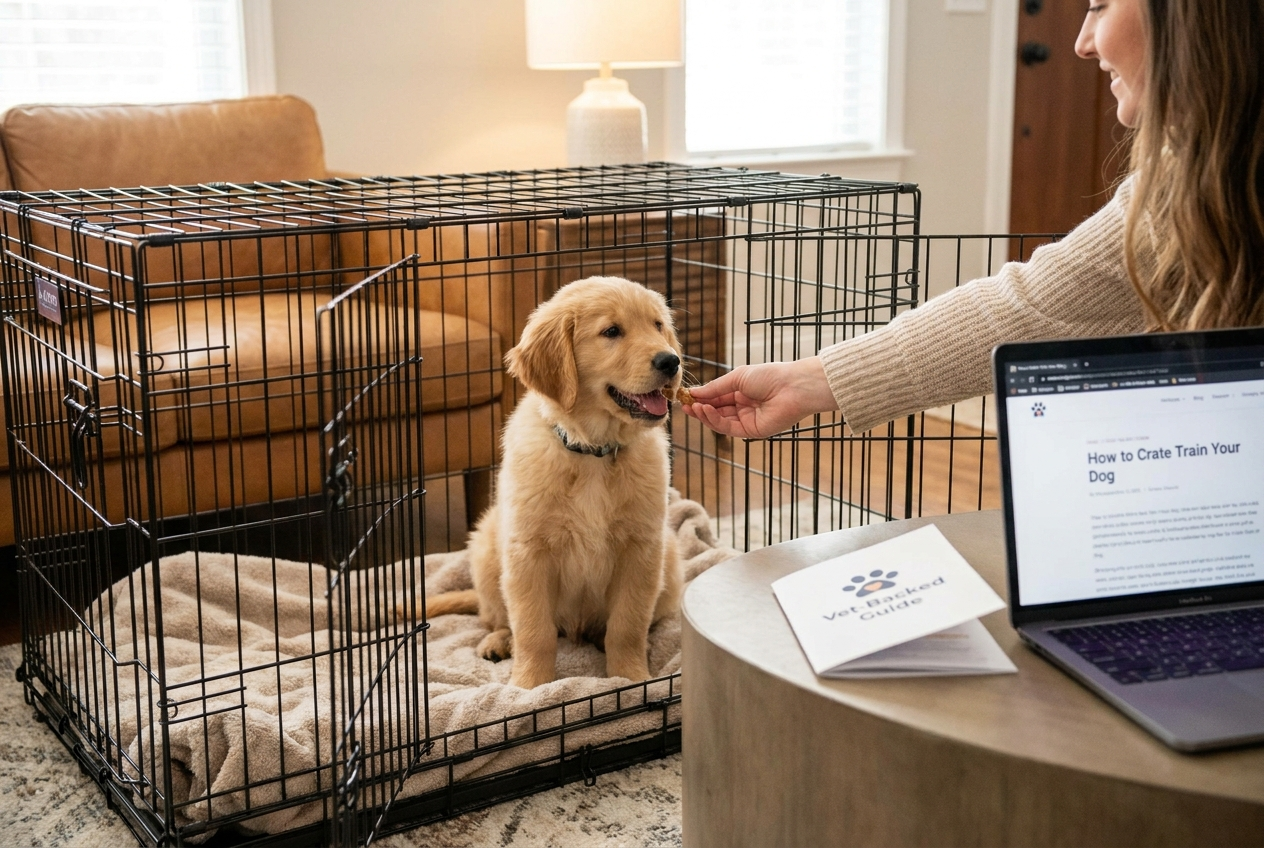
Place the crate in a room where your family spends time — the living room or kitchen, not an isolated corner. Put comfortable bedding and a few familiar toys inside. Leave the door open.
Drop treats near the crate, then just inside the entrance, then further inside. Never push or force your dog into the crate. The Animal Humane Society is clear on this point: "training should take place in a series of small steps — don't go too fast."
Praise your dog every time they show interest in or enter the crate. The goal of this stage is simple positive association — the crate means good things happen.
3. Feed meals in the crate
Once your dog is entering the crate willingly, begin feeding their regular meals inside it. Start with the food bowl near the entrance, then gradually move it toward the back over successive meals.
Once your dog is eating comfortably at the back of the crate, start closing the door during mealtimes. Open it as soon as they finish eating. Over time, increase the duration after eating — first a few minutes, then gradually longer.
If your dog whines to be let out, you have moved too quickly. Step back to a shorter duration and build up again more slowly.
4. Extend crate time while you are home
Begin leaving your dog in the crate for short periods while you are present — 10 minutes, then 20, then 30. Use a calm cue word such as "crate" or "kennel" each time you ask them to go in, and give a treat or a KONG filled with food as an incentive.
"The more the dogs associate the crate with a relaxed mindset, the more they'll ultimately enjoy hanging out in there. If you put the dog in the crate when they're playing, they'll want to come back out. But if you bring them in when they're calm, they will likely view it as a place of rest."
5. Begin leaving the house
Once your dog can comfortably stay in their crate for 30 minutes without showing anxiety or distress, begin leaving the house for short periods. Keep your departure routine calm and matter-of-fact. Long, emotional goodbyes increase anxiety.
Start with 30-minute absences and build gradually to longer periods. Keep arrivals equally low-key — excited reunions signal to your dog that your absence was something to worry about.
How Long Can a Dog Stay in a Crate?
This is a critical question, and the answer depends on age.
⏰Puppies under 6 months: No more than 3–4 hours at a time. Puppies can only hold their bladder for roughly one hour per month of age.
⏰Adult dogs (over 1 year): Generally up to 4–6 hours during the day. The 2:1 crate rule, as described by fear-free certified trainer Rachel Lane, is useful: "For every two hours a dog spends in their crate, they should spend one hour outside it."
⏰Overnight: Most adult dogs can be crated overnight — 7–8 hours — once fully trained. Keep the crate near your bedroom initially so your dog does not associate it with isolation.
⚠️ Important Note
A dog crated all day and all night does not get enough exercise or human interaction and can become depressed or anxious. Crate training is a tool, not a substitute for companionship and activity.
Common Mistakes to Avoid
❌Using the crate as punishment: This creates negative associations that are very difficult to undo. The crate must always be a positive space.
❌Moving too fast: Rushing the process causes anxiety. Each stage should be comfortable before progressing.
❌Ignoring whining immediately: If your dog whines when first introduced to the closed door, wait for a brief pause in the whining before opening — otherwise you teach them that whining gets the door open.
❌Leaving too long too soon: Exceeding your dog's bladder capacity before they are ready creates accidents in the crate, which makes training significantly harder.
❌Stopping too early: Continue crating your dog for short periods even after they are trained and comfortable, so they do not associate it exclusively with being left alone.
Crate Training and International Pet Travel
If you are planning to travel internationally with your dog, crate training is not optional — it is essential. Dogs travelling in the cargo hold of a commercial aircraft must be in an IATA-approved crate for the entire journey, which can last anywhere from two hours to over 20 hours on long-haul routes.
Airlines check that crates meet specific size, ventilation, and construction standards. The crate must be large enough for your dog to stand, turn, and lie down. It must have proper ventilation on multiple sides, a secure door, absorbent bedding, and clip-on water and food bowls accessible from outside.
A dog that is comfortable and relaxed in their crate at home will travel far better than one experiencing their crate for the first time at an airport. Begin crate training at least 8–12 weeks before any planned travel.
✈️ Ready for International Travel?
For a complete, country-specific guide to what your dog needs before travelling internationally — including health certificates, vaccination requirements, microchipping, and airline-approved crate specifications — use Pet Holiday Club's free checklist tool at petholidayclub.com. We cover 190+ countries, government-sourced and vet-verified.
Frequently Asked Questions
Written by
Ekaterina Shmeleva (DVM)