The 2026 United States Pet Travel Blueprint: Operational Rules for Exporting from and Importing to the USA
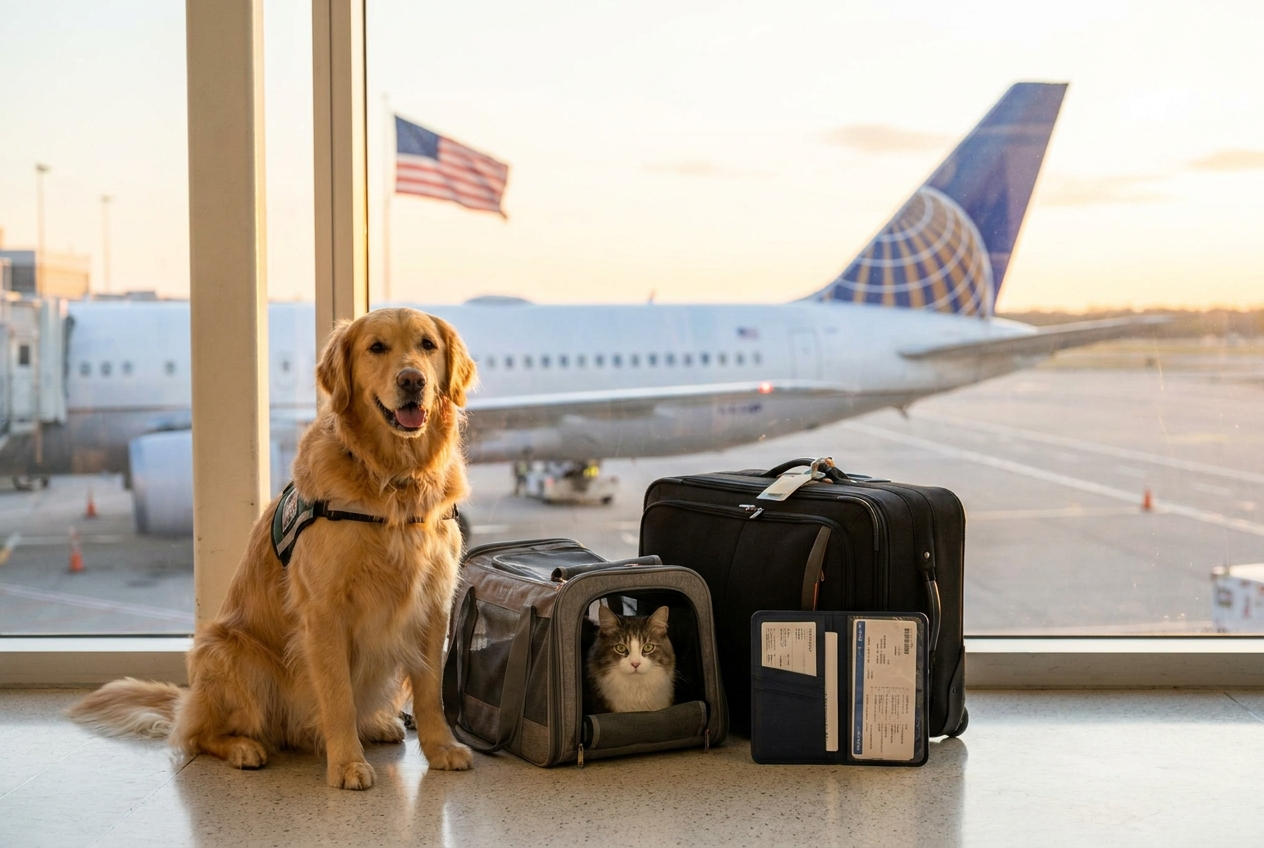
How do you transport a dog or cat into or out of the United States in 2026? Moving an animal outbound from the USA requires navigating the digital USDA VEHCS platform to secure official country-specific health certificates like the EU Annex IV or regional import permits. Conversely, importing a pet into the USA demands strict alignment with the latest CDC Dog Importation Regulations, forcing all dogs arriving from high-risk rabies countries to clear customs exclusively through select US airports equipped with dedicated CDC border inspection facilities.
As one of the world's largest hubs for international pet relocation, the United States enforces rigorous biosecurity measures on live animal movements. Whether you are flying a dog out of Los Angeles to the European Union or shipping a cat from overseas into New York, the logistical parameters demand total accuracy.
Following recent updates to global agricultural data frameworks and domestic disease-control measures, customs officials are cross-referencing multi-leg routing documents with intense scrutiny. If you arrive at an international gate with a missing transshipment declaration form, an unverified digital stamp, or a non-compliant microchip sequence, your pet faces immediate entry denial or state-mandated quarantine at the point of arrival. While traditional corporate brokers can manage the physical transit, keeping a handle on costs and timelines requires understanding exactly how the system operates. If you want control over your upcoming itinerary, try PetHolidayClub.com first to instantly map your specific origin and destination parameters. Let’s break down the operational rules governing the primary US export and import travel directions this year.
The 2026 United States Active Relocation Matrix
Before booking a passenger flight or cargo air-freight asset, analyze the core operational hurdles governing primary US export and import travel routes:
Flight Corridor | Route Type | Biosecurity Classification Status | Core Transit & Border Hurdles |
USA ➔ Spain / Denmark | Export | Standardized EU Tier 1 | Requires USDA VEHCS digital sign-off + Non-Commercial EU Annex IV Certificate. |
USA ➔ Mexico | Export | Streamlined Regional | Bypasses traditional health certs; relies on direct SENASICA gate inspection. |
USA ➔ Dominican Republic / Panama | Export | Multi-Tiered LATAM | Mandates local pre-clearance forms, health logs, and home quarantine filings. |
USA ➔ Thailand | Export | Strict Asian Hub | Requires automated DLD import permit approval + Bangkok manifest checks. |
USA ➔ Turkey | Export | Transcontinental Bridge | Requires dual-step USDA VEHCS alignment + local digital ministry tracking. |
UK / Netherlands / Cyprus ➔ USA | Import | CDC Low-Risk Rabies Exemption | Streamlined entry pathway; simple CDC Import Form + valid microchip log. |
India / Turkey ➔ USA | Import | CDC High-Risk Rabies Lock | High Friction. Requires mandatory CDC Dog Import Permit + specific BIP port entry. |
Part 1: Export Directions — Leaving the United States
Moving an animal outbound from the United States relies heavily on the Veterinary Export Health Certification System (VEHCS) managed by the USDA's Animal and Plant Health Inspection Service (APHIS). This secure digital infrastructure transmits health records from accredited private veterinarians to federal veterinary officials for official state endorsement. However, the operational steps downstream change drastically depending on your destination's regional biosecurity laws.
[Accredited Vet Exam] ➔ [Digital Upload to USDA VEHCS] ➔ [Federal Endorsement Stamp] ➔ [Valid Outbound Flight Asset]
1. USA ➔ Spain & Denmark (The European Union Gate)
The European Union maintains uniform health guidelines under its non-commercial live animal regulations, meaning the physical prep for Madrid or Copenhagen follows an identical regulatory framework.
The Chronological Sequence Rule: Pets must be microchipped with a 15-digit ISO 11784/11785 compliant chip before or on the exact same day as their primary rabies vaccination. Any vaccination administered prior to chip implantation is legally null and void.
The 21-Day Waiting Lockout: If your pet is receiving a first-time rabies vaccine or a booster shot following a lapse in coverage, they are legally barred from entering Spain or Denmark until 21 clear days have passed from the date of injection.
The EU Annex IV Certificate: Your accredited vet must issue an EU Non-Commercial Health Certificate. This file must be submitted via USDA VEHCS for official electronic endorsement. Once digitally signed by the USDA, it provides you a strict 10-day window to board an international flight and arrive at an EU Border Inspection Post (BIP).
2. USA ➔ Mexico (The Streamlined Border Corridor)
The logistical flow for taking a domestic pet from the United States into Mexico remains one of the most streamlined corridors available, thanks to bilateral agricultural agreements.
The Certificate Exemption: You do not need to obtain an expensive, federally endorsed USDA international health certificate to cross into Mexico with a pet dog or cat.
The SENASICA Portal Check: Upon arrival at a Mexican land border or airport terminal, travelers must present their pet to an official SENASICA animal health inspection officer. You must provide a clear private veterinary record or invoice on letterhead showing:
Your pet is free from external parasites and open wounds.
A valid rabies vaccination log administered within the past 12 months.
If the SENASICA officer detects ticks or fleas during the physical evaluation, you will be directed to an on-site local veterinarian to pay for a complete anti-parasitic treatment before border entry is granted.
3. USA ➔ Dominican Republic & Panama (The Caribbean & Latin American Tracks)
Exporting pets from the US to the Caribbean and Central America involves navigating specific local consular rules and pre-arrival authorization filings.
The Dominican Republic Vector: Requires an international health certificate issued by an accredited vet and endorsed by the USDA within 15 days of departure. Upon arrival, you must pay an official animal sanitation inspection fee of roughly $10 USD per animal at customs.
The Panama MINSA/MIDA Protocol: Panama requires both a USDA health certificate and a specialized pre-arrival import notification form filed with the Ministry of Agricultural Development (MIDA).
The Home Quarantine Mandate: To bypass a costly mandatory 14-day institutional quarantine facility stay at Tocumen International Airport (PTY), owners must submit a "Home Quarantine Request" form to the Ministry of Health (MINSA) at least three business days prior to landing, paying an administrative license fee of $130 USD per pet.
4. USA ➔ Thailand (The Southeast Asian Portal)
Thailand enforces strict automated import controls to protect its domestic livestock and wildlife ecosystems.
The DLD Advance Permit: You cannot simply board a flight to Bangkok with a pet using just a health certificate. At least 14 to 45 days before departure, you must submit an electronic application through the Thai Department of Livestock Development (DLD) portal to secure an official DLD Import Permit.
The Clinical Rules: The health documentation must explicitly state that the animal has been vaccinated against Rabies, Leptospirosis, Distemper, Hepatitis, and Parvovirus at least 21 days prior to travel. All animals must enter Thailand via an approved manifest cargo routing or clear the Suvarnabhumi Airport Animal Quarantine Station immediately upon arrival if traveling as checked baggage.
5. USA ➔ Turkey (The Transcontinental Airbridge)
Bringing a pet from the United States into Turkey requires clear synchronization between your private vet and federal regulators.
The USDA VEHCS Path: Your pet must travel with a United States International Certificate for Health Examination for Small Animals. This form must be completed by a USDA-accredited veterinarian and digitally signed and endorsed through the USDA VEHCS online portal.
The Landing Clearance: Upon touching down at Istanbul Airport, your digital health files are reviewed by the local border inspection post. Pets must also have a record of a valid rabies vaccination administered at least 21 days before entry into Turkish territory.
Part 2: Inbound Frameworks — Importing Into the United States
Importing a dog, cat, or ferret into the United States has changed completely following the comprehensive deployment of the Centers for Disease Control and Prevention (CDC) Dog Importation Regulations. This modern update classifies global origins into two simple categories: Low-Risk Rabies territories and High-Risk Rabies territories.
[CDC INBOUND US LANDING CLASSIFICATION]
/ \
[Low-Risk Origin Hubs] [High-Risk Origin Hubs]
(UK / Netherlands / Cyprus) (India / Turkey)
│ │
- CDC Dog Import Form - Active CDC Import Permit
- Microchip, 6mo+ Age - Designated CDC BIP Airport
- Any US Port of Entry - Mandatory Titer/Quarantine Check
1. Low-Risk Origins: United Kingdom, Netherlands, & Cyprus ➔ USA
If you are relocating a pet dog into the United States from countries officially classified by the CDC as low-risk or entirely free of canine rabies—such as the UK, the Netherlands, or Cyprus—the inbound entry path is highly accessible.
The Baseline Entry Rules: The dog must be at least 6 months old on the exact calendar day of entry, possess an ISO-compliant microchip, and look visually healthy.
The CDC Dog Import Form: The owner must fill out an electronic CDC Dog Import Form via the official CDC portal before boarding their flight. This generates a digital receipt that must be shown to your airline carrier during check-in.
Port Flexibility: Pets traveling from these low-risk origins can land at any international airport in the United States without restricted routing.
2. High-Risk Origins: India & Turkey ➔ USA
If you are importing a dog into the United States from a country classified as a high-risk rabies zone—such as India or Turkey—the security checks are incredibly demanding. This path requires significant advance planning.
The Mandatory CDC Dog Import Permit: You must apply for and receive an official CDC Dog Import Permit online before booking any travel assets. This application requires uploading verified microchip records, a history of valid rabies vaccinations, and an official rabies blood titer report from an approved laboratory.
The Restricted Port Mandate: Dogs traveling from high-risk zones are legally blocked from landing at standard US airports. They must enter the United States exclusively through one of the specific ports of entry equipped with an active, on-site CDC Border Inspection Facility. These airports include:
New York (JFK)
Los Angeles (LAX)
Miami (MIA)
Atlanta (ATL)
Washington D.C. (IAD)
Chicago (ORD)
Attempting to fly a dog from Mumbai or Istanbul into an unauthorized airport like Boston (BOS) or San Francisco (SFO) will lead to an immediate entry denial. The airline will be forced to return the animal to their origin country on the next available flight at the owner's expense.
Part 3: Universal Technical Requirements for US Entry
Whether your pet is returning home or arriving in America for the first time, US Customs and Border Protection (CBP) alongside the CDC enforce strict standardization baselines.
1. Identification and Microchip Architecture
Every animal must be formally microchipped prior to any final clinical evaluations or travel health certification stamps.
Hardware Compliance: If a microchip is used, it must be a passive radio-frequency transponder complying with ISO Standard 11784 and readable by an HDX or FDX-B reader.
Scanner Interface: The chip must be fully scannable by an ISO 11785-compatible scanner. If your pet uses an atypical regional chip, the traveling owner bears full responsibility for providing an appropriate scanner during the physical border gate check. A clearly readable tattoo is also accepted if applied prior to current microchip mandates.
2. Rabies Vaccine and Booster Controls
Approved Biologicals: The vaccine administered must be an inactivated option (modified live vaccines are strictly banned) or an approved recombinant option compliant with global standards published by the World Organisation for Animal Health (WOAH/OIE).
The Sequencing Anchor: The exact vaccination date must be meticulously logged inside the pet’s passport or veterinary certificate. Crucially, the vaccination cannot be administered before the microchip implantation date. The day of the vaccination counts as Day 0.
The Booster Clause: If a booster vaccination is administered after a previous vaccine's coverage window has formally expired, it is legally treated as a brand-new primary vaccination, restarting all administrative waiting periods.
3. Advanced Chronological Timeline Scheduling
For high-friction routes requiring rabies antibody titers (FAVN checks) prior to entering or returning to the United States, use this exact mathematical scheduling matrix:
[THE MEDICAL CHRONOLOGICAL SCHEDULE]
Rabies Vaccine Administered ➔ [Wait 30 Days] ➔ Blood Sample Drawn ➔ [Wait 3 Months] ➔ Approved US Port Entry
Blood Draw Window: Blood must be taken at least 30 days after the latest rabies vaccination.
Laboratory Threshold: The blood sample must be processed by an EU-approved or CDC-approved laboratory, demonstrating a rabies antibody level of at least 0.5 IU/ml.
The 3-Month Lockout: The test must be completed at least 3 months before entry into the United States if originating from a high-risk zone without a US-issued vaccination certificate.
The Repeat Titer Exemption: A new rabies titer test is not required if the animal previously achieved an acceptable antibody level and rabies vaccinations have been kept continuously valid without a single day of coverage lapse.
Part 4: Onboard Capacity Caps & Document Lifespans
1. Passenger Pet Allowance Limits
To prevent commercial puppy mill exploitation under the guise of personal travel, US customs regimes enforce a strict capacity ceiling on non-commercial passenger travel:
[PASSENGER CAPACITY LIMITS]
Max 2 Pets Per Traveler
[Track A: 2 Cats] ➔ [Track B: 1 Cat + 1 Dog] ➔ [Track C: 2 Dogs]
Critical Operational Mandate: Each individual animal must travel with its own separate, dedicated folder of original documents.
2. Certificate Expiration Lifespans
The Export/Import Window: The official Veterinary Health Certificate endorsed by the exporting nation's official veterinary authority remains valid for exactly 4 months from the date it is signed by the official government veterinarian, or until the rabies vaccination expires—whichever comes first.
Master US Relocation Countdown Checklist
Keep your cross-corridor milestones organized with this chronological countdown log based on a standardized international relocation blueprint:
[ ] Day -150 (5 Months Out): Implant your pet's ISO 11784/11785 microchip if not already present. Administer an approved inactivated or recombinant rabies vaccine (Day 0 of the medical clock).
[ ] Day -120 (4 Months Out - Earliest Titer Window): Visit an authorized vet at least 30 days after the rabies shot to draw blood for the Rabies Antibody Titration Test. Route the sample to an approved lab.
[ ] Day -90 (3 Months Out - The Waiting Lock): Receive passing lab results showing an antibody count $\ge 0.5\text{ IU/ml}$. This begins the mandatory 3-month countdown before your pet can legally land in the USA from high-risk zones.
[ ] Day -60 (2 Months Out): Submit your DLD advance permit requests for Thailand exports, or file your pre-arrival home quarantine forms with Panama's MINSA platform.
[ ] Day -45 (1.5 Months Out): Purchase an IATA Container Requirement 1 (CR1) compliant flight crate or a highly ventilated soft carrier. Begin positive crate training at home to lower your pet's travel stress.
[ ] Day -30 (1 Month Out): Complete your pet’s core vaccinations (DHPP/FVRCP) and make sure your primary vet's digital access credentials for the USDA VEHCS platform are active.
[ ] Day -10 (10 Days Out): Complete your pet's final clinical health exam with an accredited vet. Have them upload the completed EU Annex IV or international forms to the USDA portal for federal signature.
[ ] Day -3 (72 Hours Out): For low-risk imports to the USA (UK, Netherlands, Cyprus), log into the CDC portal and submit your mandatory CDC Dog Import Form to generate your airline check-in receipt.
[ ] Day 0 (Travel Day): Arrive at the terminal 4 hours before your flight. Bring your printed, bilingual document folder (Passport, Original Titer Sheets, and Health Certificates) to present at the gate counter.
Traditional brokers handle everything—but if you want absolute control over your timeline and budget, try PetHolidayClub.com first. Select your exact US export or import route today to generate your error-free digital travel roadmap.
Frequently Asked Questions
What are the strict criteria for a microchip to be accepted for US entry?
The microchip must be a passive radio-frequency transponder that fully complies with ISO Standard 11784. It must utilize HDX or FDX-B transmission technology and be readable by standard ISO 11785-compatible scanners. If your pet has a non-standard chip, you must provide your own scanner at the border checkpoint.
Can I bring my pet to Mexico from the USA using the digital USDA VEHCS portal?
No, because a formal USDA international health certificate is completely exempted for personal dogs and cats crossing into Mexico. Instead, you simply bring your pet directly to a SENASICA border inspection office at your destination land port or airport gate, presenting standard veterinary proof of a rabies vaccination given within the past 12 months.
What happens if I fly a dog from a high-risk rabies country like India into an unapproved US airport?
Your dog will be immediately denied entry into the United States. Under CDC border enforcement laws, dogs arriving from high-risk zones can only clear customs at designated airports with active CDC quarantine facilities (JFK, LAX, MIA, ATL, IAD, ORD). The airline will return the animal to the origin hub on the next outbound flight at the owner's expense.
How long does an international Veterinary Health Certificate remain valid for US travel?
The certificate remains legally valid for 4 months from the exact date it is signed and endorsed by the official government veterinarian of the exporting country, or until the pet's rabies vaccination coverage window expires, whichever comes first.
Are puppies and kittens under 3 months allowed to enter the US from low-risk zones?
No. Under current CDC biosecurity mandates, all dogs and cats must be at least 6 months old on the exact calendar day of entry into the United States, regardless of whether they originate from a low-risk country like the UK or a high-risk country.