Turkish Airlines Pet Policy 2026: Cabin Rules, Istanbul Hub, and Route-Specific Requirements
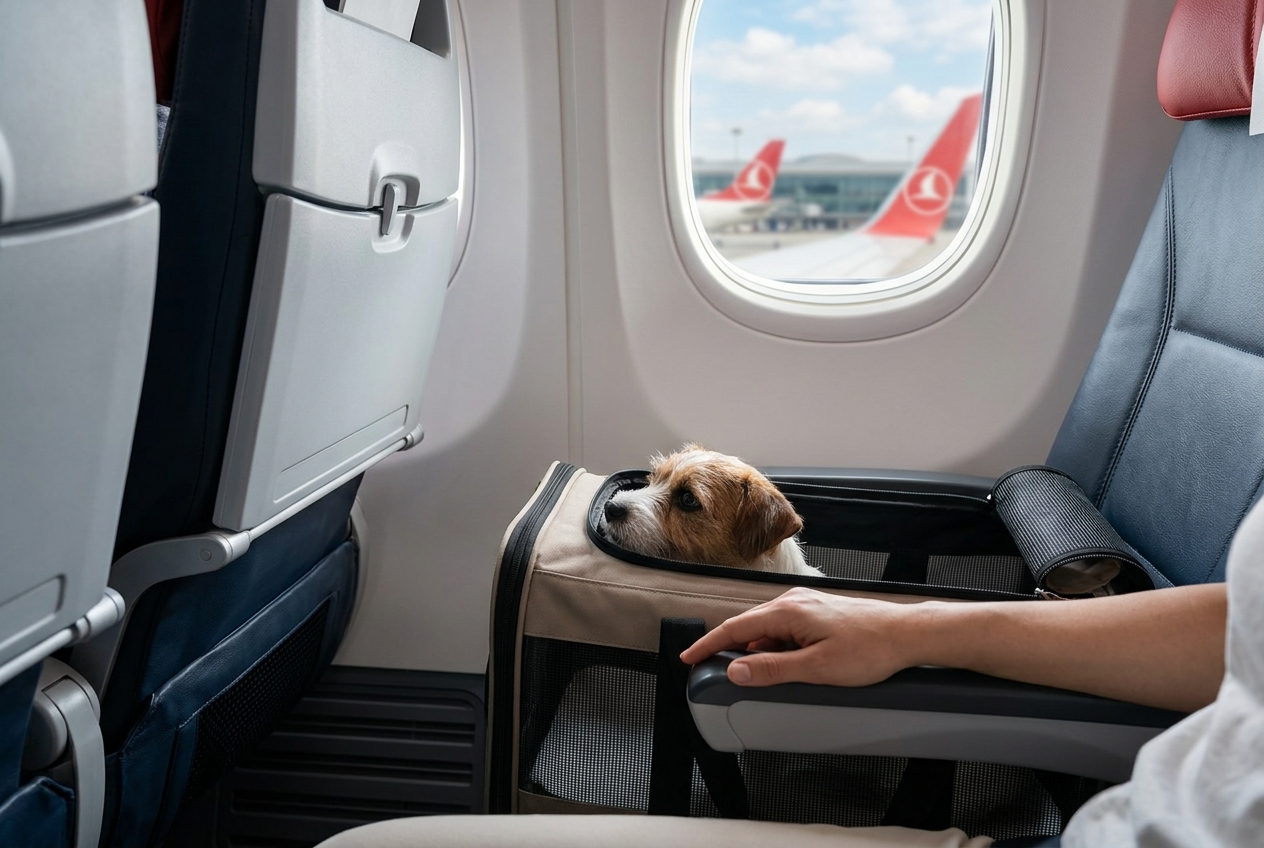
If you book a ticket with Turkish Airlines intending to travel with your dog and your cat on the same flight, one of them will be denied boarding at the gate—even if they are traveling with different passengers in completely separate cabins. Turkish Airlines enforces a strict "no-mix" safety protocol: cats and dogs (or cats and birds) are never allowed on the same aircraft simultaneously. Whichever species is booked and confirmed first locks out the other species for that entire flight. If a passenger has already registered a cat for the cabin, no dogs can board that plane—neither in the cabin nor in the climate-controlled cargo hold. This unique operational rule is one of the many reasons why navigating this global carrier’s pet policy requires precise, up-to-date knowledge.
As a massive global airline connecting over 120 countries through its mega-hub at Istanbul Airport (IST), Turkish Airlines is a primary choice for pet owners moving animals between Europe, the Americas, Asia, and the Middle East. However, because Istanbul is a primary transit point, a simple layover can completely alter your pet’s entry requirements, particularly concerning rabies antibody titer tests.
Turkish Airlines Pet Policy: Key Facts
In-Cabin Pet Fee: Starts at approximately $75 USD for international flights departing from or arriving in Turkey, calculated via a dynamic segment-by-segment online fee calculator.
In-Cabin Weight Limit: Strictly 8 kg (17.6 lbs), which must include the combined weight of the pet and its carrier.
Hold/Cargo Pet Fee: Starts at $150 USD per segment for international flights, categorized dynamically by your pet’s weight class (Light, Medium, or Heavy).
Maximum Carrier Dimensions (Cabin): 23 cm Height × 30 cm Width × 40 cm Length (approximately 9" H × 11.8" W × 15.7" L). Soft-sided carriers are mandatory.
Allowed Species: Domestic dogs, cats, and small songbirds (specifically budgerigars and canaries).
Istanbul Transit Rules: Transit times exceeding 4 hours require the owner to provide food, an automatic watering bowl, and clear feeding instructions affixed to the exterior of the cargo crate.
In-Cabin Pet Rules (PETC)
To travel in the cabin as a "Pet in Cabin" (PETC), your animal must meet strict weight, container, and behavioral criteria. Only domestic dogs, domestic cats, and small songbirds like canaries or parakeets are permitted inside the passenger cabin.
Carrier Requirements & Dimensions
Turkish Airlines has one of the smallest maximum height requirements in the industry for in-cabin carriers. Soft-sided carriers are mandatory; hard-sided cases are not permitted in the passenger cabin.
Height: Must not exceed 23 cm (approx. 9 inches).
Width: Must not exceed 30 cm (approx. 11.8 inches).
Length: Must not exceed 40 cm (approx. 15.7 inches).
Ventilation: The soft carrier must have ventilation holes of at least 2.5 cm in diameter on at least three sides.
Closure: The bag must be fully leak-proof, chew-safe, and remain zipped or closed securely throughout the entire duration of the flight.
Weight Limits
The combined weight of the pet and the soft carrier must not exceed 8 kg (17.6 lbs). This limit is absolute. Airport agents at check-in will weigh your pet inside the carrier. If the scale reads 8.1 kg, your pet will be rejected from cabin travel and must either be re-registered for the cargo hold (if a suitable hard-sided crate is available) or denied boarding.
In-Cabin Booking and Seating Restrictions
Passenger Limit: A maximum of two pets can be booked per passenger, but only one carrier is allowed in the cabin per person (the second pet must travel in the hold).
Multiple Pets in One Carrier: You may carry two pets of the same species (e.g., two cats or two small dogs) in a single in-cabin carrier, provided they are familiar with each other, can comfortably stand and turn around, and their combined weight remains under the 8 kg ceiling.
Seat Allocation: Passengers traveling with an in-cabin pet are restricted to standard window seats or specific front-row seats. You cannot sit in exit rows or bulkhead seats for safety reasons.
Cargo & Aircraft Hold Pet Rules (AVIH)
If your pet and its carrier weigh more than 8 kg, they must travel in the aircraft's climate-controlled, pressurized cargo hold as "Animal in Hold" (AVIH).
Crate Specifications for the Hold
The safety of your pet in the cargo hold depends entirely on the design of their crate. Turkish Airlines enforces standard International Air Transport Association (IATA) Live Animals Regulations:
Dimensions: Cargo crates cannot exceed 75 cm Height × 75 cm Width × 125 cm Length.
Material: Only hard-surfaced crates (heavy-duty plastic, metal, or wood) are accepted. Soft-sided bags are strictly prohibited in the cargo hold.
Space Requirements: The crate must be large enough for your pet to stand fully upright (without their ears touching the top), turn around comfortably, and lie down in a natural position.
Locking Mechanism: The crate must feature a secure, lateral locking system made of metal.
Labeling: You must securely affix an identification label to the outside of the crate containing your full name, address, phone number, destination, the number of animals inside, and your pet’s name.
Hold Flight Fees & Weight Classes
Cargo pet fees are processed as excess baggage and are categorized by weight brackets, which include the combined weight of your pet and their hard-sided crate:
Light (0–23 kg / 0–50.7 lbs): Starts at $150 USD per international segment.
Medium (24–32 kg / 52.9–70.5 lbs): Starts at $150 USD per international segment.
Heavy (33 kg+ / 72.7 lbs+): Starts at $150 USD per international segment, up to a maximum weight ceiling of 50 kg (110 lbs) for standard checked AVIH. Pets over 50 kg must be shipped via Turkish Cargo as manifest freight.
For comprehensive information on preparing your pet's documentation for international borders, you can reference the Pet Travel Country Guides | Import & Export Rules by Country | Pet Holiday Club to ensure you don't miss any country-specific certificates.
Breed & Species Restrictions
Due to safety concerns regarding respiratory distress at high altitudes and potential aggression, Turkish Airlines restricts several dog and cat breeds from flying.
Short-Nosed (Brachycephalic) Breed Regulations
Brachycephalic breeds have compromised respiratory systems that make them highly vulnerable to heatstroke and oxygen deprivation during flights. Turkish Airlines handles these breeds with a dual-tiered policy:
The Brachycephalic Rule: Flat-nosed cats and dogs listed below are permitted to fly in the cabin only, provided they meet the 8 kg weight limit. They are strictly prohibited from traveling in the cargo hold as standard baggage. If they exceed 8 kg, they can only be transported through specialized commercial shipping via Turkish Cargo, which utilizes advanced climate management.
Restricted Cat Breeds (Cabin Only) | Restricted Dog Breeds (Cabin Only) |
Persian | Pug (all types) |
Scottish Fold | French Bulldog / English Bulldog |
British Shorthair | Boston Terrier / Boxer |
Burmese / Birman | Pekinese / Shih Tzu |
Himalayan / Exotic Shorthair | Lhasa Apso / Chow Chow / Shar Pei |
Completely Banned Dog Breeds
In accordance with international aviation safety regulations and Turkish import laws, the following dog breeds (and their crossbreeds) are completely banned from all Turkish Airlines passenger flights:
Pitbull Terrier / American Pitbull Terrier
American Staffordshire Terrier
Staffordshire Bull Terrier
Bull Terrier
Japanese Tosa
Dogo Argentino
Fila Brasileiro
Cargo-Restricted Breeds (Turkish Cargo Only)
Certain large, powerful guardian breeds are not allowed to travel as standard checked baggage in the hold. They may only fly if booked directly through the cargo terminal via Turkish Cargo in specialized reinforced crates:
Doberman (including Pinscher Doberman and all Doberman types)
Rottweiler
Mastiff (except Bull Mastiff)
American Bulldog / Bandog / Tosa Inu
Caucasian Ovcharka / Anatolian Shepherd / Boerboel
Presa Canario
Wolfdog Hybrids
International Route Requirements & The Istanbul Hub
Connecting through Istanbul Airport (IST) introduces complex regulatory challenges that many pet owners fail to anticipate.
The Istanbul Transit Trap: Rabies Titer Tests (FAVN)
Turkey is classified as an "unlisted third country" (high-risk rabies country) by the European Union and the United Kingdom. This status has serious implications if you are transiting through Istanbul:
The 3-Month Wait Rule: If you are traveling from the UK or EU to another destination and layover in Istanbul with a pet traveling in the cargo hold, your pet is technically transiting through a high-rabies-risk country. To re-enter the UK or EU after this transit, your pet must have a valid Rabies Antibody Titer Test (FAVN).
Timeline: The blood sample for the FAVN test must be drawn at least 30 days after the rabies vaccination. After the blood draw, your pet must wait 3 full calendar months before they are allowed to enter or re-enter the UK or EU.
Quarantine Risk: Skipping this step will result in your pet being seized at the EU/UK border and placed in commercial quarantine for up to 21 days at your expense.
General Export and Import Documentation
To fly internationally with Turkish Airlines, you must present the following paperwork at the check-in desk:
ISO 11784/11785 Microchip: Must be implanted before any vaccines are administered. The microchip number must match all health records exactly.
Rabies Vaccination Certificate: Administered at least 30 days and no more than 12 months before travel. Turkish Airlines does not recognize the 3-year rabies vaccine; annual boosters are mandatory.
Veterinary Health Certificate: Must be issued by an official government veterinarian in the country of origin within 48 hours (2 days) of departure.
Destination Entry Permits: For example, when traveling to the Turkish Republic of Northern Cyprus, you must obtain an import permit from their Veterinary Department, which is valid for 60 days.
How to Book a Pet on Turkish Airlines: Step-by-Step
Turkish Airlines requires all pet reservations to be fully confirmed at least 6 hours prior to departure. Because aircraft have strict limits on the number of animals allowed in each cabin, you should book your pet's slot the moment you purchase your own ticket.
1.Check Flight Availability:Before purchasing your ticket.
Before buying your passenger ticket, call the Turkish Airlines customer service line or use the live chat to verify if the flight has open pet slots. Airlines restrict the total number of cabin and cargo pets allowed per aircraft model.
2.Book Your Ticket and Retrieve PNR:Immediate.
Purchase your flight ticket. Once confirmed, locate your 6-character Passenger Name Record (PNR) code, which is required to add services to your reservation.
3.Add Pet via Website or App:Minimum 6 hours before departure.
Log into the "Manage Booking" portal on Turkish Airlines official website or the mobile app using your PNR and last name. Select "Traveling with Pets," input your pet's species, exact weight, and carrier dimensions (length, width, height).
4.Calculate and Confirm Fees:Online payment.
Use the integrated Pet Fee Calculator on the platform to view your estimated fee. Complete the booking. Note that while the reservation is confirmed online, you will pay the physical pet fee at the airport check-in desk on the day of departure.
5.Arrive Early for Veterinary Check-In:3 to 4 hours before flight.
On travel day, bypass the self-service kiosks and head directly to the main check-in counter. An agent will physically inspect your carrier, weigh the pet, and verify your veterinary health certificates, rabies records, and microchip documents.
Tips for Flying via the Istanbul Hub
Traveling through Istanbul Airport (IST) requires operational preparation to ensure your pet’s comfort and safety:
Supply Extra Food & Automated Waterers: If your transit at IST exceeds 4 hours, or if your total flight duration is over 8 hours, you must attach dry food in a leak-proof container and an automated, drip-free water dispenser to the inside of the cargo crate. Turkish ground handlers will replenish water during long layovers.
Lounge Access with Pets: If you have access to the Turkish Airlines Miles&Smiles or Business Class Lounges during your layover, your in-cabin pet is welcome to join you. They must remain inside their zipped carrier at all times. Guide or assistance dogs must wear a muzzle while inside the lounge.
The Pilot's Final Word: Under Turkish Airlines rules, the pilot-in-command has absolute authority over whether pets are allowed in the cargo hold. If the pilot determines that ground temperatures in Istanbul are too high, or that cargo hold ventilation is suboptimal, they can deny boarding to cargo pets. Always have a backup plan in case of extreme weather delays.
How Turkish Airlines Compares for Pet Travel
Airline Feature | Turkish Airlines | Lufthansa | Air France |
In-Cabin Weight Limit | 8 kg (17.6 lbs) | 8 kg (17.6 lbs) | 8 kg (17.6 lbs) |
Max Carrier Height | 23 cm (9 in) | 23 cm (9 in) | 28 cm (11 in) |
Allowed Cabin Species | Dogs, Cats, Small Birds | Dogs, Cats | Dogs, Cats |
Brachycephalic Hold Travel | Prohibited (Cargo/Cabin only) | Prohibited | Prohibited |
UK / Ireland Pet Flights | Prohibited (Except Service Dogs) | Allowed via Cargo Only | Allowed via Cargo Only |
Frequently Asked Questions
Q: Can my dog and cat travel together on the same Turkish Airlines flight?
No. Turkish Airlines enforces a strict species-isolation rule. If a cat is booked in the cabin or hold, no dogs are permitted on that entire aircraft, and vice versa.
Q: What happens if my pet and carrier weigh more than 8 kg?
If the combined weight exceeds 8 kg, your pet cannot travel in the cabin. They must travel in the climate-controlled cargo hold in an approved hard-sided crate.
Q: Does Turkish Airlines allow pets on flights to the United Kingdom?
No. Due to strict UK border regulations, Turkish Airlines does not transport pets in the cabin or hold on any routes entering the United Kingdom, except for certified assistance dogs.
Q: Can I use a hard-sided carrier for my pet in the cabin?
No. Turkish Airlines requires all pets traveling in the passenger cabin to be housed in specifically manufactured, soft-sided carriers that can compress under the seat.
Q: Is a rabies titer test required to transit through Istanbul?
If you transit through Istanbul from an EU/UK country and plan to return, your pet will require an FAVN titer test and a subsequent 3-month waiting period to re-enter.
Q: What is the minimum age for a puppy or kitten to fly?
Puppies and kittens must be at least 10 weeks old to travel on domestic or international Turkish Airlines flights. Younger animals are not permitted.
Before flying with your pet on Turkish Airlines, make sure you have the right documentation for your destination. Pet Holiday Club covers 190+ countries with government-sourced, vet-verified pet travel checklists at petholidayclub.com — so you arrive prepared, not refused.