SAS Pet Policy 2026: Flying With Pets Across Scandinavia — Complete Guide
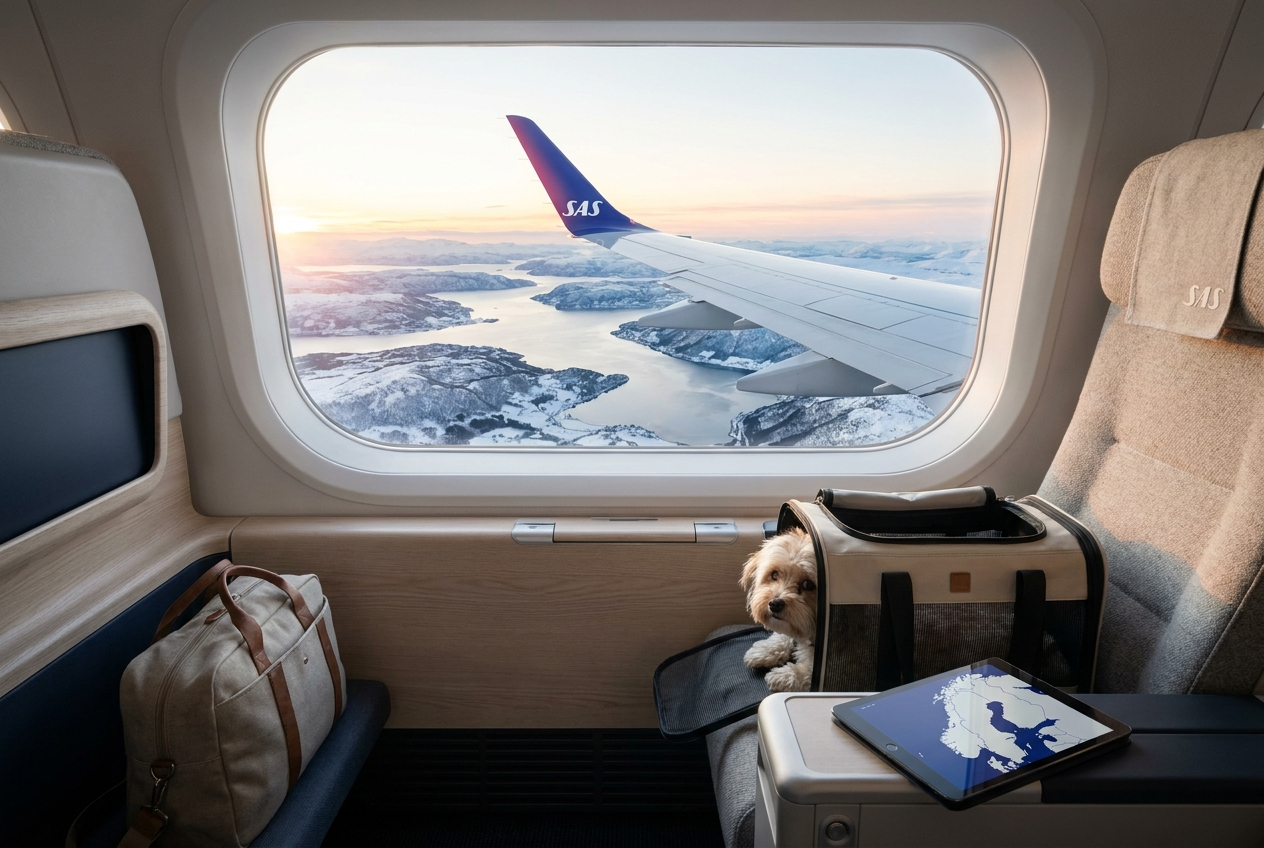
An overlooked detail about flying with a pet on Scandinavian Airlines (SAS) is that they allow you to transport two small cats or two small dogs inside the exact same cabin carrier, provided they are of a similar size, naturally get along, and do not exceed the airline's strict under-seat weight threshold. While most global carriers restrict you to a single animal per carrier, this Nordic-specific allowance makes traveling with pairs significantly easier and less stressful for the animals.
Operating as the flag carrier for Denmark, Norway, and Sweden, SAS is a gateway to the Arctic and the broader European continent. However, because the airline straddles both European Union member states (Sweden and Denmark) and a non-EU European Economic Area member (Norway), the entry rules change depending on which capital you touch down in. Navigating these regional quirks, booking limits, and strict container specifications is essential to avoid being turned away at the boarding gate.
SAS Pet Policy: Key Facts
To give you an immediate snapshot of what to expect when flying with your animal on SAS:
In-Cabin Pet Fee: €55 to €99 (or $60 to $115 USD / 550 to 990 SEK/NOK/DKK) per direction depending on the route.
In-Cabin Weight Limit: Strictly 8 kg (17.6 lbs) combined weight of the pet and its carrier.
Maximum Carrier Dimensions (Cabin): 40 cm L × 25 cm W × 23 cm H (15.7 in × 9.8 in × 9 in).
Hold/Cargo Pet Fee: €100 to €250 ($110 to $270 USD) per direction depending on the route.
Hold Weight Limit: Up to 150 kg (330 lbs) combined weight of the animal and crate (cargo limits vary by aircraft type).
Allowed Species: Dogs and cats only. Other animals must be shipped via SAS Cargo.
Service Animals: Fully trained assistance and guide dogs fly free of charge in the cabin with no carrier requirement, subject to pre-registration.
In-Cabin Pet Rules (PETC)
If your dog or cat is small enough to fit comfortably under the seat in front of you, they can travel in the cabin on almost all SAS-operated flights.
Carrier Specifications and Rules
The airline is remarkably strict about the dimensions of cabin pet carriers. Unlike some airlines that permit slightly larger dimensions for soft-sided bags, SAS maintains a hard maximum that applies to all carrier types.
Hard-sided vs. Soft-sided: You may use either a rigid container or a soft-sided bag (often referred to as a "Sherpa bag"). The soft bag must be made of water-resistant, bite-proof, and claw-proof material.
Dimensions: The maximum size is 40 cm Length × 25 cm Width × 23 cm Height.
The Squeeze Factor: If you use a soft bag, it can be slightly larger than these dimensions, but only if it can be compressed down to fit the 23 cm height limit without restricting the animal's breathing or movement.
Comfort Standard: Your pet must be able to stand up, turn around, and lie down in a natural position inside the closed carrier.
The One-Carrier Exception: You can carry up to two small dogs or cats in the same container, provided they are used to each other, fit comfortably together, and their combined weight (including the carrier) does not exceed 8 kg (17.6 lbs).
For a comprehensive breakdown of import documents and microchipping rules for every country SAS serves, you can access the Pet Travel Country Guides | Import & Export Rules by Country | Pet Holiday Club to cross-reference your specific route before your trip.
Cabin Conduct and Limitations
Your pet carrier counts as your one piece of under-seat cabin baggage. You are still allowed to bring a small personal item (like a laptop bag or purse) on board, but any larger carry-on bag must be stowed in the overhead bins or checked.
Once you board the aircraft, the carrier must remain under the seat in front of you for the duration of the flight. Under no circumstances are you allowed to open the zipper, let your pet poke its head out, or place the pet on your lap—even if the seat next to you is empty.
Furthermore, SAS does not allow pets in the cabin in Business Class on intercontinental flights to or from Asia and North America. The design of SAS’s long-haul Business Class seats features specialized footwells and electronic consoles that do not provide safe under-seat stowage for a pet carrier. If you wish to fly with your pet in the cabin on a long-haul route, you must book your seat in SAS Go (Economy) or SAS Plus (Premium Economy).
Checked Baggage & Cargo Hold Pet Rules (AVIH)
If your pet and their carrier exceed the 8 kg limit, they must travel in the cargo hold as checked baggage. This option is available on most SAS-operated aircraft, which feature heated, pressurized, and ventilated baggage compartments.
The Travel Crate: IATA LAR Compliance
Your pet must travel in a rigid, flight-approved kennel that complies with the International Air Transport Association (IATA) Live Animals Regulations (LAR).
Material: The crate must be made of rigid plastic, fiberglass, metal, or solid wood. Crates made entirely of wire mesh or those with collapsible folding mechanisms are strictly banned.
Fasteners: The two halves of a plastic crate must be secured with metal bolts and nuts. Plastic snap-latches alone are not accepted.
Ventilation: The crate must have ventilation grilles on at least three sides (for domestic/European flights) or all four sides (for international long-haul flights).
Door Security: The door must be made of welded or cast metal and have a secure, multi-point locking system. Plastic doors are prohibited.
Interior: The floor must be solid, leak-proof, and covered with an absorbent material like pee pads or a blanket. Straw, hay, or wood shavings are banned due to agricultural import laws.
Wheels: If your crate has wheels, they must be removed or taped securely to prevent the crate from rolling inside the aircraft hold.
Hold Fees (Per Direction)
Route Type | Cabin Fee (PETC) | Hold Fee (AVIH) |
Domestic (Denmark/Norway/Sweden) | €55 / $60 | €100 / $110 |
Within Europe / Scandinavia | €75 / $80 | €150 / $165 |
To / From USA, Canada, and Asia | €99 / $115 | €250 / $270 |
Breed Restrictions & Snub-Nosed Bans
Scandinavian Airlines places the physical safety of pets above all else. Because of this, they enforce strict guidelines regarding brachycephalic (flat-faced) dog and cat breeds, as well as breeds categorized as potentially dangerous.
Brachycephalic Breed Restrictions
Brachycephalic animals have shortened snout anatomy, which results in narrow nostrils and an elongated soft palate. Under conditions of stress, high ambient temperatures, and changes in air pressure, these animals are highly susceptible to respiratory distress and hyperthermia.
Hold Cargo Ban: SAS does not accept brachycephalic (snub-nosed) dogs or cats for transport in the cargo hold (AVIH) under any circumstances.
If you have a snub-nosed pet, they are only allowed to fly with SAS if they are small enough to travel in the cabin (under 8 kg including the carrier) and can breathe comfortably within the under-seat space.
Impacted Brachycephalic Breeds:
Dogs: All Bulldogs (English, French, American), Pugs, Boston Terriers, Boxers, Shih Tzus, Lhasa Apsos, Pekingese, Brussels Griffons, Japanese Chins, Chow Chows, and Cavalier King Charles Spaniels.
Cats: Persian, Himalayan, Exotic Shorthair, and British Shorthair.
Classified and Potentially Dangerous Breeds
SAS does not enforce blanket bans on specific guard or "dangerous" breeds, but they do require specialized handling. If you are traveling with breeds such as American Staffordshire Terriers, Pit Bull Terriers, Mastiffs, or Caucasian Shepherds as checked baggage, you must secure them in a reinforced, custom-built wooden or metal container (conforming to IATA CR82 standards) rather than a standard plastic crate.
Navigating the Three Scandinavian Gateways: Denmark, Sweden, and Norway
Because SAS is the flag carrier of three separate nations, flying with your pet means understanding the veterinary and customs differences between them. While Sweden and Denmark are EU member states, Norway is not part of the EU. This creates distinct pathways for pet entry.
                  ┌──────────────────────────────┐
                  │   Flying to Scandinavia      │
                  └──────────────┬───────────────┘
                                 │
         ┌───────────────────────┼───────────────────────┐
         ▼                       ▼                       ▼
  ┌─────────────┐         ┌─────────────┐         ┌─────────────┐
  │   DENMARK   │         │   SWEDEN    │         │   NORWAY    │
  │   (EU State)│         │   (EU State)│         │ (Non-EU/EEA)│
  └──────┬──────┘         └──────┬──────┘         └──────┬──────┘
         │                       │                       │
         ├───────────────────────┴───────────────────────┼───────────────────────┐
         ▼                                               ▼                       ▼
  ┌──────────────────────────────┐                ┌─────────────┐         ┌─────────────┐
  │ Standard EU Pet Passport     │                │ Swedish     │         │ Mandatory   │
  │ Microchip & Rabies Vaccine   │                │ Customs     │         │ Tapeworm    │
  │ (Wait 21 days for primary)   │                │ Declaration │         │ Treatment   │
  └──────────────────────────────┘                └─────────────┘         └─────────────┘
1. Entering Sweden (Stockholm Arlanda - ARN)
As an EU member, Sweden follows standard EU entry protocols. Your pet must have an ISO-compliant microchip, a valid rabies vaccination (administered after the microchip was implanted, with a 21-day waiting period for primary vaccines), and an EU Pet Passport or non-commercial EU Health Certificate.
Mandatory Customs Declaration: Sweden requires you to declare your pet to Tullverket (Swedish Customs) before or immediately upon arrival. You can complete this declaration online via the Tullverket website prior to boarding. If you do not declare your pet, you risk heavy fines or having the animal quarantined at Stockholm Arlanda.
2. Entering Denmark (Copenhagen Kastrup - CPH)
Denmark also adheres to the harmonized EU pet movement rules. The paperwork requirement matches Sweden's exactly.
Entry Points: If you are flying into Copenhagen from a non-EU country, you must enter through a designated Border Control Post (BCP) where a customs officer or veterinarian can inspect the animal’s paperwork. Copenhagen Airport is a fully authorized BCP for live animals. You must notify the Danish Veterinary and Food Administration (Fødevarestyrelsen) at least 24 hours before your flight's scheduled landing.
3. Entering Norway (Oslo Gardermoen - OSL): The Tapeworm Rule
Norway is a member of the EEA but is not an EU member state. While they recognize the EU Pet Passport and standard microchip/rabies protocols, they enforce a critical extra safeguard: Echinococcus multilocularis (tapeworm) treatment.
The Treatment Window: All dogs entering Norway from any country (except those coming directly from Finland, Ireland, Malta, or Northern Ireland) must be treated for tapeworm by a licensed veterinarian.
The Timing: The treatment must be administered using an approved drug containing praziquantel or epsiprantel. It must be completed between 24 hours and 120 hours (1 to 5 days) before your scheduled arrival time in Norway. Your vet must stamp and sign this treatment directly in your dog's Pet Passport or Health Certificate.
Alternate 28-day Protocol: If you travel frequently between Sweden and Norway, you can opt for the "28-day treatment scheme." This requires your dog to be treated at least twice by a vet, with a maximum interval of 28 days between treatments, before starting travel. After that, they must receive regular treatments every 28 days.
How to Book a Pet on SAS: Step-by-Step
Because aircraft holds and cabins have strictly enforced animal limits, you should book your pet's travel at the same time you buy your own seat.
1.Check Route Availability:Prerequisite.
Before purchasing your ticket, review the SAS schedule. Avoid booking codeshare flights (flights operated by partners like Delta or airBaltic), as pet policies are determined by the operating airline. Ensure your destination airport is a designated live animal entry point.
2. Book Your Ticket and Request Pet Space:Within 24 Hours.
Purchase your passenger ticket on Scandinavian Airlines official website. Immediately after booking, log into the My Bookings section of the website. Select "Add Special Baggage" and choose "Pet in Cabin" or "Pet in Hold."
3.Submit Pet Details:Within 24 Hours.
Enter your pet's breed, total weight (including the carrier), and the precise outer dimensions of your transport crate or soft bag. The system will process this request against the remaining pet quota for your specific aircraft.
4.Receive Confirmation and Pay:Before Departure.
Once your pet is approved by SAS, you will receive an email confirmation. You must pay the pet transport fee, which can be done in advance through the online portal or at the airport check-in desk on your day of travel.
5.Prepare Paperwork:1-10 Days Before Flight.
Visit your veterinarian to secure your EU Pet Passport or completed EU Health Certificate. If flying to Norway, ensure your dog receives the praziquantel tapeworm treatment within the mandatory 24–120 hour window.
Pro-Tips for Flying with Pets on SAS
Book SAS Plus for Comfort: Since pets are banned from Business Class on long-haul routes, booking SAS Plus (Premium Economy) is the best way to get extra legroom for yourself while keeping your pet in the cabin. The under-seat space in SAS Plus is identical to or slightly more generous than SAS Go, making it easier to monitor your pet.
Helsinki Transit Warnings: If you are transiting through Helsinki (HEL) on an SAS flight bound for Norway, remember that Finland is also free of the fox tapeworm. If your dog has not had the treatment before leaving Sweden or Denmark, you will need to arrange vet care in transit, which is incredibly difficult. Always complete the treatment in your country of origin.
Keep Carriers Clean: Nordic ground crews are fastidious about hygiene. If your checked crate is dirty, has an odor, or lacks secure water dishes, the ramp agent has the authority to refuse loading the animal onto the plane. Clean your crate thoroughly the night before.
How SAS Compares to Competitors
Airline | Cabin Weight Limit | Max Cabin Carrier Dimensions | Hold Travel Option | Snub-Nosed Hold Ban |
SAS | 8 kg (17.6 lbs) | 40 × 25 × 23 cm | Yes | Yes (Strictly Banned) |
Norwegian | 8 kg (17.6 lbs) | 43 × 31 × 20 cm | Yes (Schengen only) | Yes (Strictly Banned) |
Finnair | 8 kg (17.6 lbs) | 55 × 40 x 23 cm | Yes | Yes (Strictly Banned) |
Icelandair | 8 kg (17.6 lbs) | 40 × 25 × 20 cm | Yes | Yes (Strictly Banned) |
Frequently Asked Questions
Q: Can I take my pet out of the carrier during an SAS flight?
No. Your pet must remain zipped completely inside their carrier, stowed under the seat in front of you, for the entire duration of the flight. Opening the carrier or letting your pet sit on your lap is strictly prohibited for safety and hygiene reasons.
Q: Does Norway require tapeworm treatment for cats?
No. The mandatory Echinococcus multilocularis (tapeworm) treatment only applies to dogs entering Norway. Cats and ferrets are completely exempt from this rule, though they still require a microchip and a valid rabies vaccination to cross the border.
Q: What happens if my dog's carrier exceeds the height limit?
If your carrier is rigid and exceeds 23 cm in height, SAS agents will refuse cabin entry at check-in. If you use a soft-sided carrier, it can be slightly taller as long as it easily compresses down to 23 cm to fit under the seat.
Q: Can I fly with a French Bulldog in the cargo hold on SAS?
No. SAS enforces a strict ban on transporting brachycephalic (snub-nosed) breeds, including French Bulldogs, in the cargo hold. They can only fly in the cabin, provided their total weight, including the carrier, does not exceed the 8 kg limit.
Q: How early should I arrive at the airport when traveling with a pet?
You should arrive at the airport at least two to three hours before your scheduled departure. You must check in at the physical desk with an agent to verify your pet's paperwork, weigh the carrier, and pay the travel fees.
Q: Are emotional support animals allowed to fly free on SAS?
No. SAS does not recognize emotional support animals for free cabin travel. Only fully trained, certified service and guide dogs are permitted to fly free of charge outside of a carrier, subject to registration at least 48 hours before departure.
Before flying with your pet on SAS, make sure you have the right documentation for your destination. Pet Holiday Club covers 190+ countries with government-sourced, vet-verified pet travel checklists at petholidayclub.com — so you arrive prepared, not refused.