The 2026 Russian Federation Pet Travel Blueprint: Operational Rules for Exporting from and Importing to Russia
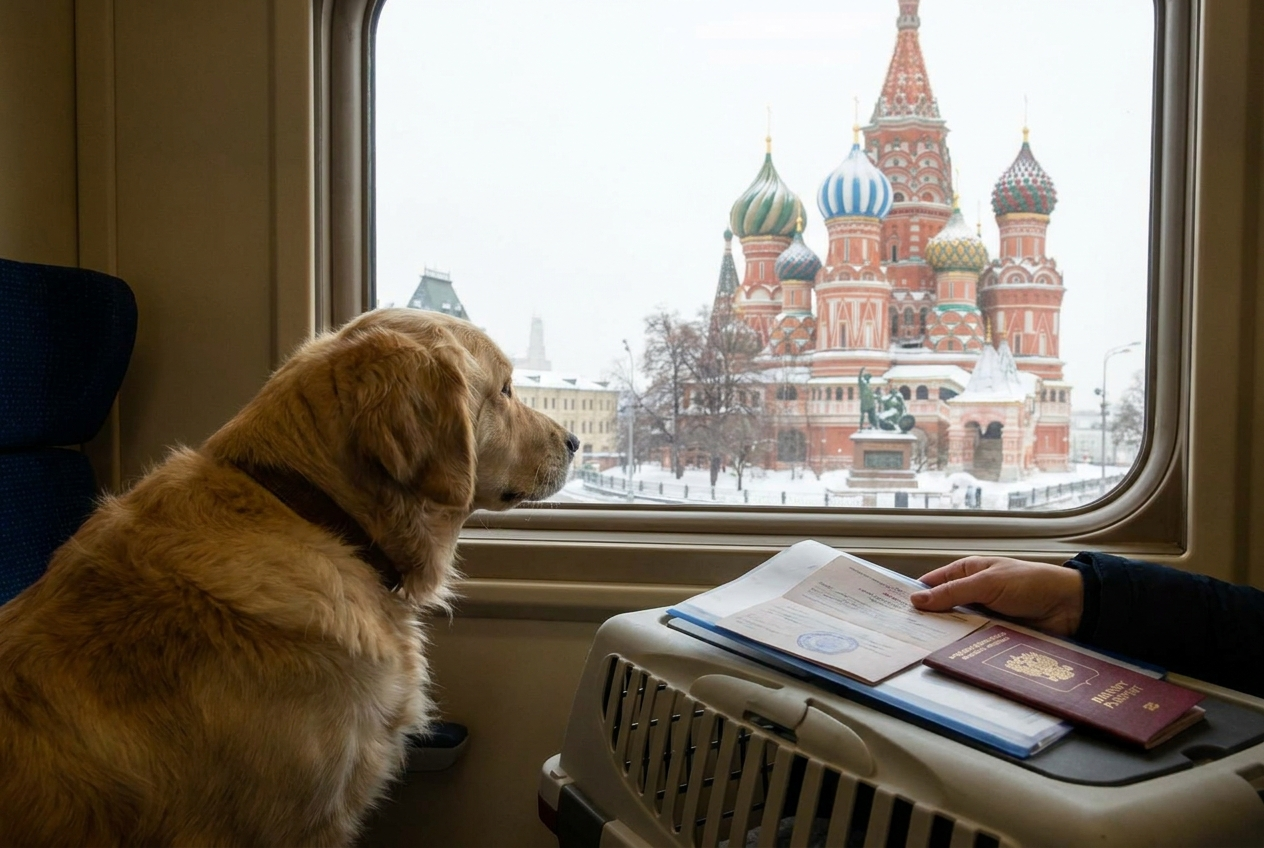
How do you move a dog, cat, or ferret into or out of the Russian Federation under the current 2026 legal framework? Following the comprehensive April 22, 2026 EU Pet Travel Overhaul, the operational landscape for Russian pet relocation has entered a phase of high administrative friction. Moving an animal outbound from Russia into an EU member state now triggers some of the tightest biosecurity protocols on earth, requiring a multi-month preparation arc centered around accredited blood serology. On the other side of the token, importing a pet into Russia requires navigating the specialized requirements of the Eurasian Economic Union (EEU) led by Rosselkhoznadzor (the Federal Service for Veterinary and Phytosanitary Surveillance), which relies on highly compressed pre-departure documentation timelines.
Because of complex geopolitical realignments, traditional direct flight routes between Russia and the West are suspended. This means your pet's physical route will almost certainly involve third-country transit hubs like Istanbul, Dubai, or Belgrade. A single day's discrepancy on a veterinary inspection stamp, an unapproved laboratory code, or an inverted microchip-to-vaccination sequence will result in your pet being turned away at international boarding gates, or worse, facing state-enforced quarantine or deportation on arrival. While cargo agents can handle physical crates, keeping total control of your budget requires mastering the exact legal mechanics. If you need immediate clarity on your upcoming trip, try PetHolidayClub.com first to map out your specific Russian origin or destination coordinates. Let’s break down the active rules governing primary Russian export and import routes this year.
The 2026 Russian Federation Active Relocation Matrix
Before booking airline cargo or excess baggage space, analyze the specific compliance parameters for primary Russian travel corridors:
Flight / Transit Corridor | Route Type | Veterinary Agency Status | Core Transit & Border Hurdles |
Russia ➔ Cyprus | Export | EU High-Risk Unlisted Tier | Extreme Friction. Requires an ISO microchip + Rabies Titer Test + 3-month wait + EU Health Certificate. |
Russia ➔ Italy | Export | EU High-Risk Unlisted Tier | Extreme Friction. Must enter via an approved EU Border Control Post (BCP) with a valid titer report. |
Russia ➔ Turkey | Export | Bilateral Third-Country Track | Moderate Friction. Requires a standard Russian Form No. 1 exchanged for an International Form No. 5a. |
Indonesia ➔ Russia | Import | EEU Low-Risk Standard Corridor | Requires an Indonesian government health certificate signed within 5 days of departure. No titer test. |
Turkey ➔ Russia | Import | EEU Low-Risk Standard Corridor | Requires an official Turkish health certificate (Form 15 or equivalent) + active 12-month rabies record. |
Part 1: Export Directions — Leaving the Russian Federation
Exporting a pet from Russia depends entirely on whether your destination considers Russia a "listed" or "unlisted" country regarding rabies risk. Because the European Union treats Russia as an unlisted third country, traveling to Europe requires an intensive 4-month preparation timeline.
[ISO Chip Verified] ➔ [Rabies Shot] ➔ [Wait 30 Days] ➔ [Blood Titer Test] ➔ [Wait 3 Calendar Months] ➔ [Border Crossing]
1. Russia ➔ Cyprus & Russia ➔ Italy (The Strict EU Titer Protocol)
The post-April 22, 2026 EU regulations have dramatically stepped up enforcement checks on documentation coming out of Russia. For both Cyprus and Italy, compliance checks look at the exact chronological order of your pet's medical events.
The Titer Test Mandate: Because Russia is an unlisted country, your pet must pass a Rabies Antibody Titration Test (FAVN). The blood sample must be drawn by an authorized veterinarian at least 30 days after the rabies vaccination date.
The 3-Month Lockout: The sample must be analyzed by an EU-approved laboratory, demonstrating a neutralizing antibody tier count of at least 0.5 IU/ml. Once a passing result is issued, your pet must wait a mandatory 3 calendar months inside Russia from the exact day the blood was drawn before they can legally enter the EU.
The Airport Exchange: Within 5 days of your flight, you must take your pet and their veterinary passport to the state clinic (SBBZh) to get Veterinary Certificate Form No. 1. At the airport's Rosselkhoznadzor veterinary border control desk (e.g., Moscow Sheremetyevo SVO, Domodedovo DME, or St. Petersburg LED), this paper will be officially exchanged for an International Veterinary Certificate (Form No. 5a / EU Health Certificate).
2. Russia ➔ Turkey (The Bilateral Non-EU Transit Track)
Turkey serves as the primary global transit hub for individuals flying out of Russia with companion animals. Because Turkey sits outside the EU's strict unlisted waiting tiers for Russian exports, the process is significantly faster.
Documentation Baseline: Your pet does not require a rabies antibody titer test to enter Turkey directly from Russia.
The 21-Day Primary Rule: The pet must be microchipped and have a valid rabies vaccine. If it is their primary rabies shot, a mandatory 21-day waiting window must pass before boarding the aircraft.
The Airport Execution: Present your state-issued Form No. 1 at the airport's Rosselkhoznadzor desk within 5 days of departure to receive your International Form No. 5a. Turkey's border officials will verify this document upon landing.
Part 2: Inbound Directions — Importing Into the Russian Federation
Importing an animal into Russia is governed by Rosselkhoznadzor and the unified veterinary requirements of the Eurasian Economic Union (EEU). Unlike the EU, Russia does not require an inbound rabies antibody titer test from any country, making the initial medical track highly accessible. However, the country operates on exceptionally tight documentation timelines.
[ROSELKHOZNADZOR INBOUND CEILING]
/ \
[Indonesia ➔ Russia] [Turkey ➔ Russia]
│ │
- ISO Microchip (Recommended) - ISO Microchip (Recommended)
- Rabies + Core Vaccines Valid - Rabies + Core Vaccines Valid
- 5-Day Origin Health Certificate - 5-Day Origin Health Certificate
- Airport Vet Desk Entry Stamp - Airport Vet Desk Entry Stamp
1. Indonesia ➔ Russia (Navigating Southeast Asian Logistics)
Moving a pet from Indonesian hubs like Jakarta or Bali to Russia requires balancing strict local export bans with Russian entry protocols.
The 5-Day Rule: You must obtain an official health certificate from the Indonesian competent authority (such as the Ministry of Agriculture). Rosselkhoznadzor regulations stipulate this certificate must be signed and dated within 5 days of the pet's arrival at the Russian border checkpoint.
Vaccination Profile: The animal must have a valid rabies vaccination administered no less than 21 days and no more than 12 months prior to entry. Additionally, Russia requires proof of protection against core species-specific diseases:
Dogs: Distemper, Hepatitis, Enteritis, Parvovirus, Adenovirus infections, and Leptospirosis.
Cats: Feline Panleukopenia (distemper), Calicivirus, and Rhinotracheitis.
2. Turkey ➔ Russia (The Active Transit Corridor)
Because Turkey is the central jumping-off point for flights into Russia (via airlines like Turkish Airlines, Pegasus, or Aeroflot), this route sees heavy traffic.
The Certificate System: The pet must be accompanied by an international veterinary passport or an official export health certificate issued by the Turkish Ministry of Agriculture and Forestry.
The Excess Baggage Option: Unlike the UK, Russia allows pets to enter the country inside the passenger cabin or as checked excess baggage, provided they meet the specific weight and dimensions of the operating airline (typically under 8 kg total for cabin transit).
The Terminal Process: Upon landing at a major Russian hub (such as Moscow Vnukovo VKO or Sheremetyevo SVO), you must take your pet directly to the Veterinary Customs Station before passing through final green-channel customs. The airport vet will inspect the animal, review the 5-day certificate, and apply an official entry stamp admitting your pet into the country.
Part 3: Universal Technical Requirements for Russian Entry & Exit
1. The Microchip Synchronization Standard
The Ground Rule: While Russia’s domestic framework historically permitted entry with only a readable tattoo, contemporary international travel pathways make a microchip practically essential. If you are exporting to the EU (Cyprus/Italy), the microchip must be implanted before the rabies vaccine. If the vaccine's batch code is logged prior to the chip's barcode scan date, the EU will treat the vaccine as legally invalid, resetting your 4-month waiting timeline.
Hardware Specs: The transponder must be a non-encrypted, 15-digit passive chip operating on the 134.2 kHz frequency, strictly complying with ISO Standards 11784 and 11785.
2. The 5-Pet Non-Commercial Border Cap
To combat commercial breeding networks, Rosselkhoznadzor enforces a strict cap on personal, non-commercial pet moves:
The Limit: An individual owner or authorized courier can import a maximum of 5 domestic pets under a personal travel declaration. If you attempt to bring in 6 or more animals, the entire shipment will be stopped at the border and reclassified as a commercial cargo enterprise. This requires pre-arranged import permits, institutional quarantine space allocations, and commercial veterinary clearing codes.
Master Russian Relocation Countdown Checklist
Keep your milestones organized with this step-by-step countdown log built for complex Russian routes:
[ ] Day -130 (4.5 Months Out): Verify your pet's ISO 11784/11785 microchip is functioning. Administer an approved rabies vaccination.
[ ] Day -100 (3.5 Months Out): For exports to the EU (Cyprus/Italy), visit an approved laboratory-linked clinic exactly 30 days after the rabies shot for the blood titer draw.
[ ] Day -90 (3 Months Out): Receive passing titer lab sheets showing an antibody count $\ge 0.5\text{ IU/ml}$. Secure your pet's safe boarding or home arrangements in Russia to complete the mandatory 3-month waiting lockout.
[ ] Day -30 (1 Month Out): Procure an IATA-compliant flight kennel. Ensure it provides adequate ventilation and allows the animal to stand up and turn around completely unhindered.
[ ] Day -14 (2 Weeks Out): Take your pet to a licensed clinic for an intermediate clinical checkup. Ensure all species-specific core vaccines (Leptospirosis, Panleukopenia, etc.) are up to date and signed off.
[ ] Day -5 (5 Days Out): Visit your local state veterinary clinic (SBBZh) inside Russia to secure Veterinary Certificate Form No. 1, or obtain the equivalent 5-day federal health document if importing from Indonesia/Turkey.
[ ] Day -1 (24 Hours Out): Complete your online pre-registration profiles with your chosen airline carrier. Double-check that your pet's booking code is explicitly linked to your seat PNR or cargo manifest bill.
[ ] Day 0 (Travel Day): Arrive at the airport's Rosselkhoznadzor Veterinary Control station at least 4 hours before departure to swap your Form No. 1 paper for an International Form No. 5a. Ensure all original laboratory titer reports are held in your hand luggage.
Traditional relocation brokers charge thousands—but if you want absolute control over your timeline and budget, try PetHolidayClub.com first. Select your exact Russian export or import track today to generate your error-free digital travel roadmap.
Frequently Asked Questions
Can I fly my dog inside the passenger cabin when entering Russia?
Yes. Unlike the United Kingdom, the Russian Federation permits pets to enter the country inside the passenger cabin or as checked excess baggage, provided they meet your specific airline's weight restrictions (usually a maximum of 8 kg including the soft-sided carrier). If your pet exceeds this weight limit, they must travel inside the aircraft's climate-controlled cargo hold.
Is a rabies antibody titer test required to import a dog into Russia from Turkey?
No. Rosselkhoznadzor does not require a rabies antibody titer test for any pets entering the Russian Federation, regardless of their country of origin. You only need to present an active microchip record, up-to-date rabies and core vaccinations, and an official international health certificate signed within 5 days of travel.
What happens if I miss the 5-day window for the Rosselkhoznadzor health certificate?
If your Veterinary Certificate Form No. 1 or your origin country's federal health certificate is issued more than 5 days before your arrival or departure checkpoint, it is legally invalid. Airline check-in staff or airport border veterinarians will deny your pet boarding or entry. You will need to book a new appointment with a local state veterinarian to re-examine the animal and issue a fresh certificate.
Can I travel to Italy from Russia with my pet immediately after passing the titer test?
No. European Union biosecurity law enforces a strict mandatory waiting period. Your pet must wait a minimum of 3 full calendar months from the exact date the successful blood sample was drawn before they are permitted to cross an EU border post.
Are there specific dog breeds banned from entering the Russian Federation?
No. Unlike several European or Asian nations, Russia does not enforce a legislative ban on specific dog breeds for international imports. All breeds are permitted to enter, provided they fulfill the standard medical, vaccination, and veterinary certification criteria.