FAVN Rabies Titer Test for Pet Travel 2026: What It Is, When You Need It, and Where to Get It
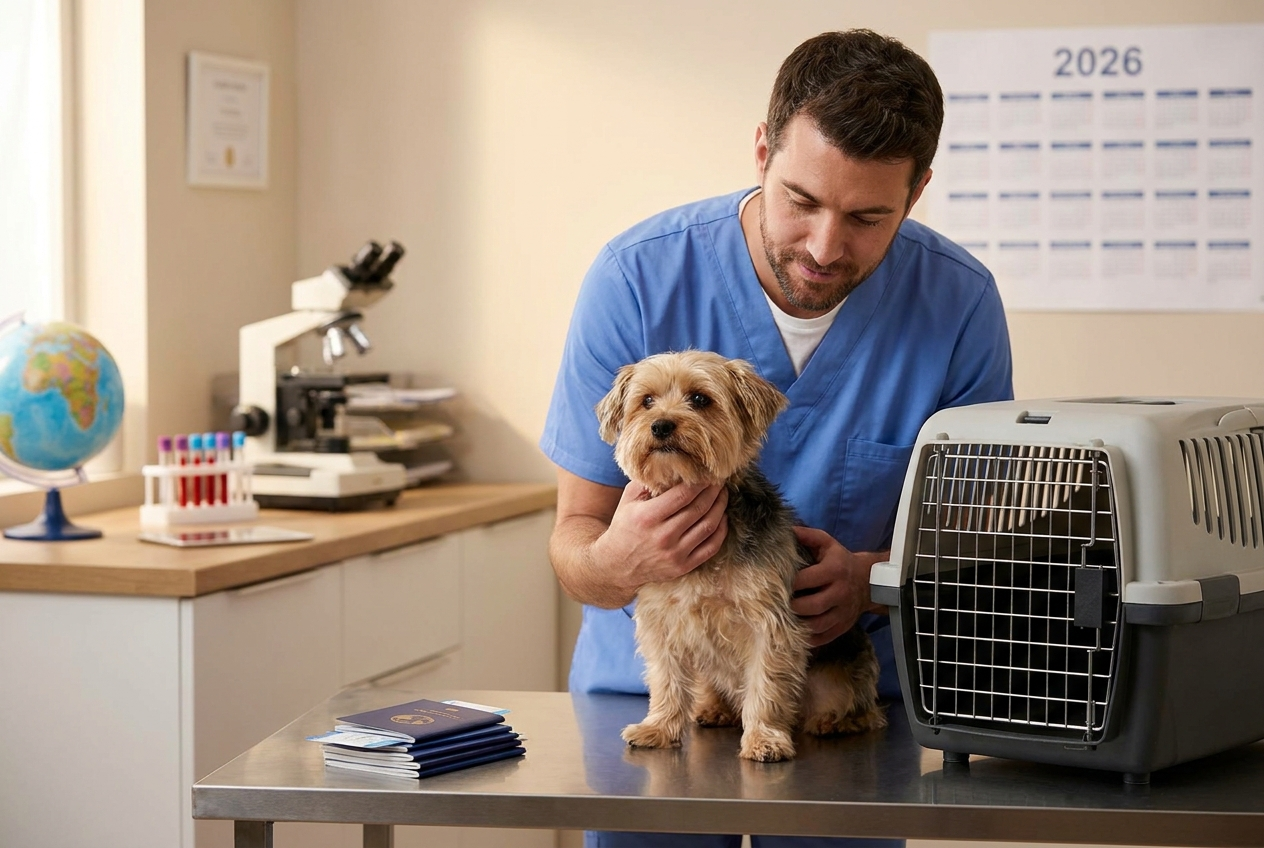
Discovering that your dog or cat requires a specialized laboratory screening called a FAVN test to cross international borders frequently triggers immediate panic for unsuspecting pet owners. Most travelers have never encountered this technical acronym until an airline booking agent or a biosecurity official suddenly flags it as a mandatory boarding requirement. The realization that a simple rabies vaccination record is no longer enough to clear your companion for travel can be incredibly stressful, especially when facing tight flight deadlines. However, understanding the regulatory mechanics of this specialized blood analysis will transform an overwhelming administrative hurdle into a manageable step in your travel preparation.
A FAVN test is not a routine checkup; it is a specialized regulatory tool designed to protect low-rabies or rabies-free islands and nations from foreign disease introduction.
What It Is: The Fluorescent Antibody Virus Neutralisation (FAVN) test is a specific rabies antibody titration assay that measures the exact level of rabies-neutralizing antibodies present in an animal's bloodstream following immunization.
When You Need It: You require this test when traveling from a country classified as having a high risk of rabies to a destination with a strict rabies-free or low-rabies status, such as Japan, Australia, New Zealand, Singapore, Hawaii, or the EU/UK when arriving from unlisted territories.
What It Costs: The baseline laboratory processing fee for the FAVN rabies titer test ranges from $150 to $300, though local veterinary blood-draw fees, clinical handling, and express overnight courier shipping typically drive the total cost to between $250 and $450.
How Long It Takes: Approved reference laboratories typically process the blood serum and release the official electronic results within 5 to 10 business days, though transport delays can extend the total turnaround window.
What Is the FAVN Rabies Titer Test?
The Fluorescent Antibody Virus Neutralisation test—almost universally abbreviated as the favn test—is a highly specialized blood serum neutralization assay performed exclusively at authorized reference laboratories. Unlike a basic health check, this diagnostic screening measures the functional efficacy of your animal's rabies immunization. Rather than simply proving that your pet received a shot, the favn rabies profile calculates exactly how well your pet's immune system responded to that vaccine by counting the volume of active rabies-neutralizing antibodies remaining in their blood.
A common point of confusion for travelers looking up information on a flavin test for dogs or cats is assuming it checks for an active rabies infection. It does not.
Because rabies is a fatal viral disease with a long incubation period, biosecurity authorities use the rabies antibody test dog or cat protocol to confirm that an animal has achieved a robust level of biological immunity. This ensures that even if the pet was theoretically exposed to the virus prior to shipment, their immune system is fully capable of neutralizing it, preventing them from introducing the pathogen into a rabies-free ecosystem.
Which Countries Require the FAVN Test?
Not every international route demands a titer test pet travel certificate. For example, a pet flying directly from the continental United States to continental Europe does not require this extraction under standard conditions.
However, if your journey originates in a country classified by the World Organisation for Animal Health (WOAH) as an unlisted or high-rabies territory, or if your destination is an isolated island ecosystem, the favn rabies titer test is legally mandatory. Review this comprehensive structural breakdown of key regional requirements:
Destination Territory | Mandatory Origin Locations | Minimum Titer Level | Mandatory Post-Test Waiting Period |
Japan | All countries globally (except designated rabies-free islands) | 0.5 IU/ml | 180 Days: Blood draw must occur at least 180 days before arrival. |
Australia | All approved exporting nations | 0.5 IU/ml | 180 Days: Must complete a 180-day hold plus undergo mandatory state quarantine. |
European Union | All unlisted/high-risk nations (e.g., Turkey, Peru, Morocco) | 0.5 IU/ml | 3 Calendar Months: 3-month wait from blood draw date before entry. |
United Kingdom | All unlisted/high-risk territories | 0.5 IU/ml | 3 Calendar Months: Strict 3-month delay required before channel transit. |
Hawaii (USA) | All locations outside Hawaii (exempt if using 5-Day-or-Less program paths) | 0.5 IU/ml | 30 Days: Must complete a 30-day post-draw countdown prior to arrival. |
Singapore | Category C and D countries | 0.5 IU/ml | 6 Months: Varies based on exact origin classification structures. |
The FAVN Test Process Step-by-Step
Fulfilling the administrative requirements of favn testing requires strict adherence to a precise chronological sequence. Deviating from this order will cause reference laboratories to reject your sample or cause customs officials to declare your final results entirely invalid.
+-------------------------------------------------------------------------+
|                  CRITICAL PROCEDURAL COUPLING RULE                      |
|                                                                         |
| Your veterinarian MUST physically scan and record your pet's 15-digit  |
| ISO microchip at the exact moment the blood draw occurs. The exact chip |
| number must be written directly onto the laboratory submission form. If |
| the microchip number on the final lab report contains a typo or does    |
| not match your health certificate, the result is completely invalid.    |
+-------------------------------------------------------------------------+
1. Verification and Re-Vaccination
Ensure your pet's ISO 11784/11785 microchip is fully active. If your animal needs a rabies booster, administer it immediately. You must wait a minimum of 21 to 30 days following the rabies vaccination before booking the blood draw. This waiting period gives your pet's immune system adequate time to generate a high volume of measurable antibodies, maximizing their chances of passing the test.
2. The Clinical Blood Draw
Book an appointment with an accredited local clinic. The veterinarian will draw a small sample of whole blood, spin it down using a centrifuge to separate the clear serum, and transfer the fluid into a specialized transport vial.
3. Authorized Laboratory Dispatch
The clinic packs the serum into an insulated container alongside cold packs and ships it via an express overnight courier service directly to one of the officially approved favn laboratories authorized by your destination country's government.
4. Results Processing and the Holding Window
The laboratory executes the fluorescent analysis and generates an official report tracking the exact antibody levels. Once a passing result is posted, you must carefully calculate your destination’s mandatory post-test waiting period before attempting to clear a border control post.
Approved FAVN Laboratories
You cannot send your pet's blood sample to a standard commercial laboratory or a local veterinary diagnostic clinic. Global customs agencies recognize results exclusively from an elite, globally designated network of state-vetted research facilities.
If you are searching for a favn test near me inside the United States, your veterinarian must route the sample to one of these primary USDA-approved reference centers:
Kansas State University (KSU) Rabies Laboratory: Located in Manhattan, Kansas, this facility processes the vast majority of commercial pet travel titers globally.
Auburn University College of Veterinary Medicine: Located in Auburn, Alabama, providing official regulatory testing services.
University of Missouri Veterinary Medical Diagnostic Laboratory: Located in Columbia, Missouri.
Cornell University Animal Health Diagnostic Center: Located in Ithaca, New York.
For travelers located inside the United Kingdom or the European Union, veterinarians must utilize specialized favn test uk or EU reference hubs. In Great Britain, the Animal and Plant Health Agency (APHA) facility in Weybridge serves as the primary processing center.
Inside continental Europe, specialized state laboratories—such as ANSES in Nancy, France, or the Friedrich-Loeffler-Institut (FLI) in Germany—handle all incoming international serum testing requests.
How Much Does the FAVN Test Cost?
Budgeting for the cost of titre testing dogs or cats requires breaking the overall billing down into three distinct operational phases. The quote you receive from your local veterinary clinic generally combines the backend laboratory processing fees with localized clinical overhead.
The typical economic breakdown of a complete international titer screening reflects these standard industry pricing tiers:
Operational Expense Category | Average Price Range (USD) | Service Scope Details |
Base Laboratory Testing Fee | $150 – $300 | Charged directly by the reference laboratory (e.g., K-State) to run the assay. |
Clinical Vet Draw & Serum Prep | $50 – $150 | Covers the physical blood draw, centrifugation processing, and packaging. |
Medical Express Courier Shipping | $40 – $90 | Mandatory temperature-controlled overnight transit via FedEx or UPS. |
Total Combined Project Cost | $240 – $540 | Varies heavily based on regional location and individual clinic markups. |
To optimize your expenses, look for a clinic that regularly processes international export paperwork, as they often benefit from predictable bulk shipping lanes. Beware of unvetted, cut-rate offers; a cheap health certificate for dogs or an unusually low-cost titer quote often indicates that the clinic is using an unapproved local lab, which will result in your paperwork being immediately rejected at the border terminal.
Technical Benchmarks: Minimum Titer Levels and Turnaround Times
The quantitative metric used by the World Health Organization (WHO) and all global biosecurity agencies to define a successful rabies favn titer outcome is a hard threshold of 0.5 International Units per milliliter (IU/ml).
If your pet's blood serum results show an antibody concentration of exactly 0.5 IU/ml or greater, the animal has achieved a passing mark. This quantitative score serves as verifiable medical proof that their vaccine response is strong enough to prevent active viral transmission.
The operational processing time inside the laboratory itself is relatively swift, typically taking between 5 and 10 business days from the moment the physical sample arrives at the intake desk.
However, you must account for external logistical padding. When you factor in the time it takes to secure a vet appointment, transit the sample via courier, allow the lab to log the intake, and wait for the USDA or DEFRA officers to return the stamped physical hard copies, you should budget for a realistic total timeline of 3 to 5 weeks to clear this phase.
What Happens if Your Pet Fails the FAVN Test?
If the laboratory analysis reveals that your animal's rabies antibody concentration has dropped below the mandatory 0.5 IU/ml threshold, the result is flagged as a clinical failure. A low score does not mean your pet is sick or has rabies; it simply indicates that their immune system did not generate a sufficient volume of protective antibodies following their last vaccination.
+-------------------------------------------------------------------------+
|                    CRITICAL FAIL RECOVERY PROTOCOL                      |
|                                                                         |
| If your pet fails to hit the 0.5 IU/ml benchmark, you must immediately   |
| administer a fresh rabies booster vaccine. The entire 30-day biological |
| waiting period completely restarts from the date of the new injection   |
| before your vet can legally draw blood for a secondary FAVN analysis.   |
+-------------------------------------------------------------------------+
Certain factors increase the likelihood of a low titer score. Young puppies or kittens receiving their very first rabies shot frequently show lower antibody responses compared to older animals who have had multiple booster cycles over several years.
Additionally, specific dog breeds or animals with compromised immune systems may require a secondary booster strategy to clear the baseline. Because a failure completely resets your preparation timeline by at least a month, starting this testing process early is vital to keeping your travel plans on track.
The Mandatory Post-Test Waiting Period
A common and costly mistake made by international travelers is assuming that the moment they receive a passing 0.5 IU/ml report, their pet is cleared to board a flight. Passing the rabies titer favn screening is only the first part of the process; you must still fulfill your destination country’s mandatory post-blood-draw waiting period.
For example, if you are traveling from an unlisted country like Turkey into the European Union, the law enforces a strict 3 calendar months waiting period that begins on the exact day the vet drew the blood sample, not the day the lab finished the test.
Even worse, if you are moving an animal to Japan or Australia, the mandatory post-draw countdown jumps to a minimum of 180 days. Attempting to enter these territories even a single day before this clock runs out will result in your pet being seized at the border and placed into an expensive state quarantine facility at your expense, completely erasing the benefit of your preparation.
Frequently Asked Questions
Q: What does FAVN stand for in pet travel?
FAVN stands for Fluorescent Antibody Virus Neutralisation. It is a specialized rabies antibody blood serum titration test required by strict rabies-free or low-rabies destinations to verify that an animal has achieved a sufficient level of immunity following vaccination.
Q: How much does a FAVN rabies titer test cost?
The total cost typically ranges from $250 to $450. This estimate combines the reference laboratory's base testing fee of $150 to $300, the local veterinary clinic's blood draw and serum processing fees, and the cost of mandatory express medical courier shipping.
Q: What is the minimum passing level for a rabies titer test?
The minimum passing antibody concentration required by all international biosecurity agencies is exactly 0.5 International Units per milliliter (IU/ml). Any score below this threshold is a failure, requiring a booster shot and a fresh test.
Q: How long do FAVN test results take to process?
The approved reference laboratory typically processes the blood sample within 5 to 10 business days. However, you should budget for a realistic total turnaround time of 3 to 5 weeks to account for shipping, processing, and document delivery.
Q: Which countries require a FAVN titer test for entry?
The test is required by strict rabies-free territories like Japan, Australia, New Zealand, Singapore, Hawaii, and the UAE. It is also mandatory for entry into the EU and UK if you are arriving from an unlisted, high-rabies risk nation.
Q: What happens if my dog or cat fails the FAVN screening?
If your pet's score falls below 0.5 IU/ml, you must administer a fresh rabies booster vaccine. You are then required to wait an additional 21 to 30 days for the immune response to build before drawing blood for a secondary test.
Because global biosecurity laws are continually updated and vary dramatically based on your exact combination of origin and destination, attempting to guess your way through complex testing timelines can result in devastating financial setbacks or missed connections. Rather than spending hundreds of dollars on premature veterinary procedures or risking a border refusal, you can instantly verify your mandatory travel requirements using the automated tools at Pet Holiday Club.
By utilizing the Pet Holiday Club checklist tool at petholidayclub.com, you will receive a fully customized digital preparation timeline matched perfectly to your specific itinerary. This platform integrates real-time regulatory data from the Global Pet Travel Preparedness Index 2026, letting you know whether a titer test is genuinely required for your route, identifying approved local clinics, and tracking your post-draw countdown windows automatically. Protect your companion's journey and avoid unexpected quarantine costs by reviewing our dedicated UK, Germany, and France pet travel articles alongside our comprehensive USDA APHIS compliance guides.