Delta Airlines Pet Travel Guide (2026): Rules, Fees & Requirements
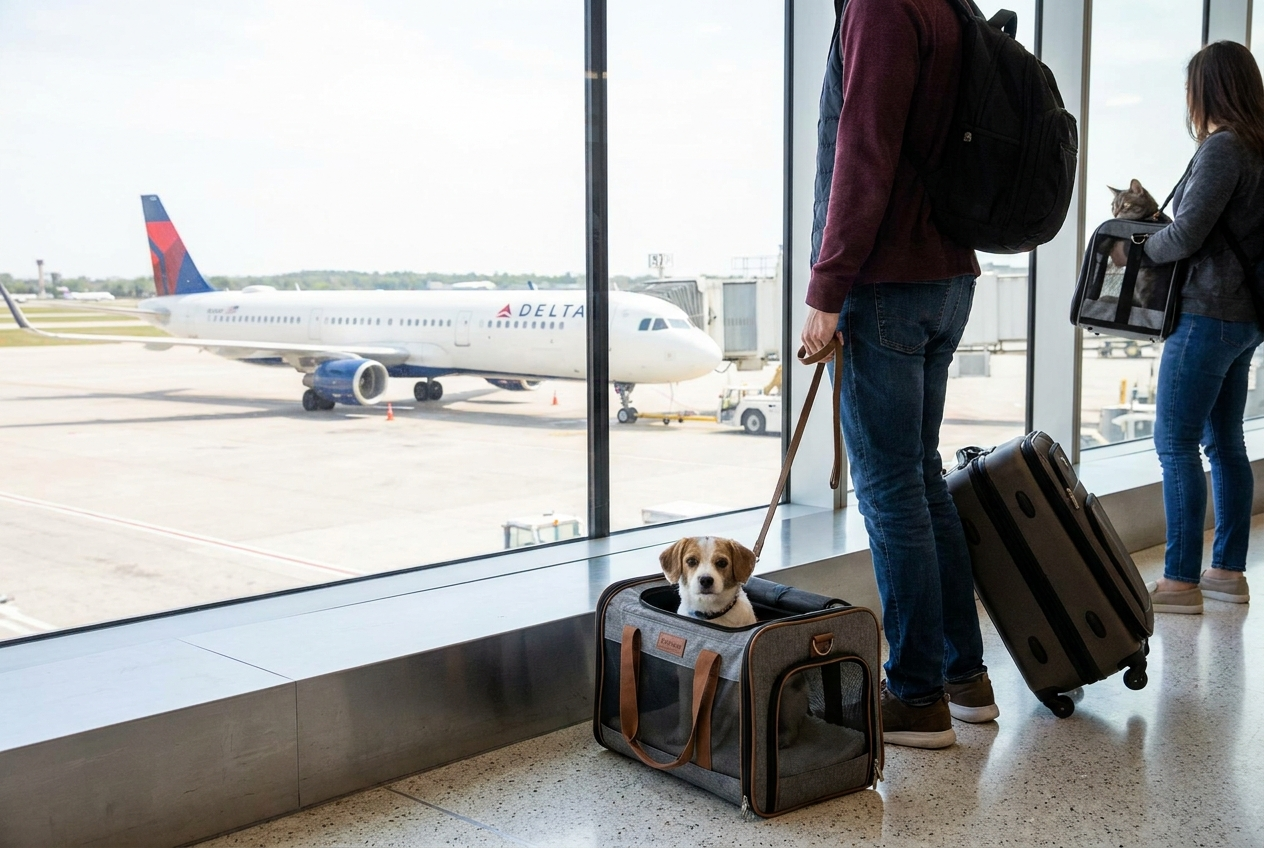
A strict fleet-wide operational directive enforced by Delta Air Lines completely bans the check-in of live animals as standard baggage, forcing travelers with larger pets to reroute entirely through automated cargo networks or stay grounded. This means your large dog can no longer be checked at the regular passenger ticket counter for a flight out of Atlanta, New York, or Los Angeles, regardless of your destination, seat class, or SkyMiles medallion tier. Navigating Delta's massive global network requires meticulous attention to varying under-seat clearances across their mainline Boeing and Airbus jets, rigid international routing embargoes, and strict age minimums updated to comply with federal regulations.
Understanding Delta's structural framework is necessary whether you are flying a small cat down to Florida or managing a complex international itinerary through their dedicated cargo shipping arm. The airline splits animal transportation into three strict, independent pathways: carry-on pets in the passenger cabin, manifest cargo shipping via Delta Cargo, and officially certified service animals (SVAN). Each tier is bound by distinct safety mandates, volumetric limits, and documentation rules designed to meet the strict standards of the United States Department of Agriculture (USDA) and the Federal Aviation Administration (FAA).
Carry-On Pet Policy: Maximizing Space Across Changing Fleet Layouts
Passengers electing to travel with a small dog or cat in the passenger cabin must remain completely aware that Delta allocates in-cabin pet spaces on a strict first-come, first-served basis. The airline enforces tight caps on the number of live animals permitted in the cabin per flight: a maximum of four pets in standard domestic main cabin configurations, two in domestic First Class, and two in domestic Delta Premium Select. Carry-on pets are completely barred from Delta One luxury suites and any international business class cabins equipped with lie-flat seating, as the physical airbag seatbelt systems and under-seat footwell designs lack the necessary open floor structures to safely house an animal carrier during takeoff and landing.
The physical size of your travel kennel must adapt directly to the specific aircraft model assigned to your route, as under-seat dimensions are far from uniform. Delta recommends utilizing a flexible, soft-sided carrier rather than a rigid plastic box because soft material can compress slightly to accommodate tight clearances without blocking row walkways. While standard maximum dimensions average around 18 x 11 x 11 inches, the absolute maximum height allowance drops significantly on certain regional configurations like the Embraer 175 or Bombardier CRJ-900. The travel carrier must be leak-proof, feature strong mesh ventilation windows on at least three distinct sides, and have secure, locking zippers to prevent animals from escaping into the aisles during the flight.
+-------------------------------------------------------------------------+
|                     THE UNDER-SEAT SPACE REALITY CHECK                  |
|                                                                         |
| Because under-seat space varies heavily by seat row and aircraft type   |
| (such as an Airbus A321 versus a Boeing 737), you are required to check |
| your exact flight number with Delta Reservations to verify the maximum  |
| height allowed for your specific row footprint before arriving.        |
+-------------------------------------------------------------------------+
The physical proportions of your dog or cat must correspond cleanly to the interior volume of your selected bag. Delta does not enforce a formal, standalone weight limit for carry-on pets on domestic routes; instead, compliance is evaluated visually by ticket agents when you print your boarding passes. Your pet must be small enough to stand up naturally, turn around completely inside the zipped carrier, and lie down comfortably without pressing hard against the mesh walls. If the animal cannot move freely during this visual check-in inspection, agents will deny your pet boarding to ensure its safety during the journey.
Delta Cargo Shipping: Navigating the Live Animal Network
Animals that exceed the size limits of a carry-on carrier can only travel with Delta by being booked as manifest cargo through the specialized Delta Cargo division. This separate shipping framework uses independent cargo terminals located away from the main passenger check-in desks, meaning you must manage separate drop-off and pickup logistics on your travel day. Delta Cargo only accepts live animal bookings from active commercial shippers registered with their platform or from individual passengers who book their shipments through a certified member of the International Pet and Animal Transportation Association (IPATA).
To ship a dog through Delta Cargo, you must provide an IATA-compliant, rigid travel crate made of heavy-duty molded plastic, solid wood, or aluminum. The crate must feature solid metal ventilation bars on all four sides, be held together by heavy-duty steel bolts, and have dual food and water bowls attached securely to the interior wire face of the door. The door must feature a central lock that fastens the top and bottom pins simultaneously so it cannot open accidentally during transit. The floor must be solid, leak-proof, and covered in thick, highly absorbent blankets or pads, and all wheels must be removed or securely disabled before loading.
+-------------------------------------------------------------------------+
|                  CRITICAL CRATE VOLUME FORMULA FOR CARGO                |
|                                                                         |
| 1. Length: Animal length from nose tip to tail base plus 4 inches.     |
| 2. Width: Twice the measurement across the widest shoulder point.      |
| 3. Height: Distance from floor to top of ears while standing. The head |
|    must never brush the top panel or structural ceiling bolts.         |
+-------------------------------------------------------------------------+
Strict Ground Temperature Restrictions and Climate Regulations
Live animal transit through the Delta Cargo network is governed by strict environmental safety boundaries that match federal USDA laws. Delta enforces an absolute climate embargo on shipping any live animal via cargo if the actual or forecast ambient ground temperature at your origin, transit hub, or destination airport falls below 45 degrees Fahrenheit (7 degrees Celsius) or climbs above 85 degrees Fahrenheit (29.4 degrees Celsius) at any point during the scheduled travel window. These temperatures are verified using official National Weather Service reports exactly 24 hours before your flight departs.
A specific operational exception to the lower temperature limit applies if your dog is accompanied by an official Acclimation Certificate signed by a licensed, accredited veterinarian. This document must state the precise minimum temperature your specific animal can safely handle based on its breed, coat density, and age; however, Delta will completely reject animals if ground temperatures drop below 20 degrees Fahrenheit (-6.6 degrees Celsius) or rise above 85 degrees Fahrenheit under any circumstances. Additionally, due to extreme runway heat, Delta enforces a permanent summer cargo ban for specific desert locations like Las Vegas (LAS), Phoenix (PHX), and Palm Springs (PSP) from mid-May through the end of September.
Prohibited Breeds and Brachycephalic Respiratory Embargoes
Delta Air Lines places the highest priority on animal safety by enforcing a complete and permanent ban on shipping all brachycephalic (short-snouted, flat-faced) dogs and cats within their cargo compartments. The short airway structure of these specific breeds makes them incredibly vulnerable to breathing difficulties, heatstroke, and severe hypoxia when subjected to the stress of a cargo hold environment. These breeds are restricted to traveling in the passenger cabin, provided they are small enough to fit within the strict under-seat carrier limits.
The official list of prohibited short-snouted breeds includes the following canine and feline populations:
Prohibited Brachycephalic Dogs: Affenpinscher, Boxer (all sub-varieties), Boston Terrier, Brussels Griffon, Bulldog (all sub-varieties, including French, English, and American), Cavalier King Charles Spaniel, Chow Chow, Dogue de Bordeaux, Dutch Pug, English Toy Spaniel, Japanese Chin, Lhasa Apso, Mastiff (all sub-varieties), Pekingese, Pug (all sub-varieties), Shar Pei, Shih Tzu, and Tibetan Spaniel.
Prohibited Brachycephalic Cats: Burmese, Exotic Shorthair, Himalayan, and Persian.
Delta also restricts the transport of specific breeds categorized as protective or historic fighting dogs due to structural safety concerns. Breeds like the Pit Bull Terrier, American Staffordshire Terrier, and Rottweiler must be shipped in custom-built, reinforced wooden or heavy-gauge metal crates that meet IATA CR82 safety requirements, featuring solid steel doors with secondary manual zip-ties.
Route Restrictions and International Entry Embargoes
International agricultural and customs regulations mean that specific geographical borders often supersede Delta's standard pet policies. The most significant route restriction involves flights heading into the United Kingdom, Ireland, and South Africa. Due to strict local biosecurity laws, pets cannot enter these countries in the passenger cabin, meaning Delta cannot transport any carry-on pets on flights landing in London Heathrow (LHR), Dublin (DUB), or Johannesburg (JNB). These animals must be booked strictly through Delta Cargo using an approved customs broker.
Additionally, Delta completely outlaws the transport of carry-on pets on all long-haul international flights that exceed a scheduled block time of eight hours. This rule protects animal welfare by avoiding situations where a pet must remain trapped inside a small carrier without access to a relief area for an extended period. The airline also maintains a year-round ban on all pet travel to and from specific international destinations, including Honolulu (HNL) due to Hawaii’s rabies-free isolation laws, and various Central American stations that lack full quarantine facilities.
Comprehensive Service Fees and Financial Matrices
Pet travel fees are charged separately from standard baggage allowances and cannot be paid using frequent flyer miles, credit card travel credits, or elite status benefits. Delta structures its pet fees as flat surcharges per kennel for each one-way travel segment. If your itinerary involves a domestic connection that exceeds a standard four-hour layover, or an international connection exceeding twenty-four hours, the airline treats each leg as a separate journey, requiring a double fee collection at the intermediate airport ticketing counter.
All fees must be settled via credit card or approved digital payment methods directly at the airport ticket counter on your departure day; cash is not accepted at mainline domestic terminals.
Service Classification | Geographic Route Boundaries | Maximum Weight & Size Allowed | Base One-Way Fee |
Carry-On Pet (PETC) | Within the US, Canada, & Puerto Rico | Max size matching under-seat dimensions; pet must move freely | $95 |
Carry-On Pet (PETC) | International Routes (Short-Haul Americas) | Max size matching under-seat dimensions; pet must move freely | $200 |
Carry-On Pet (PETC) | Long-Haul International (Over 8 Hours) | Strictly prohibited across all fleet cabin tiers | Banned |
Delta Cargo Shipping | Domestic Routes (Short-Haul Hubs) | Crate sizes Extra Small to Medium (Up to 100 lbs combined) | $275 - $495 |
Delta Cargo Shipping | Domestic Routes (Long-Haul Transcontinental) | Crate sizes Large to Extra Large (Up to 150 lbs combined) | $550 - $900 |
Delta Cargo Shipping | International Cargo Lanes | Varying by volumetric density and destination country tariffs | Custom Quote |
Booking Protocols and the Airport Check-In Process
You cannot add a carry-on pet or secure a Delta Cargo slot using automated online check-in features or third-party travel websites. In-cabin pet reservations must be made by calling the Delta Reservations team directly. When you call, you must provide the agent with your passenger record locator, along with the exact physical dimensions, structural materials, and estimated combined weight of your pet and carrier.
For cargo travel via Delta Cargo, reservations must be arranged separately through the delta official website portal or by calling them at least 14 days before your desired travel date. You will need to provide your dog's exact measurements, their microchip ID number, and destination details to generate an official air waybill number.
On your departure day, you must check in at the main airport ticket counter at least three hours before your flight. You must present your photo ID, your pet's reservation confirmation code, and all required health documents. While Delta no longer requires a formal veterinary health certificate for domestic in-cabin flights within the United States, international routes and all manifest cargo flights require an official USDA-approved health certificate issued within 10 days of travel.
Certified Service Animals and Federal DOT Guidelines
Trained service dogs performing essential tasks for individuals with visual, auditory, psychiatric, or physical mobility disabilities fly completely free of charge inside Delta's passenger cabins. The airline strictly aligns its assistance animal protocols with the United States Department of Transportation (DOT) air travel regulations. Emotional support animals (ESAs) are no longer recognized as official service animals under these guidelines and must travel under standard carry-on pet rules, paying the regular $95 cabin fee.
To travel with a trained service dog, you must complete and submit the official U.S. Department of Transportation Service Animal Air Transportation Form via Delta's online portal at least 48 hours before your flight window opens. This federal document requires the handler to legally certify the animal's current training credentials, its behavioral track record in high-stress public spaces, and active rabies vaccination dates. The service dog must remain securely attached to a professional harness, leash, or tether at all times and must sit directly on the cabin floor within the footprint of your assigned seat without encroaching into the aircraft aisles or neighboring passenger legroom spaces.
Frequently Asked Questions
Q: What is the carry-on pet fee for Delta Airlines?
Delta charges a flat fee of $95 per kennel for each one-way domestic travel segment within the United States, Canada, and Puerto Rico.
Q: Can a large dog fly as checked baggage on Delta?
No, Delta has completely eliminated checked baggage options for pets. All large dogs must be shipped strictly as manifest cargo through Delta Cargo.
Q: Can my pet fly with me in Delta One business class?
No, carry-on pets are completely barred from Delta One luxury suites and international business class cabins due to under-seat space limitations and safety designs.
Q: What are the size limits for a Delta under-seat pet carrier?
While maximum carrier dimensions average around 18 x 11 x 11 inches, you must check your specific flight number to verify row clearances.
Q: Are French Bulldogs allowed to fly via Delta Cargo?
No, Delta enforces a permanent ban on all short-snouted and brachycephalic breeds within the cargo hold due to severe respiratory health risks.
Q: How old must a puppy be to fly on Delta?
For domestic travel within the United States, a puppy must be at least 8 weeks old. For international flights, they must be at least 16 weeks old.
Managing complex airline pet rules, balancing container size calculations, and navigating shifting temperature embargoes can quickly become overwhelming for any traveler. Rather than risking a last-minute boarding refusal at the airport gate, you can automate your pre-flight preparation using the specialized platform at Pet Holiday Club. By utilizing the interactive planning tools available at petholidayclub.com, you can instantly generate a comprehensive, step-by-step travel timeline designed around your specific airline choices, your pet's breed metrics, and your final destination rules. The system automatically tracks shifting IATA crate mandates, calculates precise under-seat clearances, and provides direct access to approved veterinary documentation checklists to ensure your companion's journey is smooth and stress-free.