Austrian Airlines Pet Policy 2026: Vienna Hub, In-Cabin Rules, and EU Entry Requirements
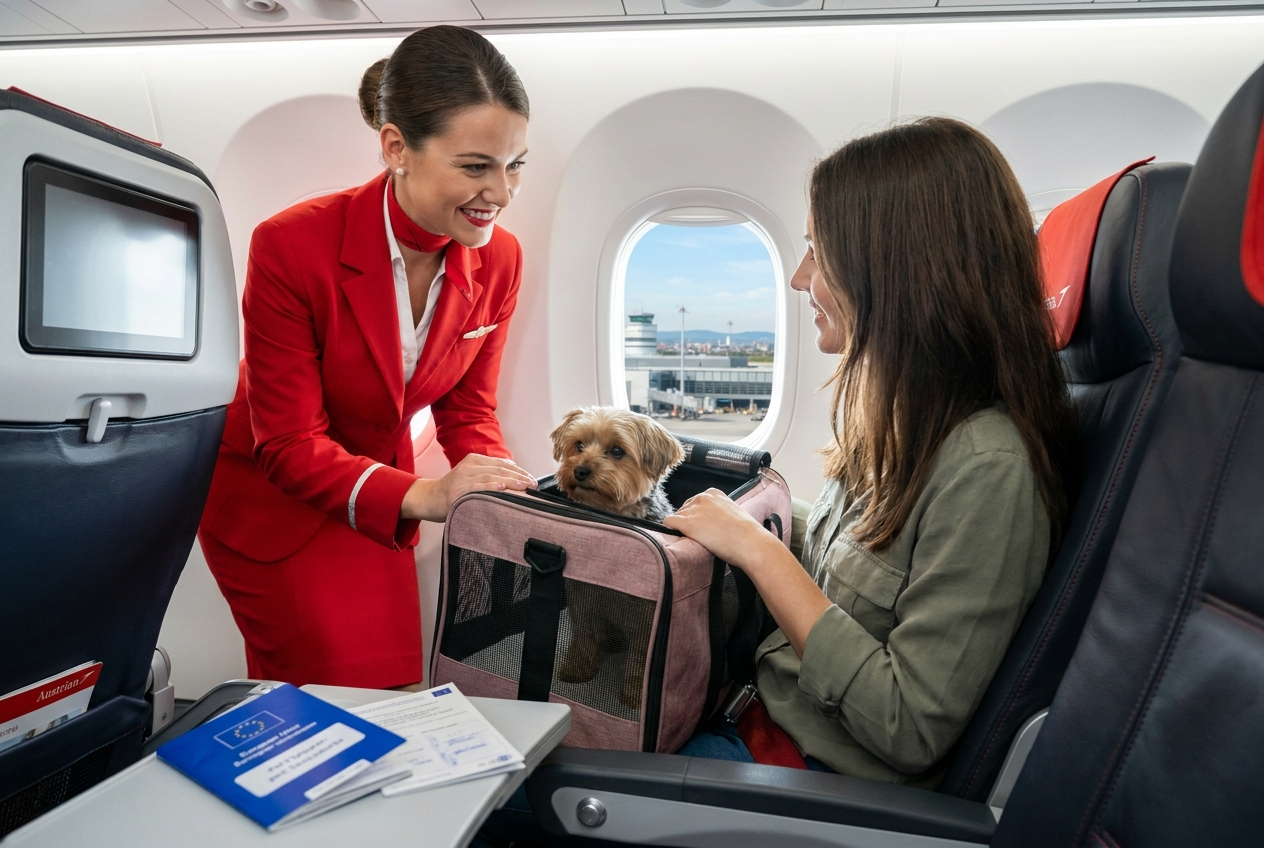
If you check in for an Austrian Airlines flight with a dog traveling in the cargo hold, a gate agent will measure the ventilation holes on your travel crate with a millimeter ruler. As of May 4, 2026, the carrier enforced a strict update to its transport rules: ventilation openings on checked pet crates must not exceed 25 mm × 25 mm (1 in × 1 in) for dogs, or 19 mm × 19 mm (0.75 in × 0.75 in) for cats. Even standard, brand-new IATA-compliant plastic crates are being turned away at check-in desks across Europe if their wire grates have gaps wider than these parameters. This hyper-specific safety protocol is characteristic of the Austrian flag carrier, which blends typical Austrian precision with some of the most rigorous pet transport policies in the Lufthansa Group.
Operating out of its highly central hub at Vienna International Airport (VIE), Austrian Airlines provides an essential gateway between Western Europe, the Americas, and the East. However, because Austria is subject to tight European Union veterinary controls, transiting or arriving here with a pet requires navigating a web of microchip timelines, rabies vaccination windows, and airline-specific equipment mandates.
Austrian Airlines Pet Policy: Key Facts
In-Cabin Pet Fee: EUR 65 to EUR 125 per direction, based on flight distance.
In-Cabin Weight Limit: Strictly 8 kg (17.6 lbs) combined weight of the pet and carrier.
Hold/Cargo Pet Fee: EUR 80 to EUR 380 per direction, determined by crate size and route.
Maximum Carrier Dimensions (Cabin): 23 cm H × 40 cm W × 55 cm L (or a combined sum of 118 cm).
Allowed Species: Only domestic dogs and cats are permitted as accompanied baggage. Rodents, birds, and reptiles must be shipped via cargo.
Vienna Airport Pet Facilities: Dedicated animal transport lounges are available for cargo and transit pets, with animal welfare specialists managing transfers.
In-Cabin Pet Rules (PETC)
For small dogs and cats, traveling in the cabin under the seat in front of you is the least stressful option. Austrian Airlines permits up to two pets per passenger in the cabin (under specific pairing conditions), but they limit the total number of animals allowed on each aircraft.
Soft Carrier Specifications
Your pet’s cabin bag must comply with the airline's strict dimensional limits to ensure it fits safely in the footwell:
Dimensions: The carrier must not exceed 23 cm Height × 40 cm Width × 55 cm Length.
Material: The bag must be entirely soft-sided, bite-proof, leak-proof, and insulated against odors. Rigid plastic crates, carriers with solid wooden frames, wheels, or telescopic handles are banned in the cabin because they cannot compress under the seat.
Interior Space: Your dog or cat must have enough room to stand up, turn around, and lie down in a natural position. The carrier must remain completely zipped at all times; your pet's head is not permitted to poke out during transit.
Age and Status Requirements
Your puppy or kitten must be at least 12 weeks old to fly on domestic or European routes. If you are flying to or from Germany, the minimum age is 15 weeks due to rabies laws. For all flights to the United States, your dog must be at least 6 months old and accompanied by a completed CDC Dog Import Form receipt. Pregnant animals are not accepted for transport in any class.
In-Flight Conduct and Seat Rules
Your pet is considered part of your carry-on baggage allowance. To fly, you must sign a copy of the "Carriage of an animal in the passenger cabin" form at the check-in desk, confirming the pet is healthy and fits the criteria. Once on board, the carrier must remain stowed under the seat in front of you during taxi, takeoff, landing, and turbulence. You are not allowed to open the carrier, place it on an empty seat next to you, or hold the pet on your lap, regardless of the flight length.
To understand the exact document requirements for landing in Austria or your final destination, you can use the Pet Travel Country Guides | Import & Export Rules by Country | Pet Holiday Club to generate a custom step-by-step paperwork checklist for over 190 countries.
Cargo & Aircraft Hold Pet Rules (AVIH)
Dogs and cats exceeding the 8 kg cabin limit must travel in the temperature-controlled, pressurized baggage compartment. While this area shares the same air circulation as the main cabin, it requires a rigid, heavy-duty crate that meets IATA Live Animals Regulations.
The Strict Ventilation Update
As of May 4, 2026, Austrian Airlines implemented a safety update regarding checked crates:
Dogs: Ventilation holes on the crate sides and back must be no larger than 25 mm × 25 mm (1 inch × 1 inch).
Cats: Ventilation holes must be no larger than 19 mm × 19 mm (0.75 inches × 0.75 inches).
If your current crate has wider slots (which is common on older or budget plastic models), you must cover those openings with a secure metal mesh or purchase a new, narrow-grid crate before heading to the airport. Check-in agents will inspect these gaps, and non-compliant kennels are systematically rejected at the counter.
Crate Comfort and Mechanics
Size: Your pet must be able to stand erect without touching the roof of the crate, turn around easily, and lie down naturally.
Assembly: The two halves of plastic crates must be secured together with metal bolts and nuts. Plastic latch-only locking systems are not permitted.
Wheels: If your crate has wheels, they must be removed or taped securely into a locked position before boarding.
Food & Water: Two empty bowls must be fixed to the inside of the wire door and be fillable from the outside without opening the crate door.
Cargo Pet Fees (AVIH)
Fees are determined by whether your crate fits within Medium dimensions (under 60 cm × 45 cm × 40 cm) or falls into the Large category (exceeding 60 cm × 45 cm × 40 cm).
Travel Zone | Cabin Fee (Max 8 kg) | Medium Hold Fee (Under 60×45×40cm) | Large Hold Fee (Over 60×45×40cm) |
Domestic (Austria) | EUR 65 | EUR 80 | EUR 160 |
Europe (incl. Morocco, Armenia) | EUR 80 | EUR 100 | EUR 200 |
Short-Haul Intercontinental | EUR 105 | EUR 130 | EUR 260 |
Medium-Haul Intercontinental | EUR 115 | EUR 170 | EUR 340 |
Long-Haul Intercontinental | EUR 125 | EUR 190 | EUR 380 |
(Intercontinental Short includes Egypt, Israel, Jordan; Medium includes USA East/Midwest, Canada; Long includes South Africa, Thailand, Los Angeles, and Japan).
Breed Restrictions & Bans
Austrian Airlines enforces rigid breed-specific regulations designed to address anatomical health risks (respiratory stress) and public safety.
Flat-Nosed (Brachycephalic) Breed Ban
Brachycephalic dogs and cats suffer from a shortened skull shape, which results in narrower nasal passages and restricted airways. Under conditions of stress, high airport ground temperatures, or dry cabin air, these pets are prone to severe respiratory failure.
Cargo Ban: Austrian Airlines completely prohibits the transport of flat-nosed (brachycephalic) dogs and cats in the cargo hold as checked baggage (AVIH).
If your flat-nosed pet weighs under 8 kg, they can still travel with you in the passenger cabin. If they exceed 8 kg, they cannot fly as standard baggage. Your only option is to ship them via a specialized animal transport agency through Swiss WorldCargo or Lufthansa Cargo, which utilizes specialized, highly ventilated, and temperature-controlled shipping chambers.
Restricted Brachycephalic Breeds on Austrian:
Dogs: Affenpinscher, Boxer, Bulldogs (all breeds), Boston Terrier, Pug (all breeds), Brussels Griffon, Bullmastiff, Cavalier King Charles Spaniel, Chow Chow, English Toy Spaniel, Japanese Chin, Lhasa Apso, Pekingese, Shih Tzu, Shar Pei, Tibetan Spaniel.
Cats: British Shorthair, Exotic Shorthair, Himalayan, Persian, Scottish Fold.
Fighting Dog Classifications
Specific dog breeds classified under Austrian regulations as "fighting dogs" (over 6 months old) cannot travel in standard plastic flight crates. They must be transported in heavily reinforced, custom-built wooden or steel containers complying with IATA CR82 specifications.
Classified Breeds requiring CR82 heavy-duty crates:
American Bully (completely banned from cargo if they display brachycephalic traits)
American Bulldog
Caucasian Ovcharka (Caucasian Shepherd)
Dogo Argentino
Karabash / Kangal (Anatolian Shepherd)
Rottweiler
Note: Pitbulls, Staffordshire Bull Terriers, and American Staffordshire Terriers must also travel under these heavy-duty container rules on Lufthansa Group flights.
EU & Austria Pet Entry Requirements
Austria is a European Union member state, meaning your pet must meet standardized EU pet import regulations. Failing to comply with these timelines will result in your pet being quarantined or sent back to your departure airport at your own expense.
For EU Residents (Traveling within Europe)
EU Pet Passport: Must be issued by an authorized EU veterinarian, showing up-to-date microchip records and rabies details.
Microchip: Must have a compliant ISO 11784/11785 15-digit microchip implanted before the rabies vaccine is administered.
Rabies Vaccination: Must be administered at least 21 days before departure.
For Non-EU Residents (Entering from the US, UK, Canada, etc.)
EU Health Certificate (Non-Commercial): Often called the "Annex IV" certificate. It must be completed and officially endorsed by an accredited USDA veterinarian (for US travelers) or official government vet within 10 days of your arrival in the EU.
Rabies Vaccination: Must be current. If your pet has a primary rabies shot, you must wait 21 days after the injection before they are eligible to enter the EU.
Rabies Titer Test (High-Risk Countries): If you are entering Austria from a country categorized as high-rabies risk, your pet must have a Rabies Antibody Titer Test (FAVN) drawn at least 30 days after vaccination. You must then wait exactly 3 months from the blood draw date before entering Austria.
How to Book a Pet on Austrian: Step-by-Step
Because aircraft cabin and hold configurations limit the total number of live animals per flight, you should secure your pet's reservation as early as possible.
1.Check Space Availability:Before ticket purchase.
Call the Austrian Airlines Service Centre before buying your flight. Inform the agent of your target dates, travel class, and your pet's dimensions to confirm that the aircraft has open animal capacity.
2.Register Your Pet Online or via Phone:Within 24 hours of flight booking.
Complete your own passenger booking. Then, use the Austrian Airlines online "Enquiry about travelling with pets" form or call the hotline again to link your pet to your Booking Code (PNR). You must supply the exact breed, weight, and carrier dimensions.
3.Obtain Your Destination Certificates:Pre-travel preparation.
Schedule a visit with an USDA-accredited or EU-authorized vet to secure your EU Health Certificate or updated Pet Passport. For help tracking these timelines, use petholidayclub.com to generate your customized travel preparation checklist.
4.Complete the Cabin Liability Form:Download and print.
If traveling with your pet in the cabin, download the official "Form for the carriage of pets in the passenger cabin" from Austrian's website. Print and sign two copies, which you will hand to the check-in desk agent on your departure day.
5.Finalize Check-In and Pay Fees:Day of flight (2–3 hours early).
Go to the main assistance check-in desk at the airport. Present your pet, their carrier, all signed forms, and import health documents. The agent will check your carrier's dimensions, weigh the pet, and process the pet travel fee.
Tips for Transiting via Vienna Airport (VIE)
No Airside Pet Relief Areas: Vienna Airport does not have any pet relief zones inside the sterile transit gates. If you are on a long layover with an in-cabin pet, they are not allowed out of their carrier. If your dog needs to relieve itself, you must clear Austrian border passport control, exit the terminal to the outdoor grassy spaces, and clear security again before your connecting flight.
The Lufthansa Group Animal Lounge network: For checked baggage pets (AVIH) with long layovers in Vienna, Austrian Airlines coordinates care through specialized transit staff. Your pet will be transferred to a quiet, climate-controlled zone, checked for wellness, and given clean water before being loaded onto their connecting flight.
Beware of Code-Share Flights: If your booking contains a leg operated by another partner airline, that airline's weight, fee, and carrier rules will apply to that segment. Check both policies carefully to ensure you aren't caught off guard.
How Austrian Compares to Competitors
Airline | In-Cabin Weight Limit | Max Carrier Height | Hold Pet Booking Option | Snub-Nosed Hold Ban |
Austrian Airlines | 8 kg (17.6 lbs) | 23 cm (9 in) | Yes, via check-in (AVIH) | Yes, strict hold ban |
Lufthansa | 8 kg (17.6 lbs) | 23 cm (9 in) | Yes, via check-in (AVIH) | Yes, strict hold ban |
SWISS | 8 kg (17.6 lbs) | 23 cm (9 in) | Yes, via check-in (AVIH) | Yes, strict hold ban |
Air France | 8 kg (17.6 lbs) | 28 cm (11 in) | Yes, via check-in (AVIH) | Yes, strict hold ban |
Frequently Asked Questions
Q: Can my puppy travel in the cabin on Austrian Airlines?
Yes, provided they are at least 12 weeks old. Puppies flying to or from Germany must be at least 15 weeks old, and those traveling to the United States must be at least 6 months old and have a completed CDC import form.
Q: What happens if my pet and carrier weigh more than 8 kg?
If the combined weight of your pet and carrier exceeds 8 kg (17.6 lbs), the airline will require your pet to travel in the climate-controlled cargo hold. Brachycephalic (flat-nosed) breeds are exempt from the cargo option and cannot fly if they exceed the 8 kg limit.
Q: Are there any specific cat breed restrictions on Austrian Airlines?
Austrian Airlines bans flat-nosed (brachycephalic) cat breeds from traveling in the cargo hold. Banned cat breeds include Persians, Himalayans, British Shorthairs, Exotic Shorthairs, and Scottish Folds. These cat breeds are only permitted to travel in the passenger cabin.
Q: What is the new cargo crate ventilation rule on Austrian?
As of May 4, 2026, ventilation holes in checked crates must not exceed 25 mm × 25 mm for dogs, and 19 mm × 19 mm for cats. Crates that exceed these dimensions will be refused at check-in.
Q: Can I take my pet out of their carrier during the flight?
No. Your pet must remain completely inside the closed, fully zipped carrier under the seat in front of you for the entire duration of the flight. Opening the carrier or letting your pet stick its head out is strictly prohibited.
Q: How do I pay the pet travel fee on Austrian Airlines?
Pet travel fees cannot be paid online in advance. You must pay the fee at the airport check-in desk on the day of your departure, after a gate agent has inspected your pet and weighed their carrier.
Before flying with your pet on Austrian Airlines, make sure you have the right documentation for your destination. Pet Holiday Club covers 190+ countries with government-sourced, vet-verified pet travel checklists at petholidayclub.com — so you arrive prepared, not refused.