American Airlines Pet Travel Guide (2026): Rules, Fees & Requirements
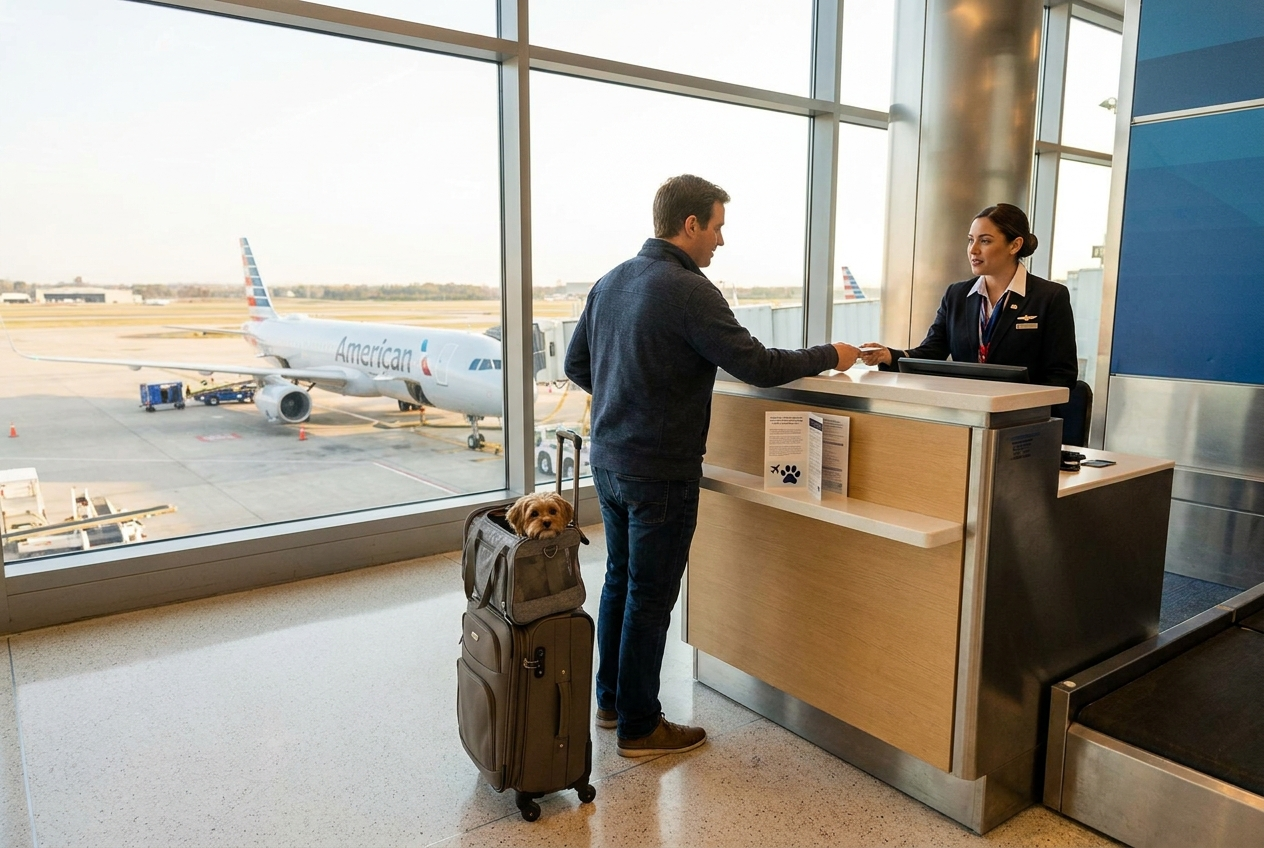
An updated baggage and cabin regulation implemented by American Airlines completely reshaped how domestic and international travelers pass through security check-ins with their companion animals. Passengers are now legally permitted to bring a fully compliant pet carrier into the passenger cabin as their designated carry-on item while still maintaining their standard, full-sized personal item (such as a laptop bag or backpack) at no additional operational cost. This single modification drastically eliminates previous multi-bag financial penalties that used to require handlers to choose between checking their primary luggage or paying extra fees at the gate. Navigating the massive global network of American Airlines requires absolute alignment with precise under-seat dimensions, strict regional cargo bans, and aircraft-specific temperature limits that vary heavily between regional regional flights and mainline wide-body transpacific routes.
Understanding the structural framework of American Airlines is necessary whether you are flying a small terrier from Dallas-Fort Worth to Los Angeles or attempting to arrange complex cargo transit through the airline's specialized cargo division. The airline divides live animal transport into three distinct operational pathways: carry-on pets in the passenger cabin, manifest cargo shipping via American Airlines Cargo (AA Cargo PetEmbark), and officially certified service animals (SVAN). Each tier is bound by distinct volumetric restrictions, safety standards, and seasonal weather restrictions designed to comply with United States Department of Agriculture (USDA) regulations and Federal Aviation Administration (FAA) safety acts.
Carry-On Pet Policy: Maximizing the Under-Seat Cabin Footprint
Passengers choosing to fly with their small dogs or cats inside the passenger cabin must remain fully aware that American Airlines treats cabin pet reservations on a strict first-come, first-served basis. The airline limits the total number of carry-on kennels to a maximum of seven per mainline flight, with a tighter restriction of five kennels on regional routes operated by American Eagle regional flights. These caps exclude certified service animals, but because the reservation slots fill up weeks in advance, travelers must secure their pet's space by contacting the reservation desk immediately upon booking their personal seat.
The physical dimensions of your pet's kennel are determined by whether you choose a hard-sided or soft-sided travel bag. Hard-sided containers face strict structural limits and cannot exceed 19 x 13 x 9 inches (48 x 33 x 22 centimeters) on mainline flights. Soft-sided containers offer greater flexibility because they can compress slightly to fit varying under-seat clearances across the different plane models; however, they should ideally align with standard retail dimensions of 18 x 11 x 11 inches. The carrier must be constructed from entirely leak-proof materials, feature secure zipper locks that prevent accidental escapes, and provide structural mesh ventilation on a minimum of three sides so the animal can breathe comfortably during taxiing and unexpected tarmac delays.
+-------------------------------------------------------------------------+
|                    THE IN-CABIN COMPLIANCE INJUNCTION                   |
|                                                                         |
| Your pet must remain completely enclosed within their under-seat carrier |
| with the door securely zipped for the entire duration of the flight,     |
| including during boarding and deplaning. Removing the animal or allowing|
| it to slide its head out violates FAA safety regulations and can lead to |
| immediate removal from the aircraft by flight crews.                    |
+-------------------------------------------------------------------------+
The physical size of your dog or cat must correspond cleanly to the interior volume of the carrier. The airline does not enforce a specific, standalone weight limit for in-cabin pets; instead, compliance is evaluated visually by gate agents at the check-in desk. Your pet must be capable of standing up naturally, turning around completely within the walls of the bag, and curled up in a comfortable sleeping position without pressing heavily against the mesh sides or top panel. If the animal appears cramped or cannot move freely during the check-in evaluation, agents are legally required to deny boarding to protect the animal's safety.
American Airlines Cargo Shipping: Navigating the PetEmbark Network
Animals that exceed the structural space constraints of the passenger cabin are completely barred from traveling as checked baggage on standard passenger tickets. American Airlines has eliminated traditional checked kennel options for typical retail travelers, requiring all larger dogs to be shipped strictly through their commercial manifest cargo network, known professionally as the AA Cargo PetEmbark program. This specialized shipping path utilizes dedicated cargo terminals separate from the main passenger airport check-in desks, requiring separate drop-off and pickup logistics.
To ship a dog via PetEmbark, you must utilize an IATA-compliant, rigid structural crate constructed of heavy-duty impact-resistant plastic, solid wood, or aluminum. The container must feature non-plastic ventilation openings on all four sides, be held together securely by solid steel metal bolts, and contain dual water and food bowls attached firmly to the inside of the metal wire door. The door must feature a centralized locking system that prevents the latches from disengaging if the crate experience shifting during flight. The floor must be completely solid, covered with high-absorbency blankets or training pads, and must not contain any wheels unless they are completely removed or taped down before loading.
+-------------------------------------------------------------------------+
|                  CRITICAL CRATE SIZING FORMULA FOR CARGO                |
|                                                                         |
| 1. Length: Distance from nose tip to tail base plus 4 inches minimum.    |
| 2. Width: Double the measurement across the widest shoulder point.      |
| 3. Height: Distance from floor to the highest point of the ears while    |
|    standing. The animal's head must never touch the ceiling panels.     |
+-------------------------------------------------------------------------+
Strict Environmental Temperature Restraints and Climate Embargoes
Live animal transport via the PetEmbark cargo network is subject to strict environmental temperature restrictions managed by federal USDA guidelines. American Airlines enforces an absolute ban on shipping any live animal via cargo if the ambient ground temperature at your origin, transit hub, or destination airport is forecast to drop below 45 degrees Fahrenheit (7 degrees Celsius) or rise above 85 degrees Fahrenheit (29.4 degrees Celsius) at any point during the travel window. These metrics are verified using real-time National Weather Service data exactly 24 hours before scheduled flight departures.
A specialized exception to the lower temperature limit exists if your dog is accompanied by an official Acclimation Certificate issued and signed by a licensed, accredited veterinarian. This document must explicitly state the exact minimum temperature your specific animal can safely withstand based on its breed, coat thickness, and health history; however, the airline will never accept animals if temperatures drop below 20 degrees Fahrenheit (-6.6 degrees Celsius) or rise above 85 degrees Fahrenheit under any circumstances. Furthermore, due to the extreme summer heat radiating from airport tarmac surfaces, the airline enforces a permanent, non-negotiable summer cargo ban for specific high-heat destination hubs, including Phoenix Sky Harbor (PHX), Las Vegas (LAS), and Tucson (TUS), stretching from mid-May through the end of September every year.
Prohibited Breeds and Brachycephalic Respiratory Bans
American Airlines prioritizes animal welfare by enforcing a complete and permanent ban on the cargo transport of all brachycephalic (short-snouted, flat-faced) dogs and cats. The physical structure of these animals' upper airways makes them highly susceptible to respiratory distress, heat exhaustion, and acute hypoxia when subjected to the stress of an aircraft cargo hold. These breeds are restricted to traveling within the passenger cabin, provided they meet the small size requirements to fit comfortably under the seat.
The official list of restricted and banned short-snouted breeds includes the following dog and cat populations:
Prohibited Brachycephalic Dogs: Affenpinscher, American Bully, Boxer (all sub-varieties), Boston Terrier, Brussels Griffon, Bulldog (all sub-varieties, including French, English, and American), Cavalier King Charles Spaniel, Chow Chow, Dogue de Bordeaux, English Toy Spaniel, Japanese Chin, Lhasa Apso, Mastiff (all sub-varieties), Pekingese, Pug (all sub-varieties), Shar Pei, Shih Tzu, and Tibetan Spaniel.
Prohibited Brachycephalic Cats: Burmese, Exotic Shorthair, Himalayan, and Persian.
In addition to respiratory bans, American Airlines restricts the transport of specific breeds categorized as protective or historic fighting dogs due to structural safety concerns. Breeds such as the Pit Bull Terrier, Staffordshire Bull Terrier, and Anatolian Shepherd must be housed in reinforced, custom-built wooden or heavy-gauge metal crates that meet IATA CR82 safety requirements, featuring solid steel doors with secondary manual security ties.
Comprehensive Pet Surcharges and Financial Matrices
Live animal travel fees are assessed independently of standard luggage allowances and cannot be combined with frequent flyer miles, credit card travel credits, or elite status benefits. American Airlines structures its pet fees as flat surcharges per kennel for each one-way travel segment. If your itinerary involves a domestic connection window that exceeds a standard four-hour layover, or an international connection exceeding twenty-four hours, the airline treats each leg as a separate journey, requiring a double fee collection at the intermediate airport ticketing counter.
All fees must be settled via credit card or approved electronic payment methods directly at the airport counter on your day of departure; cash payments are not accepted at mainline US domestic terminals.
Service Classification | Geographic Route Network | Weight & Size Parameters Allowed | Base One-Way Fee |
Carry-On Pet (PETC) | Within the US, Canada, Mexico, & Caribbean | Max size matching under-seat dimensions; pet must move freely | $150 |
Carry-On Pet (PETC) | International Routes (Transatlantic/Transpacific) | Strictly prohibited on standard long-haul flights into Europe/Asia | Banned |
PetEmbark Cargo | Domestic Routes (Short-Haul Hubs) | Crate sizes Extra Small to Medium (Up to 100 lbs combined) | $250 - $450 |
PetEmbark Cargo | Domestic Routes (Long-Haul Transcontinental) | Crate sizes Large to Extra Large (Up to 150 lbs combined) | $500 - $850 |
PetEmbark Cargo | Approved International Cargo Paths | Varying by volumetric density and destination country tariffs | Variable Quote |
Booking Guidelines and the Check-In Documentation Process
You cannot add a carry-on pet or secure a PetEmbark cargo slot through the standard automated online check-in features or third-party reservation systems. In-cabin reservations must be made by calling the American Airlines Special Assistance Desk. When you call, you must provide the agent with your confirmed passenger record locator, along with the exact physical dimensions, structural materials, and estimated combined weight of your pet and carrier.
For cargo travel via PetEmbark, reservations must be arranged separately through the dedicated portal or by calling to their official phone number at least 10 to 14 days before your desired travel date. You will need to provide your dog's exact measurements, their microchip ID number, and destination details to generate an official air waybill number.
On the day of your flight, you must check in at the main airport ticket counter at least three hours before departure. You must present a valid government-issued photo ID, your pet's reservation confirmation code, and all required health records. While American Airlines no longer mandates a formal veterinary health certificate for domestic in-cabin flights within the United States, international routes and all manifest cargo flights require an official USDA-endorsed health certificate (Form 7001) issued within 10 days of travel.
Certified Service Animals and Federal DOT Regulations
Trained service dogs performing essential tasks for individuals with visual, auditory, psychiatric, or physical mobility disabilities fly completely free of charge inside the passenger cabin. American Airlines strictly aligns its assistance animal protocols with the United States Department of Transportation (DOT) air travel regulations. Emotional support animals (ESAs) are no longer recognized as official service animals under these guidelines and must travel under standard carry-on pet rules, paying the regular $150 cabin fee.
To travel with a trained service dog, you must complete and submit the official U.S. Department of Transportation Service Animal Air Transportation Form via the online portal at least 48 hours before your flight window opens. This federal document requires the handler to legally certify the animal's current training credentials, its behavioral track record in high-stress public spaces, and active rabies vaccination dates. The service dog must remain securely attached to a professional harness, leash, or tether at all times and must sit directly on the cabin floor within the footprint of your assigned seat without encroaching into the aircraft aisles or neighboring passenger legroom spaces.
Frequently Asked Questions
Q: What is the carry-on pet fee for American Airlines?
The airline charges a flat fee of $150 per kennel for each one-way domestic travel segment within the United States, Canada, Mexico, and the Caribbean.
Q: Can a large dog fly as checked baggage on American Airlines?
No, the airline has eliminated checked baggage options for pets. Large dogs must be shipped strictly as manifest cargo through the AA Cargo PetEmbark network.
Q: What are the exact dimensions for an under-seat pet carrier?
Hard-sided carriers cannot exceed 19 x 13 x 9 inches. Soft-sided carriers should be around 18 x 11 x 11 inches and must fit under the seat ahead of you.
Q: Does my carry-on dog count as my personal item?
No, your pet carrier counts as your primary carry-on bag. You can still bring one additional personal item, like a backpack or purse, for free.
Q: Are Pugs allowed to fly in the cargo hold with American Airlines?
No, the airline enforces a permanent ban on all short-snouted and brachycephalic breeds within the cargo hold due to severe respiratory health risks.
Q: What are the temperature limits for shipping a dog via cargo?
Cargo transport is banned if ground temperatures drop below 45 degrees or rise above 85 degrees Fahrenheit at any airport along your flight path.
Managing complex airline pet rules, balancing container size calculations, and navigating shifting temperature embargoes can quickly become overwhelming for any traveler. Rather than risking a last-minute boarding refusal at the airport gate, you can automate your pre-flight preparation using the specialized platform at Pet Holiday Club. By utilizing the interactive planning tools available at petholidayclub.com, you can instantly generate a comprehensive, step-by-step travel timeline designed around your specific airline choices, your pet's breed metrics, and your final destination rules. The system automatically tracks shifting IATA crate mandates, calculates precise under-seat clearances, and provides direct access to approved veterinaryspecialised documentation checklists to ensure your companion's journey is smooth and stress-free.