Airlines That Allow Large Dogs in Cabin (2026 Complete Guide)
You have a large dog. You need to travel. But every single airline page you read leaves you with the exact same frustrating realization: it feels completely impossible to fly together.
Let’s skip the marketing fluff and look at the actual reality of flying with a large dog this year.
The 2026 Bottom Line
If you are looking for a traditional commercial flight where your Golden Retriever or German Shepherd can sit next to you for the price of a standard pet fee, it doesn't exist.
Major commercial airlines globally still strictly limit in-cabin pets to small dogs and cats that can fit inside a small carrier under the seat in front of you. This means a hard weight limit of 8 to 10 kg (17 to 22 lbs), including the weight of the bag itself.
However, the travel landscape isn't completely closed. Depending on your budget, your destination, and some major new European aviation rules rolling out this year, you have options.
Why "Pet-Friendly" Ads Are Misleading
When an airline claims to be "pet-friendly," it is easy to assume they welcome all dogs. In practice, that friendliness is reserved for animals small enough to spend the entire flight zipped inside a duffel bag at your feet.
If your dog weighs 40 lbs, 60 lbs, or more, they simply will not fit into the physical dimensions of a commercial airline seat footprint. Airlines prioritize cabin safety and clear evacuation pathways above all else, which is why standard policies automatically exclude medium and large breeds from the main cabin.
To find a realistic solution, you first have to understand exactly how global aviation authorities classify a "cabin-eligible" pet.
The Hard Limits of Commercial Cabin Space
Airlines base their pet rules on physical space, not breed or temperament. To fly inside a standard commercial cabin, your pet must pass a dual test:
The Comfort Test: The dog must be able to stand up, turn around, and lie down naturally inside their travel carrier.
The Dimension Test: That carrier must slide entirely underneath the seat in front of you without blocking the aisle.
Because regional aircraft designs vary, international regulations have created strict operational baselines:
Region | Primary In-Cabin Rule | Typical Weight Limit (Dog + Carrier) |
United States | Strict under-seat dimensions (approx. 18” x 11” x 11”) | Functional cap around 20 lbs (9 kg) |
Europe | Absolute weight threshold across major carriers | Strictly 8 kg (17.6 lbs) |
Canada | Under-seat limits alongside specific weight caps | Max 10 kg (22 lbs) |
Asia & Middle East | Highly restrictive policies; many carriers ban cabin pets | Max 6–8 kg (13–17 lbs) if allowed |
If your dog is past these limits, a standard commercial economy or business class ticket will not work. You will need to look at alternative flight strategies.
The 4 Ways Large Dogs Actually Fly This Year
When large dogs travel across the country or around the world, they utilize specific alternative transit channels. Here is how those flight methods compare on cost, accessibility, and comfort:
1. Commercial Cargo Hold (Manifest or Excess Baggage)
Large Dogs in Cabin? ❌ No
Average Cost: $500 – $3,000+
Best For: International relocations and meeting strict island entry laws (like the UK or Australia).
The Reality: Despite the anxiety the word "cargo" brings, major airlines carry pets in specialized, structurally isolated holds. These zones are completely pressurized and climate-controlled to match the cabin temperature directly above them.
The Risk Factor: The real danger isn't the flight; it's the tarmac. If a plane experiences a ground delay in extreme summer heat or freezing winter conditions, the temperature can fluctuate. This is why airlines enforce strict seasonal temperature embargoes (typically stopping pet travel if ground temperatures exceed 85°F/29.5°C) and outright ban snub-nosed (brachycephalic) breeds like Bulldogs due to respiratory risks.
2. Shared Private Charters
Large Dogs in Cabin? Yes
Average Cost: $4,000 – $12,000+ per seat
Best For: Pet parents moving long distances who want to avoid the cargo hold entirely.
The Reality: Companies like K9 JETS allow multiple pet owners to crowd-source and split the cost of a private aircraft. On these flights, your large dog sits directly on the cabin floor at your feet or on the seat beside you without a crate.
Primary Routes: This model has expanded significantly across major international lanes, particularly New York to London, Florida to Europe, and select hubs connecting Western Europe to the Middle East.
3. Semi-Private Regional Operators
Large Dogs in Cabin? Sometimes (With seat purchase)
Average Cost: $1,000 – $3,000
Best For: Fast, low-stress domestic travel within specific regional networks.
The Reality: In the United States, semi-private carriers like JSX allow medium and large dogs (up to 79 lbs) to fly directly in the cabin. The catch? You must purchase a second, adjacent passenger seat for the dog, and they must remain leashed on the floor directly in front of that seat.
4. Full Private Jet Charter
Large Dogs in Cabin? Yes
Average Cost: $10,000 – $120,000+
Best For: Ultimate scheduling flexibility, multiple large pets, and high-budget travel.
The Reality: Booking an entire private aircraft gives you complete control over the environment. There are no size or breed restrictions, but you remain fully responsible for ensuring your dog meets all entry paperwork, microchipping, and vaccination rules for your destination country.
The 2026 Commercial Exception: Italy’s Policy Shift
The biggest structural shift in commercial aviation is currently unfolding in Southern Europe. Italy’s civil aviation authority (ENAC) has formally established a regulatory framework allowing medium and large dogs up to 30 kg (66 lbs) directly into the commercial passenger cabin.
Italy's national carrier, ITA Airways, has integrated this program into select domestic routes.
If you utilize this specific commercial exception, you must follow strict safety protocols:
You must book a dedicated adjacent seat space for the dog.
The dog does not travel inside a bag but must wear a safety harness secured directly to the seatbelt assembly.
An absorbent mat must be placed down, and a muzzle must be available if requested by the crew.
Aircraft are strictly limited to a few large dogs per flight to maintain cabin balance.
While this is an encouraging shift for pet travel advocacy, it remains a localized domestic exception within Italy. It does not apply to standard transatlantic flights or broader European routes, where classic under-seat weight limits remain heavily enforced.
Service Dogs vs. Emotional Support Animals (ESAs)
It is highly critical to avoid using outdated internet advice regarding Emotional Support Animals. Under current international DOT and aviation regulations, ESAs are legally classified as standard pets. They do not receive special cabin access and must adhere to the exact same under-seat size and weight limits as any other dog.
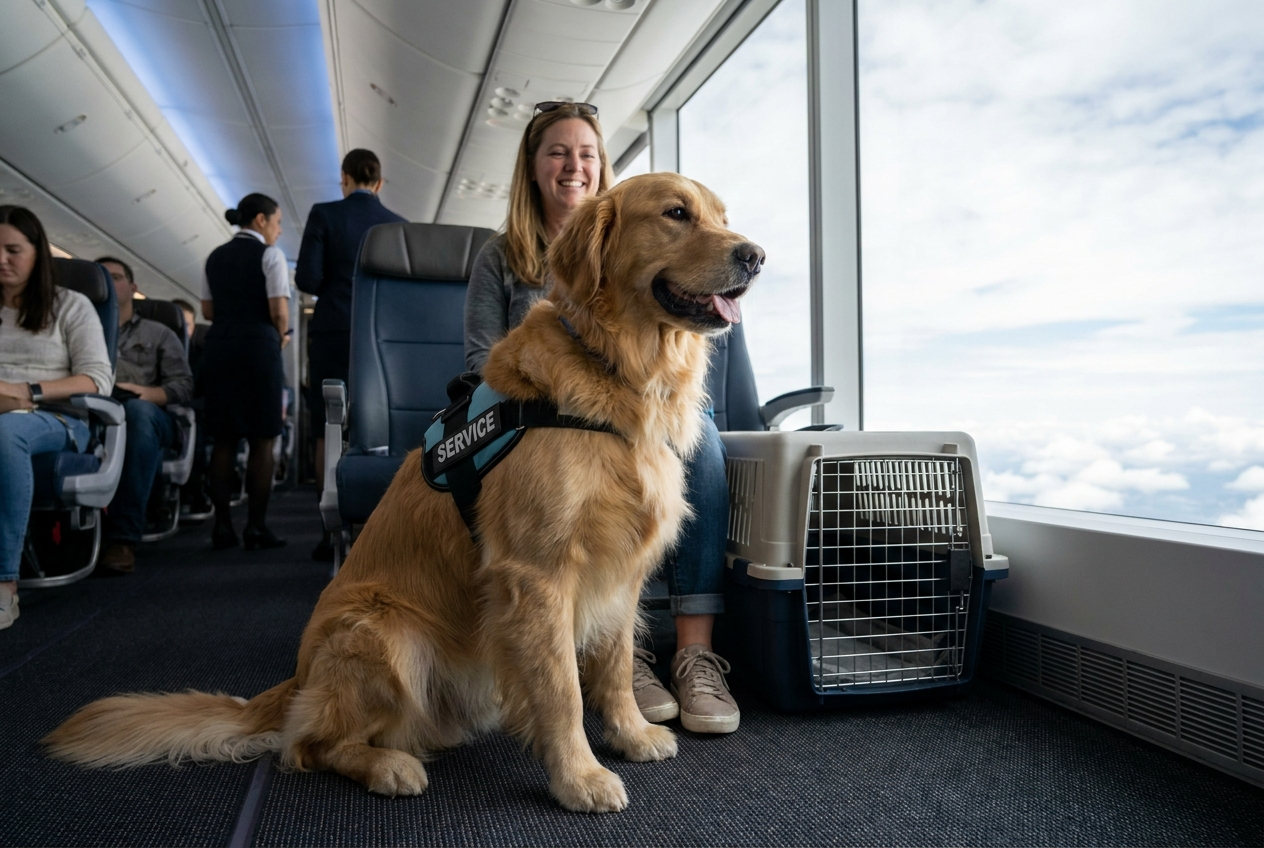
Only officially trained, task-specific Service Dogs (such as mobility assistance or guide dogs) are permitted to fly outside of a carrier in the commercial cabin for free. Airlines require comprehensive verification paperwork submitted well ahead of the departure date, and misrepresenting a pet as a service animal carries severe legal consequences.
Frequently Asked Questions
Can a 50 lb dog fly inside a commercial cabin?
On standard global flights, no. A 50 lb dog vastly exceeds the space constraints of an under-seat carrier. The only commercial exceptions are specific domestic routes within Italy on ITA Airways under their specialized large-dog seat booking program, or domestic regional flights on semi-private carriers like JSX.
What is the safest way to fly a large dog internationally?
If your budget allows, a shared private charter is the lowest-stress method because your dog stays with you in the cabin. If you choose the commercial cargo route, safety comes down to preparation: select a non-stop flight, use a sturdy, IATA-compliant crate, and avoid traveling during peak summer or winter months to bypass temperature risks.
Why do some countries require large dogs to fly as cargo?
Certain destinations—such as the United Kingdom, Australia, New Zealand, and Hong Kong—have incredibly strict biosecurity and rabies-prevention laws. These countries legally mandate that all arriving pets enter via manifest cargo through designated animal reception centers, completely overriding individual airline cabin policies.
Streamlining Your Next Steps
Successfully flying with a large dog requires shifting your focus away from standard airline booking engines. Because policies are dictated by a complex mix of aircraft types, regional laws, and changing seasonal temperatures, your best path forward is to map your exact geographic route first.
Once you know your destination's specific entry requirements, you can work backward to choose the ideal travel window and transit method for your dog's specific size.