Best Airlines for Pet Travel in 2026: Complete Cabin vs. Cargo Ranking
The 2026 Landscape: What Actually Changed
Three things shifted in 2025 and 2026 that changed the entire airline pet travel market, and if you're working from old information, you're going to hit a wall.
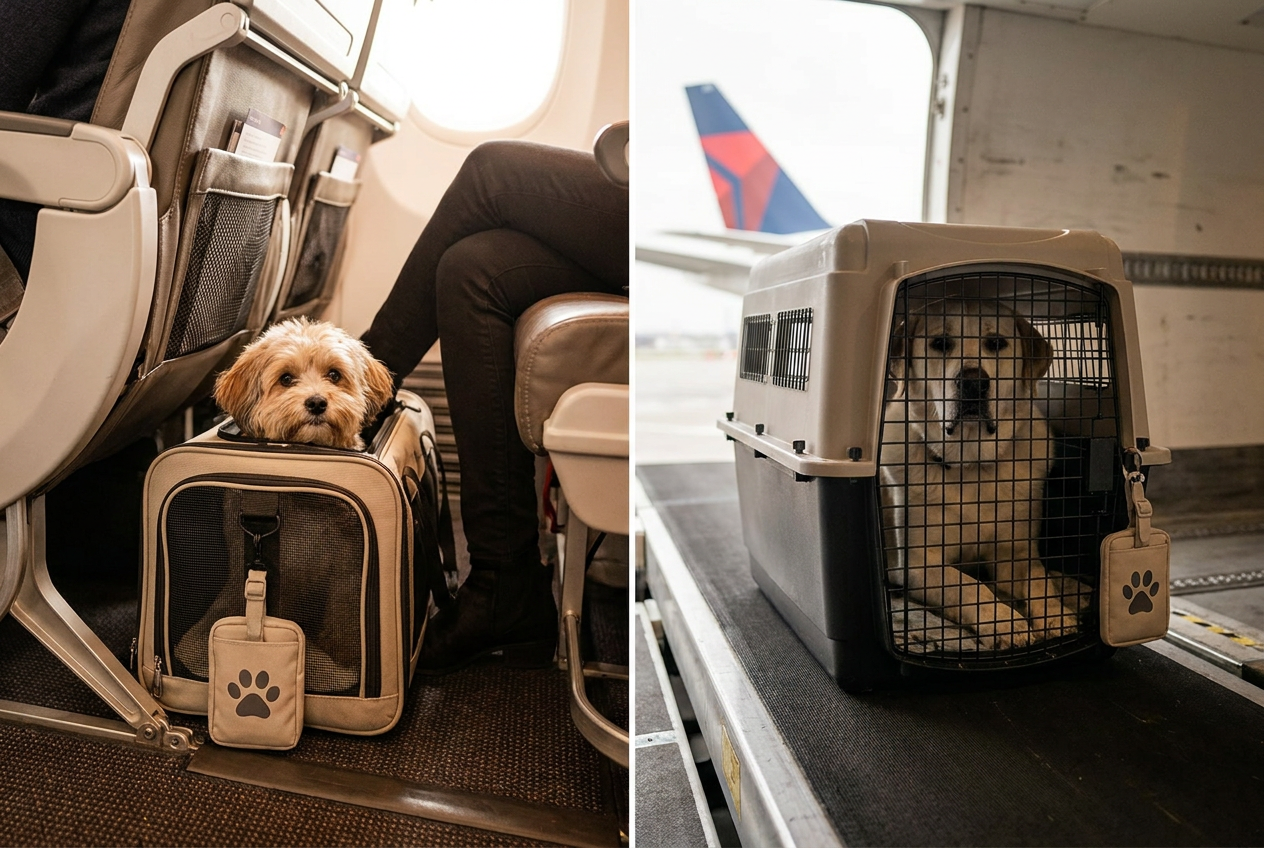
First: Delta, United, and American Airlines all ended cargo pet transport for the general public. As of 2025–2026, their cargo or 'checked baggage' pet services are restricted exclusively to active US military personnel and US State Department employees with PCS orders. If you have a large dog and were planning to fly one of these US carriers cargo, that option is gone.
Second: In-cabin fees went up. Most major US carriers now charge $150 one-way for in-cabin pets. Alaska Airlines is the outlier at $100 one-way, making it the cheapest mainstream US option.
Third: New alternatives emerged. SkyePets launched long-haul in-cabin pet flights between Australia and the US. K9 JETS expanded its transatlantic routes. And Italy's civil aviation authority ENAC updated its rules to allow medium and large dogs in domestic aircraft cabins — a first in Europe.
With that context set, here's how 2026's main carriers actually stack up.
The Full 2026 Airline Rankings: Small Pets (Under 8kg In-Cabin)
# | Airline | In-Cabin Fee | Max Weight | International? | Snub-Nosed? | Best For |
1 | KLM Royal Dutch | €45–€150+ | 8kg total | Yes – most routes | Cabin restricted | EU routes, Schiphol hub |
2 | Lufthansa | €50–€170 | ~8kg total | Yes – most routes | Cabin restricted | Europe, India, US |
3 | Alaska Airlines | $100/way | No set limit* | Select international | Restricted | US West Coast, cheapest US fee |
4 | Air France | €50–€200 | ~8kg total | Yes – most routes | Cabin restricted | EU & Africa routes |
5 | Turkish Airlines | Varies by route | ~8kg total | Yes – select routes | Cabin restricted | Middle East, Asia, Africa |
6 | Delta Airlines | $150/way | No set limit* | Select routes | Restricted | US domestic, select intl |
7 | United Airlines | $150/way | No set limit* | Select routes | Restricted | US domestic, some intl |
8 | American Airlines | $150/way | No set limit* | Select routes | Restricted | US domestic, some intl |
9 | JetBlue | $125/way | 20lb total (strict) | Domestic US only | Restricted | Domestic US, competitive fee |
10 | Southwest | $95/way | Carrier fits under seat | Domestic US only | Restricted | Cheapest US domestic option |
11 | British Airways | N/A – cargo only | N/A | Cargo via IAG Cargo | N/A | UK routes, cargo shipment only |
12 | Emirates | N/A – cargo only | N/A | SkyCargo only | N/A | Dubai hub, cargo only |
13 | Qatar Airways | Checked bag/cargo | Checked: 32kg box | Yes, selected routes | Restricted in cargo | GCC, relocation routes |
* Carrier must physically fit under the seat in front — no separate weight limit stated, but practically limits to smaller dogs.
1. KLM Royal Dutch Airlines — Best for International Pet Travel in 2026
If your pet is under 8kg (including their carrier) and you're flying to or through Europe, KLM is consistently the smoothest experience available. And I say that not because the airline pays us anything, but because their infrastructure for pet travel is genuinely superior to most competitors.
Schiphol Airport in Amsterdam has a dedicated KLM Animal Hotel for transit pets — something most European hubs simply don't offer. For cats and small dogs in cabin, KLM allows travel on most international routes. The carrier dimensions are 46 x 28 x 24cm (soft-sided, waterproof), and the combined weight of pet plus carrier must stay under 8kg. Fees range from €45 for short European hops to €150+ for intercontinental routes.
Where KLM falls short: Snub-nosed breeds (brachycephalic dogs) are restricted from cargo. Online pet booking isn't available — you must call KLM's customer service to add a pet reservation. And the Dutch banned breed list applies to dogs entering the Netherlands, so check that before booking a KLM transit.
2. Lufthansa — Best European Carrier for Long-Haul Pet Travel
Lufthansa handles more international pet travel volume than any other European carrier, and it shows in their procedures. Their in-cabin allowance mirrors KLM (pet plus carrier under approximately 8kg) but their cargo operation — Lufthansa Cargo — is also one of the most reputable for larger pets on routes where cabin isn't possible.
The fee structure for in-cabin pets runs from around €50 for European routes to €170+ for transatlantic. Carrier dimensions: soft-sided bag, maximum approximately 55 x 40 x 23cm. You must call Lufthansa to add a pet to your booking — online reservation isn't available.
Lufthansa's key strength is its Frankfurt hub: one of Europe's best-equipped airports for live animal transit. If you're routing a large pet via cargo from the US to Europe, or from India to Europe, Lufthansa Cargo is one of the most reliable pathways. Their climate-controlled holds and professional live-animal handling standards are consistently cited by IPATA-accredited relocation specialists as industry-leading.
What to watch: Lufthansa has strict brachycephalic breed restrictions in both cabin and cargo. And as with all EU-entry routes, your pet will need a valid EU pet passport (or an Animal Health Certificate if you're coming from the UK or USA). Generate your Lufthansa documentation checklist at PetHolidayClub.com.
3. Alaska Airlines — Best US Carrier for Value and Flexibility
In NerdWallet's 2026 analysis of US carriers, Alaska Airlines scored 57 out of 60 points — the highest of any carrier reviewed. The reason: a combination of clear policies, the lowest mainstream US in-cabin fee ($100 one-way, compared to $150 at Delta, United, and American), and a booking process that doesn't require you to call three different numbers.
Alaska allows two small pets in one cabin if they fit comfortably in a single space under the seat. There's no separate weight limit — the carrier just needs to fit under the seat in front of you. Species accepted include dogs, cats, and some birds (not parrots). Alaska also operates select international routes where pets are permitted, though you'll need to verify this route by route.
Where Alaska falls short: Snub-nosed breeds are restricted. Hawaii pet travel carries additional strict documentation requirements (FAVN titre test, microchip, and specific rabies vaccination timing). And Alaska has ended general-public cargo pet transport, meaning large dogs have no cargo option through this carrier.
4. Air France — Best for EU & Africa Routes
Air France mirrors Lufthansa and KLM's in-cabin policy: small pets under approximately 8kg including carrier, allowed on most international routes. Their CDG (Charles de Gaulle) airport hub has veterinary services available for international arrivals, which matters if your destination requires health inspection at the point of entry.
For non-EU pets entering France (including dogs from the UK and US), Air France requires the EU-equivalent documentation: a valid health certificate, proof of microchip (ISO 15-digit standard), and rabies vaccination records. Dogs travelling into France from non-EU countries also need tapeworm treatment administered 1–5 days before arrival.
Air France's partnership with KLM for cargo means their larger-pet cargo options — via AF/KLM Cargo — are also well-regarded, particularly for routes between the US, Africa, and Europe.
5. Turkish Airlines — Best for Middle East, Africa & Asia Routes
Turkish Airlines stands out in one specific category: route coverage. If you're travelling to destinations that most European and US carriers don't serve directly — parts of Africa, Central Asia, the Middle East — Turkish is often the only airline with in-cabin pet access on that route.
Their in-cabin allowance follows the European standard (approximately 8kg total), and their Istanbul hub offers reasonable live-animal transit facilities. Turkish is one of the few carriers that occasionally permits pets in business class on certain aircraft types, though this is not guaranteed and must be confirmed at booking.
Important: Turkish has stricter brachycephalic restrictions than some competitors. Their cargo service operates globally but requires advance arrangement and documentation that varies significantly by destination country. For Istanbul-routed trips, confirm your pet's documentation requirements for Turkey's transit zone at PetHolidayClub.com.
The US Big Three: Delta, United & American in 2026
These three carriers dominate US domestic pet travel, but 2025–2026 brought a significant reduction in what they offer internationally.
Delta Airlines
Delta's in-cabin fee is $150 one-way (increased from $125 in 2025 for tickets purchased after April 8, 2025). Carrier dimensions: maximum 17 x 11 x 9.5 inches soft-sided. Delta allows pets in the Delta Sky Club lounges provided they remain in the carrier.
The big change: Delta no longer offers cargo pet transport for the general public. As of 2025–2026, pets in cargo are restricted to active US military and US State Department personnel with permanent change of station orders. Civilian large-dog owners must look elsewhere — K9 JETS, IPATA-certified relocation companies, or Lufthansa/Qatar cargo.
Delta permits pets on domestic flights and select international routes — but not all international routes, and not all aircraft types. You cannot add a pet online; you must call Delta directly.
United Airlines
United's in-cabin fee is also $150 one-way. There is an additional $125 layover surcharge if your journey includes a layover longer than 4 hours on a domestic connection. That's a potentially significant hidden cost on connecting itineraries.
PetSafe — United's cargo programme — is no longer available to the general public as of 2026. Like Delta and American, it's now restricted to US military and State Department personnel. Civilian passengers needing to transport large pets via cargo must use licensed IPATA relocation companies or international carriers with cargo programmes (Lufthansa Cargo, Qatar Cargo, Emirates SkyCargo).
United allows cats and dogs only (no other species for international travel). Certain destinations have import restrictions that United will flag at booking, but it's worth independently verifying these at PetHolidayClub.com before you commit to a ticket.
American Airlines
American's policy mirrors the others: $150 one-way, in-cabin only for small pets, soft-sided carrier (18 x 11 x 11 inches for mainline flights; 16 x 12 x 8 inches for American Eagle regional flights). Cargo is now military-only.
American permits pets on domestic routes and select international routes up to 12 hours. The cabin option requires the carrier to fit under the seat in front — no weight limit is stated separately, but realistically this means small dogs and cats.
JetBlue and Southwest: US Budget Options
JetBlue charges $125 one-way — slightly cheaper than the Big Three — but enforces the strictest weight limit in US aviation: 20lb total (pet plus carrier). That's tighter than Delta, United, or American's carrier-must-fit rule. There are no breed exceptions. JetBlue operates US domestic routes only for pet travel.
Southwest is the cheapest mainstream US option at $95 one-way for in-cabin pets, domestic routes only. No Hawaii, no international. Pets must be at least 8 weeks old and vaccinated. If you're flying a small pet domestically and price is the main factor, Southwest wins.
For Large Dogs: The Real Options in 2026
This is where most of the information online is out of date. With Delta, United, and American all ending general-public cargo, large-dog owners in 2026 have fewer options — but they do exist.
K9 JETS: A UK-founded private jet service operating pay-by-seat transatlantic routes (typically $9,000–$11,000 per seat including your pet). Dogs travel in the cabin with no crate required. Routes include NYC-London and Dubai-London. Over 7,000 pets flown since 2023. This is currently the most practical option for large dogs flying transatlantically.
Lufthansa Cargo / Qatar Cargo / Emirates SkyCargo: These international carriers still accept pets as manifest cargo, handled through their dedicated live-animal divisions. IATA-compliant crates are required. This is the pathway most IPATA-certified relocation companies use for large pets on long-haul routes.
Copa Airlines: Accepts larger pets in cargo on Latin American routes. Important caveat: the veterinarian at Panama Tocumen airport (PTY) — who must inspect all incoming animals — is only available on weekdays. Copa does not carry pets on weekends because the vet is unavailable. Plan accordingly.
British Airways, Emirates & Qatar: The Cargo-Only Reality
Let's be clear about these three, because a lot of pet owners book a BA or Emirates flight assuming they can bring their dog in the cabin.
British Airways does not allow pets in the cabin under any circumstances, except for recognised assistance dogs. All pets travel as cargo through BA's partner IAG Cargo (for inbound UK shipments) or PetAir UK (for pets being exported from the UK). This aligns with UK PETS Travel Scheme requirements, which require pets arriving in the UK to enter as manifest cargo — not as cabin or checked baggage.
Emirates: virtually all pets travel via Emirates SkyCargo. Climate-controlled holds, trained live-animal handlers, strict IATA compliance. Popular for pets travelling between India, the Middle East, and Europe. Not a cabin option.
Qatar Airways: more nuanced. Qatar offers a checked-baggage option for dogs and cats on many routes (within size and weight limits, in an approved IATA kennel). This is different from cabin travel — the pet travels in the hold alongside checked bags, not in the passenger cabin. Qatar Cargo is also a primary pathway for large pets on relocation routes. Falcons, uniquely, may travel in the cabin on certain routes per UAE cultural regulations.
What Documentation Do You Actually Need?
Every airline on this list requires the same foundational documents for international pet travel. The airline's pet fee is just the beginning. What actually makes or breaks your trip is whether your documentation satisfies the destination country's import rules.
The core international requirements are: an ISO-standard microchip (15-digit, ISO 11784/11785 — note that US 9-digit chips are not accepted in the EU, UK, or Japan), a rabies vaccination given after the microchip was implanted, and a health certificate signed by a licensed veterinarian within 10 days of your travel date. US-based travellers also need their vet's health certificate endorsed by USDA APHIS — a process that costs $38 and takes 1–10 business days.
Depending on your destination, additional requirements may include: rabies titre tests (Japan, Australia, Hawaii), tapeworm treatment (UK entry for dogs), import permits (UAE, India, Thailand), quarantine periods (Australia, New Zealand), and EU pet passport or UK Animal Health Certificate.
The Verdict: Which Airline Should You Choose?
Your situation | Recommended airline |
Small pet, UK/US to Europe | KLM (best hub facilities), Lufthansa (most routes), Air France (France routes) |
Small pet, US domestic (budget) | Southwest ($95/way) or Alaska ($100/way) |
Small pet, US domestic (reliability) | Alaska Airlines — best overall US carrier per 2026 analysis |
Small pet, UK/US to Middle East/Asia | Turkish Airlines (widest route coverage) or Lufthansa via Frankfurt |
Large dog, transatlantic | K9 JETS ($9k–$11k/seat) — currently the only reliable in-cabin option transatlantically |
Large dog, Europe routes | Lufthansa Cargo or KLM Cargo via IPATA-certified relocation company |
Any pet, UK entry | Must arrive as cargo/checked baggage — British Airways (IAG Cargo) or any carrier routed through an approved UK PETS entry point |
Large dog, Latin America | Copa Airlines cargo (weekdays only — no weekend entry through Panama) |
Frequently Asked Questions
Which airline is cheapest for pet travel in 2026?
For US domestic travel: Southwest Airlines at $95 one-way. Alaska Airlines at $100 one-way. For international travel: KLM and Air France from €45 on short European routes. For large dogs internationally: K9 JETS at $9,000–$11,000 per seat (includes you and your dog).
Can large dogs fly in the cabin on commercial airlines in 2026?
On commercial airlines, no — not on any of the major carriers covered here. The only in-cabin option for large dogs on international routes is through private jet services like K9 JETS or Bark Air. Italy is an exception for domestic Italian flights only: ENAC updated its 2026 rules to allow medium and large dogs in the passenger cabin on domestic Italian routes.
Do US airline pet cargo programmes still exist in 2026?
For the general public: no, not at Delta, United, or American. All three have restricted cargo pet transport to active US military and State Department personnel as of 2025–2026. Civilian pet owners who need to transport large pets must use IPATA-certified relocation companies, or book directly with international carriers that maintain open cargo programmes — Lufthansa Cargo, Qatar Cargo, and Emirates SkyCargo being the primary options.
Is it safe for pets to fly in cargo?
When booked through a reputable carrier with IATA-compliant crates and climate-controlled holds (Lufthansa Cargo, KLM Cargo, Qatar Cargo, Emirates SkyCargo), cargo transport is a well-regulated and widely used option. The American Veterinary Medical Association (AVMA) advises against sedation for cargo travel as it can impair thermoregulation at altitude. A healthy, correctly-crated pet in a modern climate-controlled cargo hold is safer than many pet owners assume.
Why can't pets fly in the cabin into the UK?
UK biosecurity regulations require all pets arriving from abroad — other than recognised assistance dogs — to enter as manifest cargo. This is part of the PETS Travel Scheme and is unrelated to individual airline policy. It applies regardless of which airline you book. Dogs entering from non-EU countries must also undergo tapeworm treatment 1–5 days before arriving in the UK.
How far in advance should I book pet travel?
Airlines limit the number of pets per flight. On popular routes during peak season, cabin pet spots fill weeks or months in advance. K9 JETS' private flights often sell out 3–6 months ahead. For any pet travel, booking as early as possible and confirming your pet reservation (not just your own ticket) is essential. Call the airline to confirm — most carriers don't allow pet booking online.
Frequently Asked Questions
Written by
Anano Gudushauri
SEO & Content Strategy Specialist at Pet Holiday Club